





 Portuguese
  English
  Spanish
  5 min of reading
  1 comment


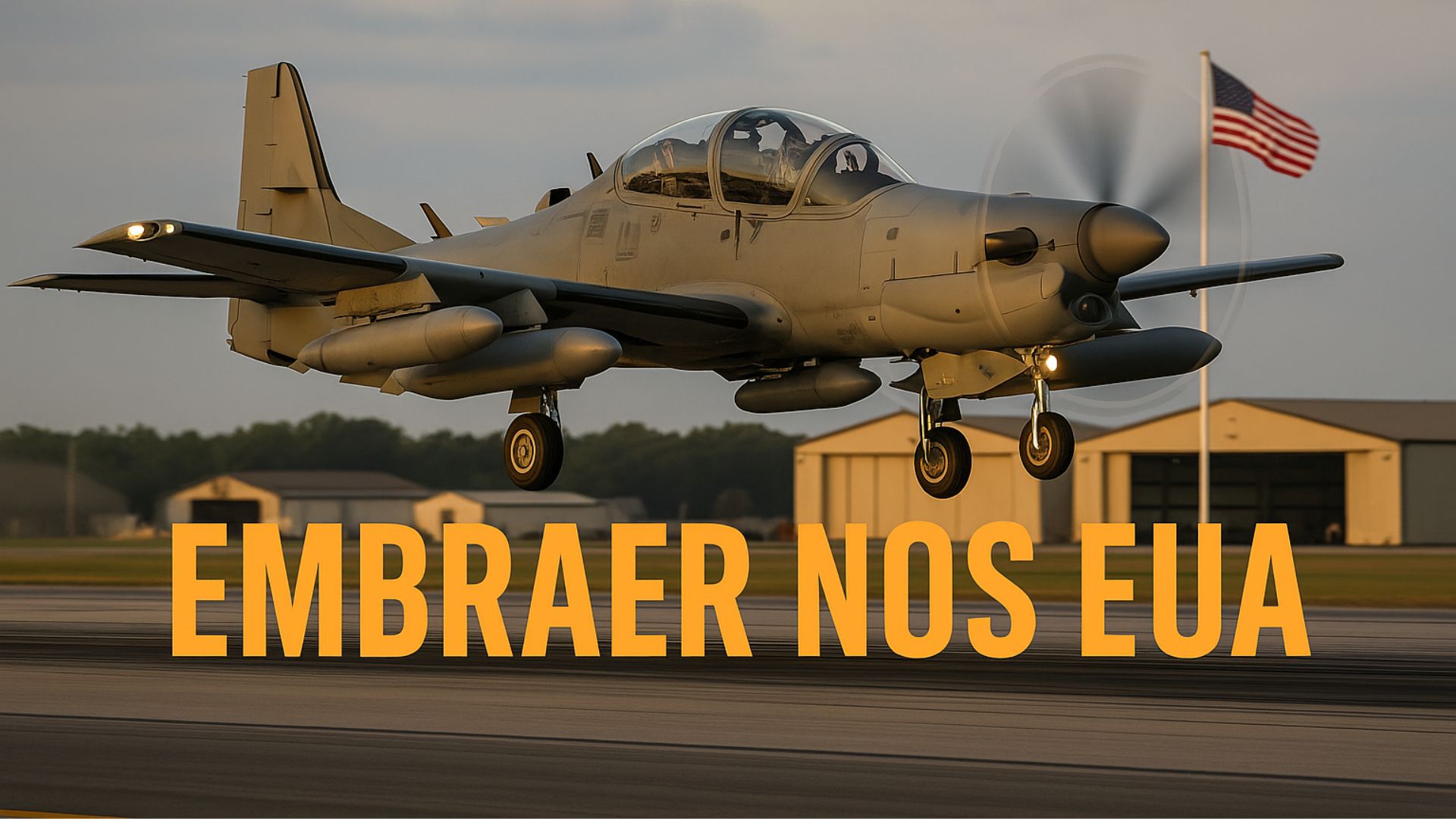


Embraer Expands Presence in the US Defense Market with Deal for A-29 Super Tucano Production in Florida and Immediate Use for Pilot Training, Accelerating Operational Readiness in New Military Programs.
Embraer has signed a deal with the US-based Sierra Nevada Corporation (SNC) for the sale of an A-29 Super Tucano, in a coordinated operation before a future case of the Foreign Military Sales (FMS) program of the US government.
The aircraft will be assembled at the defense production line in Jacksonville, Florida, and the investment has been structured to allow immediate pilot training to begin as soon as the main contract is awarded.
The amount has not been disclosed.
-
Inflation in March reaches 0.88% according to IBGE and pressures the Brazilian economy, impacting family budgets and requiring more strategic decisions to maintain financial control.

-
In Paraná, distributor Pacto connects 100% of the load in Coronel Vivida to batteries: a BES of 10 MW and 20 MWh costs just over R$ 30 million and lowers the local tariff now.
-
With a dependence of up to 80% on gas imported from the United States, Mexico is responding with a robust energy strategy, betting on shale gas, creating a scientific committee, and preparing to expand natural gas production to reduce vulnerability and strengthen its energy security in the coming years.

-
The United States proposes to Brazil a critical minerals agreement with a minimum price to combat Chinese dumping and priority for investment, but the Planalto is blocking the signing out of fear of upsetting China and due to electoral calculations in a year of competition.

Deal in the US Aims to Accelerate Training and Delivery
According to the companies, the early purchase has operational significance.
Since the aircraft will already be available, crew training can begin shortly after the FMS is signed, shortening the timeline to Initial Operational Capability (IOC) by up to one year.
Although the final customer of the FMS has not been disclosed, the strategy reinforces Embraer’s presence in the US defense market and seeks to reduce typical availability bottlenecks of international programs.
The announcement took place on September 23 during the Air, Space & Cyber Conference of the AFA in National Harbor, Maryland, a traditional showcase for announcements related to the US Air Force.
The choice to present the deal in this environment gives institutional scale to the move and highlights the appetite for light attack and ISR platforms with lower operating costs than supersonic jets.
Production in Florida and Consolidated Partnership
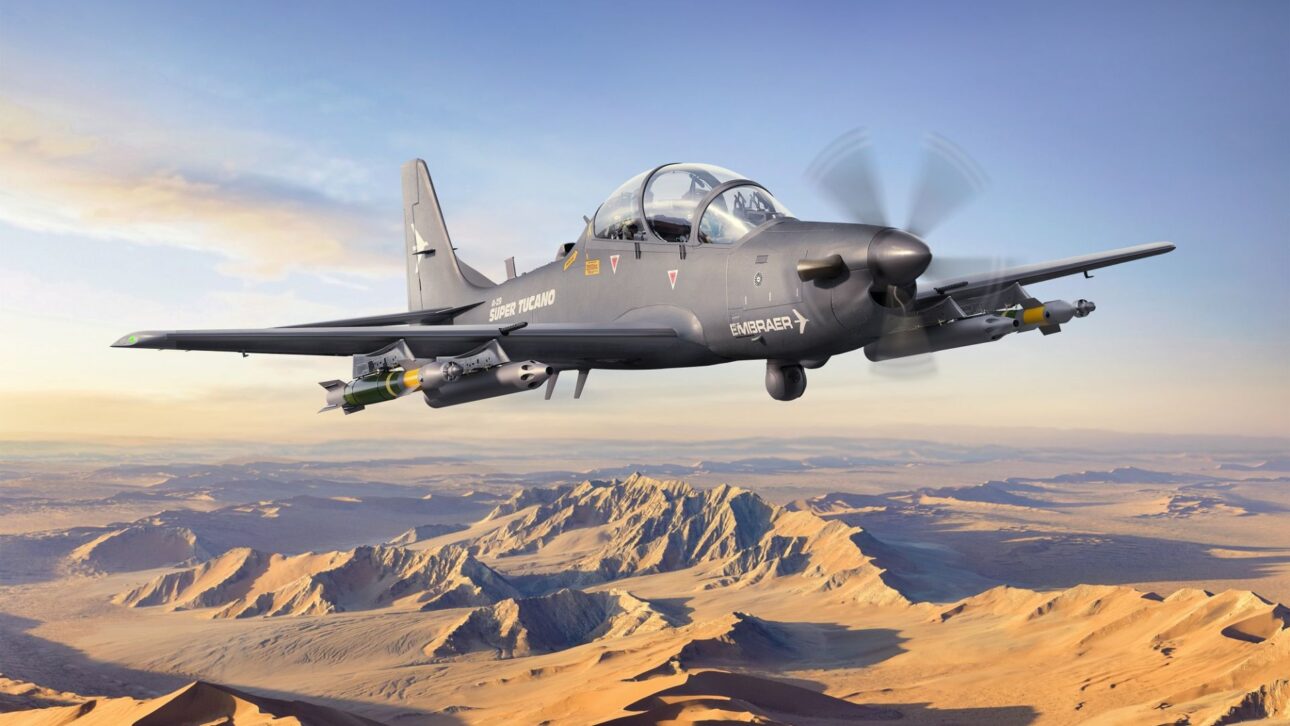
Embraer has been assembling the A-29 in US territory for over a decade, in an industrial arrangement with SNC that has already delivered nearly 50 aircraft to different air forces through contracts from the US and foreign clients.
The current purchase strengthens this chain, preserves specialized labor, and helps maintain the production cadence in the state of Florida.
This partnership model meets two objectives.
On one hand, it reduces logistical and customs risks for US government programs.
On the other, it facilitates support, training, and updates throughout the lifecycle, which are crucial when it comes to platforms employed intensively in surveillance missions, close air support, and border patrol.
What Is the A-29 Super Tucano
Classified as an aircraft for light attack, armed reconnaissance, and advanced training, the A-29 is a two-seat turboprop with a reinforced structure, digital avionics, and a wide range of guided and unguided munitions.
The combination of extended range, operation on rugged airstrips, and lower flight hour costs compared to tactical jets has made it a recurring option for counterinsurgency, low-altitude interception, and advanced joint terminal attack controller training (JTAC).
In the sensor package, Embraer highlights the electro-optical/infrared system with laser designator, night vision compatibility, secure communications, and data link.
These features enable precise target identification and near-real-time information sharing, integrating the A-29 into networked command and control architectures.
In addition to the mission set, the platform has been designed for robustness and simplified maintenance, with easy access to avionics and engines.
This is critical for operations from forward bases.
In terms of employment envelope, the Super Tucano performs tasks ranging from tactical training to close air support, interdiction, armed ISR, and escort, with proven performance in various theaters and more than 600,000 flight hours accumulated.
Pilot Training and Next Steps
SNC states that the early acquisition will allow more flight hours for the pilots who will operate the aircraft from the main contract in the future.
This increases the readiness of the units receiving the A-29.
The exact location of the training has not been disclosed in the announcement.
The company emphasizes that the immediate availability of the aircraft reduces the time to IOC.
In previous programs mediated by the US, a significant portion of training occurred at US bases, but the companies did not detail the arrangement for the new case.
From an institutional perspective, the formal signing of the FMS still depends on the standard procedure, which includes evaluation by the State Department and notification to Congress.
This process is usual in foreign military sales and tends to take several months, depending on the support package, delivery timelines, and sensitive technology items.
Meanwhile, the line in Jacksonville continues to be a pillar of Embraer’s strategy for the region.
Why the Deal Matters for Embraer
The transaction reinforces Embraer’s image as an established supplier in the US defense market.
This aspect is relevant for future campaigns of the KC-390 Millennium and for new opportunities for the A-29 itself.
The visibility gained on a high-profile stage, combined with the manufacturing base in Florida, enhances the perception that the company can meet local operational and regulatory requirements.
This is a differentiator in competition with global rivals.
There is also a demand component.
In recent years, the demand for light attack aircraft has resurged, including for tasks such as armed surveillance, drone interdiction, and law enforcement at borders.
In this niche, the A-29 has been positioned as a cost-effective solution with state-of-the-art sensor packages, the ability to operate in austere environments, and integration with Western command and control doctrines.
Capabilities That Anchor Employment
In scenarios where area persistence, cost per flight hour, and precise identification and designation capability make a difference, infrared sensors with laser, night vision, encrypted radio, and data link become central.
By allowing the crew to detect, track, and designate targets accurately and securely transmit data, the A-29 supports 24/7 operations with a lower acoustic signature than jet platforms.
This maintains interoperability with tactical centers on the ground.
Meanwhile, the ability to start training immediately after approval of the FMS is likely to accelerate the readiness curve of the units receiving the aircraft.
In practice, more pilots come online sooner, and commanders can plan real missions with certified crews.
This minimizes gaps between the physical delivery of the aircraft and its operational employment.
What to Watch for Next
The identification of the FMS customer, the final timeline, and the details of the support package will be the next milestones to follow.
It will also become clearer whether the training will occur at centers in the United States or at facilities in the final user’s country.
This depends on bilateral agreements and the availability of specific infrastructure.
With the initial order secured, Embraer and SNC indicate that they may expand production according to demand and any new contracts mediated by Washington.
With Embraer strengthening its industrial footprint in Florida and the A-29 consolidated as a light attack and ISR solution, what other missions or markets should gain traction for the platform in the coming months?









Sinceramente, se houver compras/vendas não serão para as Forças Armadas americanas, vamos deixar bem claro isso.