





 Portuguese
  English
  Spanish
  3 min of reading
  0 comments


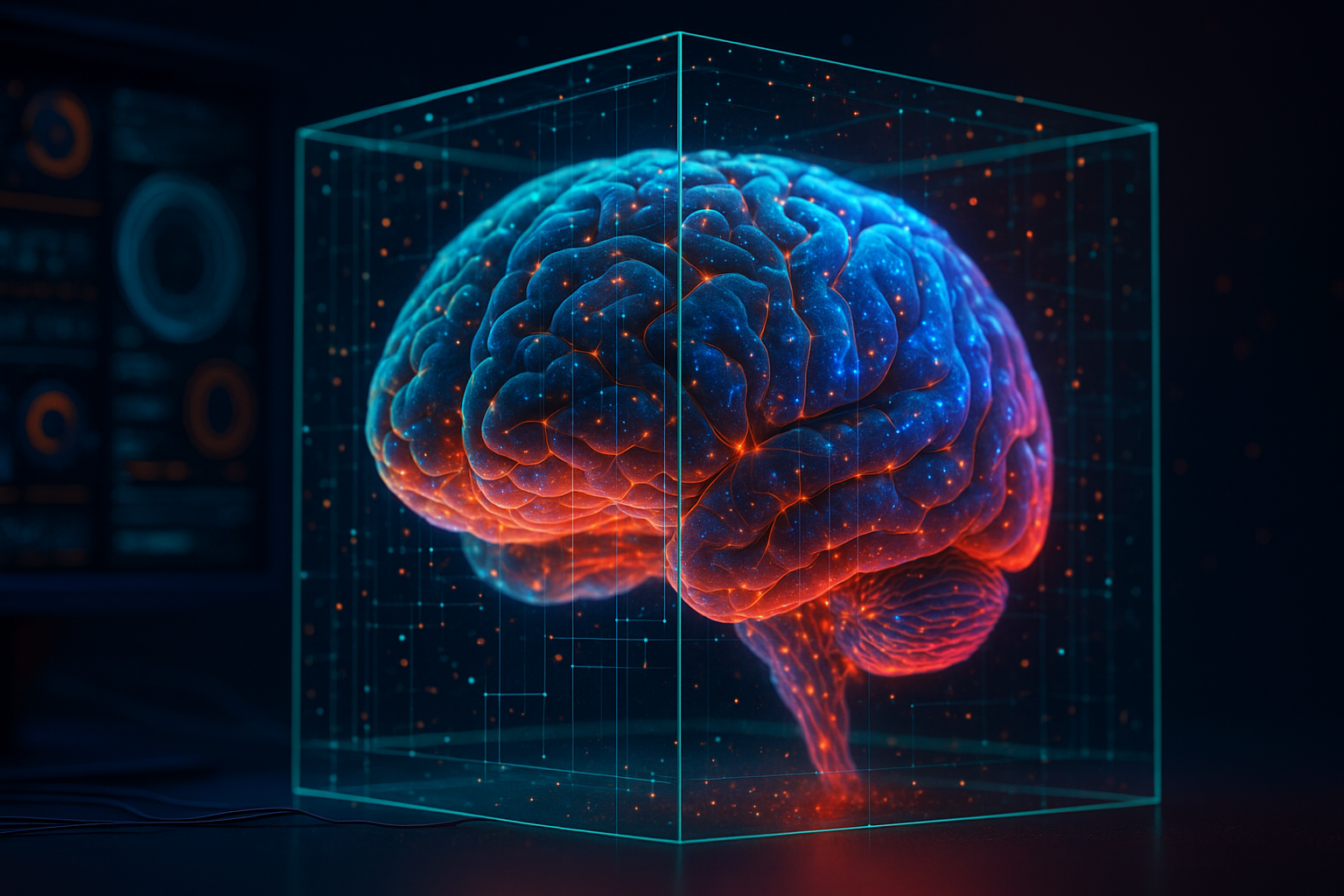
Groundbreaking Research Reveals AI Advancement by Mapping Brain Structure with Unprecedented Detail
In a groundbreaking achievement, scientists from Harvard and Google used artificial intelligence to map, in 3D, just 1 cubic millimeter of human brain tissue.
This microscopic fragment generated 1.4 petabytes of data. This is equivalent to about 14,000 4K movies, an unprecedented volume for such a small sample.
Brain Scanned with Unprecedented Precision
The research, conducted between late 2024 and early 2025, used a sample of brain tissue donated by a patient with epilepsy.
-
They were brilliant! Scientists discover that our ancestors in China were already making super advanced tools 160,000 years ago, changing everything we knew.

-
Scientists unveil 3 million years of climate secrets hidden in the ice of Antarctica.

-
Ancient farmers created “aggressive plants” that changed nature forever.

-
Astronomers find a “backward” solar system that ignores all the rules of space and leaves scientists scratching their heads!


The fragment measured just 3 mm in length and contained approximately 50,000 brain cells, 150 million synapses, and 230 millimeters of blood vessels.
The scientists sliced the tissue into over 5,000 ultra-thin sections. They then scanned each section with advanced high-resolution electron microscopy technology.
Subsequently, artificial intelligence algorithms reconstructed the data and created an interactive 3D model that reveals never-before-seen details of brain structure.
This visually detailed model allows exploration of fibers, synapses, vessels, and neural connections at microscopic levels, enabling new discoveries about the functioning of the human brain.
Data Volume and Computational Challenges
The amount of data surprised the scientists themselves. To store the 1.4 petabytes generated, a large data center would be required, with dozens of dedicated servers.
If the same method were applied to a complete human brain, the final volume of data would exceed 1.6 zettabytes, or 1.6 billion terabytes.
Storing such a volume would require infrastructure comparable to 57 hectares of servers, roughly equivalent to the size of dozens of football fields.
Moreover, the estimated cost to map the entire brain with this level of detail would exceed US$50 billion, according to projections made by the researchers.
Even with so many logistical challenges, the team believes that this type of technology could be used in specific parts of the brain for advanced studies in neurology.
Advancement for Science and Future Applications
Indeed, this reconstruction represents a significant leap in understanding human brain architecture.
For the first time, it is thus possible to observe neural connections in a real three-dimensional context.
With this, doctors and neuroscientists, in turn, will be able to develop new approaches to understand diseases such as Alzheimer’s, epilepsy, Parkinson’s, and other neurological conditions.
Furthermore, this database, consequently, could serve as a model for the development of more efficient AI systems, directly inspired by the functioning of the human brain.
The collaboration between universities and technology companies like Harvard and Google demonstrates that the union between science and innovation can produce truly revolutionary advancements.
Finally, the project also points toward the future of personalized medicine, where high-precision brain maps could eventually be used for tailored diagnostics and treatments.










Seja o primeiro a reagir!