





 Portuguese
  English
  Spanish
  5 min of reading
  0 comments


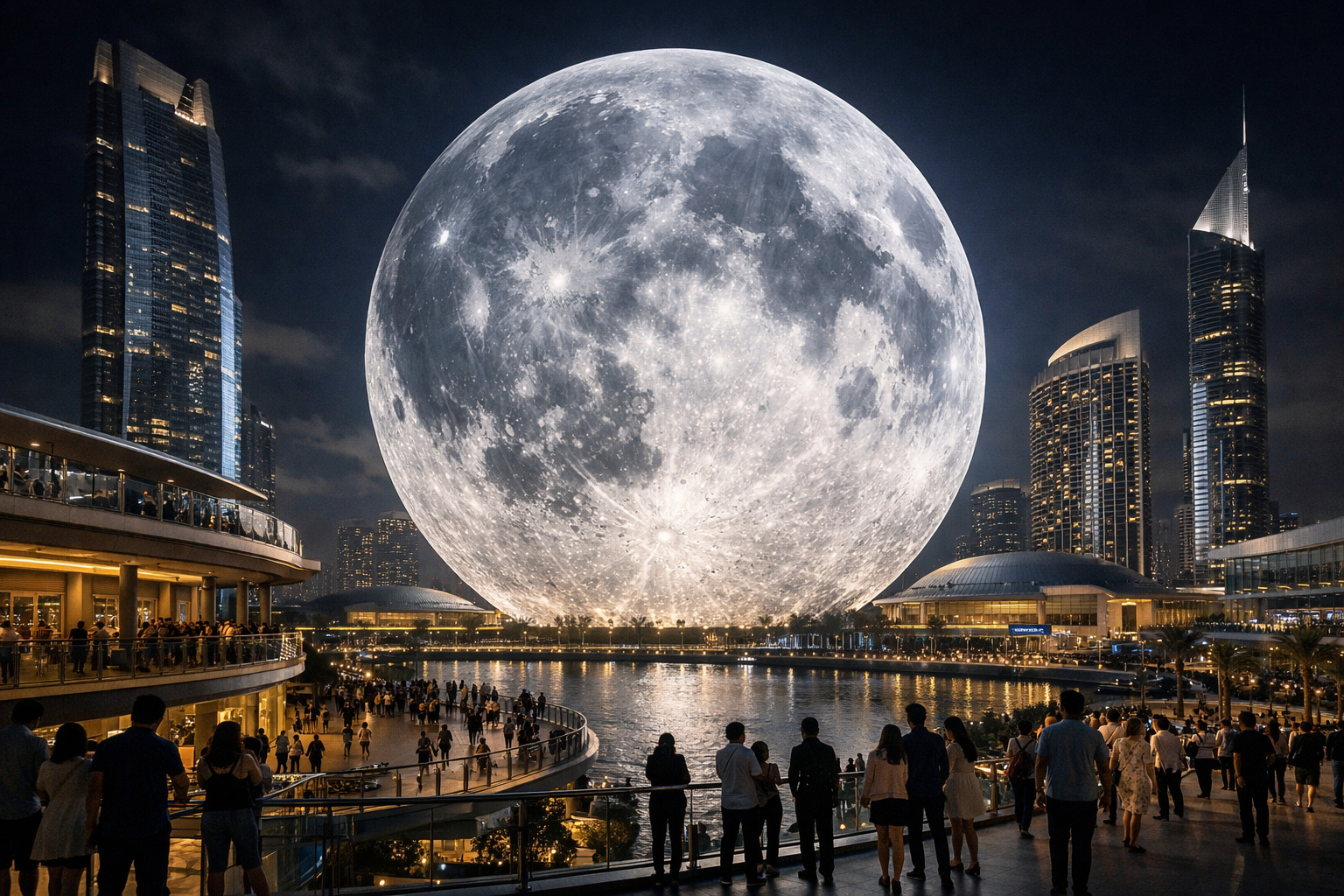
Billion-Dollar Initiative From Canadian Company Plans to Build an Artificial Moon 312 Meters High, Giant Hotel, Residential Areas, and Immersive Experiences That Could Transform Global Tourism
The race to host one of the boldest architectural projects of the 21st century has gained a new chapter. Spain has officially entered the international competition to host a development valued at US$ 5 billion that aims to recreate an artificial version of the Moon on Earth. The proposal, which blends tourism, entertainment, and immersive technology, is already attracting interest from ten countries, including United Arab Emirates, China, United States, India, Australia, and even Brazil.
Moreover, if the project really comes to fruition, it could become the largest spherical structure ever built on the planet. The plan forecasts a gigantic sphere measuring 312 meters high and 271 meters in diameter, dimensions capable of surpassing the current world record of the Sphere in Las Vegas, which has 112 meters in height and 157 meters in width.
This information was disclosed by Forbes.es, which detailed the plans of the Canadian company Moon World Resorts, responsible for the conception of the futuristic venture.
-
Scientists transform sawdust into fire-resistant panels, stabilize the compound with an enzyme extracted from watermelon seeds, and turn waste into promising material for construction.

-
Forget concrete: architects are replacing tons of concrete with giant blocks of expanded polystyrene to build the roofs of houses and reduce structural weight by up to 50%, cut costs, improve thermal insulation, and speed up construction.
-
The Brazilian state enters the center of the global race for critical minerals by starting the construction of the largest underground nickel mine in Latin America, a mineral essential for electric car batteries that the entire world is competing for at this moment.
-
New CCR concrete paving technology promises roads up to 3x more durable, less maintenance, and cost reduction in Brazil.

Project Aims to Create an Artificial Moon with a 4,000-Room Hotel and Immersive Lunar Experience
The project, simply called Moon, was conceived by the Canadian company Moon World Resorts and intends to go far beyond a traditional themed hotel. In fact, it is a gigantic tourism and real estate complex that combines iconic architecture, immersive technology, and unprecedented entertainment experiences.
Within the main structure, the construction of a hotel with 4,000 rooms is planned, as well as luxury residences, convention centers, restaurants, leisure areas, and dining spaces. However, the most impressive element of the project will be the detailed recreation of the lunar surface, which will allow visitors to walk on a terrain designed to simulate the topography of the Moon.
At the same time, the complex would occupy an area of approximately 200 hectares, becoming a true tourist district dedicated to the space experience. According to the company’s projections, the site would have the capacity to receive up to 10 million visitors per year, with about 2.5 million specifically coming to experience the so-called “lunar experience”.
The financial model is also noteworthy. The project anticipates the combination of private capital with the pre-sale of approximately 10,000 residential units, distributed among attached towers and secondary structures that would be part of the complex.
In addition to the enormous central sphere, the master plan includes a series of complementary structures, such as:
- 20 perimeter towers connected by an elevated panoramic walkway
- 16 secondary spheres
- premium residential areas
- convention center
- leisure and dining areas
- transport interchange
- heliport and vertiport
- integration of solar panels on the outer ring
Consequently, the result would be a skyline dominated by circular geometries, designed to turn the complex into a new global architectural icon.
Spain Competes for the Project Against Major Powers and Bets on Established Tourism
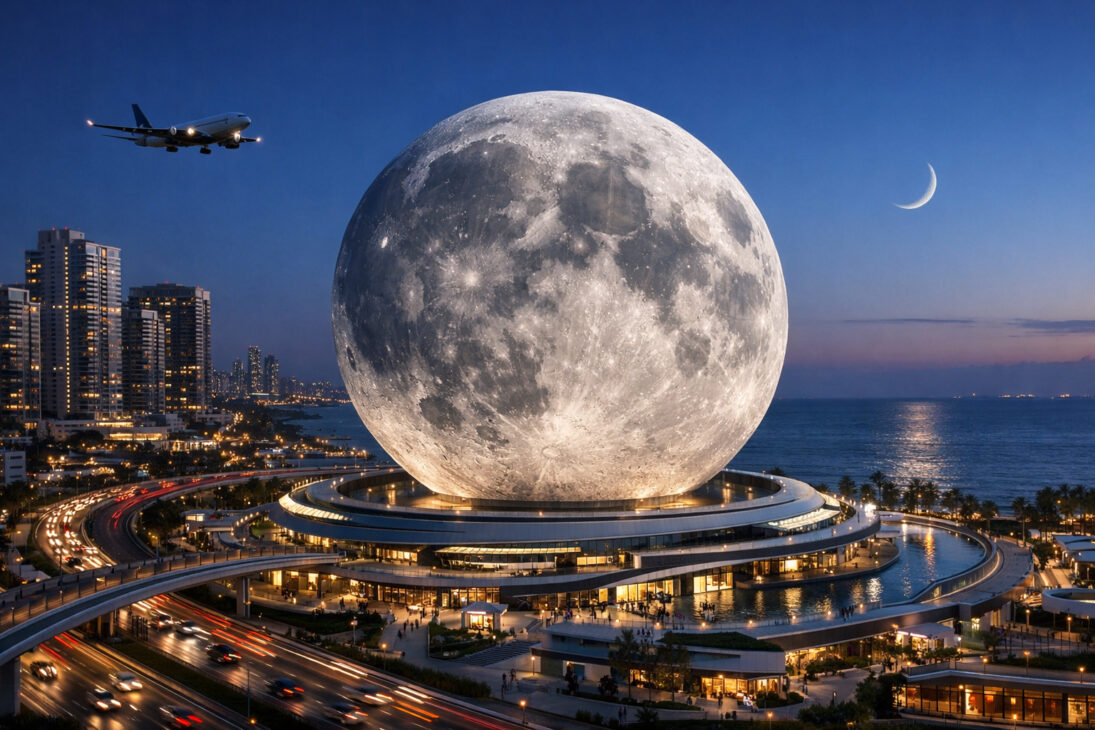
The decision on which country will host the first version of the project has yet to be made. However, the list of candidates includes some of the most powerful economies on the planet, such as United Arab Emirates, China, United States, India, and Australia.
Nevertheless, Spain emerges as a competitive candidate. This is because the country possesses characteristics considered strategic for an undertaking of this magnitude.
Among the analyzed factors are:
- regulatory agility
- availability of strategic land
- tax incentives
- institutional support
- local investment capacity
On one hand, China and the United Arab Emirates usually have an advantage due to their administrative speed and financial capacity to approve megaprojects quickly. On the other hand, Spain offers a different set of advantages.
The country has established tourist infrastructure, a high-level hotel network, and experience in managing significant international visitor flows. Therefore, this combination may make Spanish territory an attractive destination for hosting the venture.
Still, experts point out that the main challenge will be the Spanish regulatory system’s ability to expedite urban authorization, something essential for a project of this scale.
Megaproject Still Conceptual and First “Moon” Could Arise in 2032
Despite the gigantic ambition, the project is still in the conceptual phase. Moon World Resorts has been presenting different versions of this idea for years, but so far none of them have been effectively built.
Currently, there is no defined location nor fully guaranteed funding. Nonetheless, the company claims that if all steps are completed according to schedule, the first artificial Moon could be inaugurated around 2032.
However, this timeline depends on various factors. Among them are the choice of the host country, the approval of urban licenses, the financial structuring, and the political stability of the chosen site.
In other words, although the concept is well-defined, the project still needs to overcome a series of obstacles before becoming a reality.
Still, experts note that the proposal reflects a growing trend in the global tourism sector: the convergence of entertainment, immersive technology, and iconic architecture.
Instead of traditional tourism, experiences capable of offering extraordinary sensations without people needing to travel to real space are emerging.
If built, the complex Moon will not only be the largest spherical building on the planet. It could also become one of the boldest economic and tourist experiments of the 21st century, showing how far the entertainment industry can go when mixed with global investment and geopolitical ambition.
The artificial Moon may never come to fruition. However, if it does, it has the potential to become one of the greatest architectural and tourist symbols of the new era of technological spectacle.
If this project really becomes a reality, would you visit an artificial Moon on Earth or would you prefer to wait for a real trip to space?






-

-

-

-

-

-

40 pessoas reagiram a isso.