






 Portuguese
  Spanish


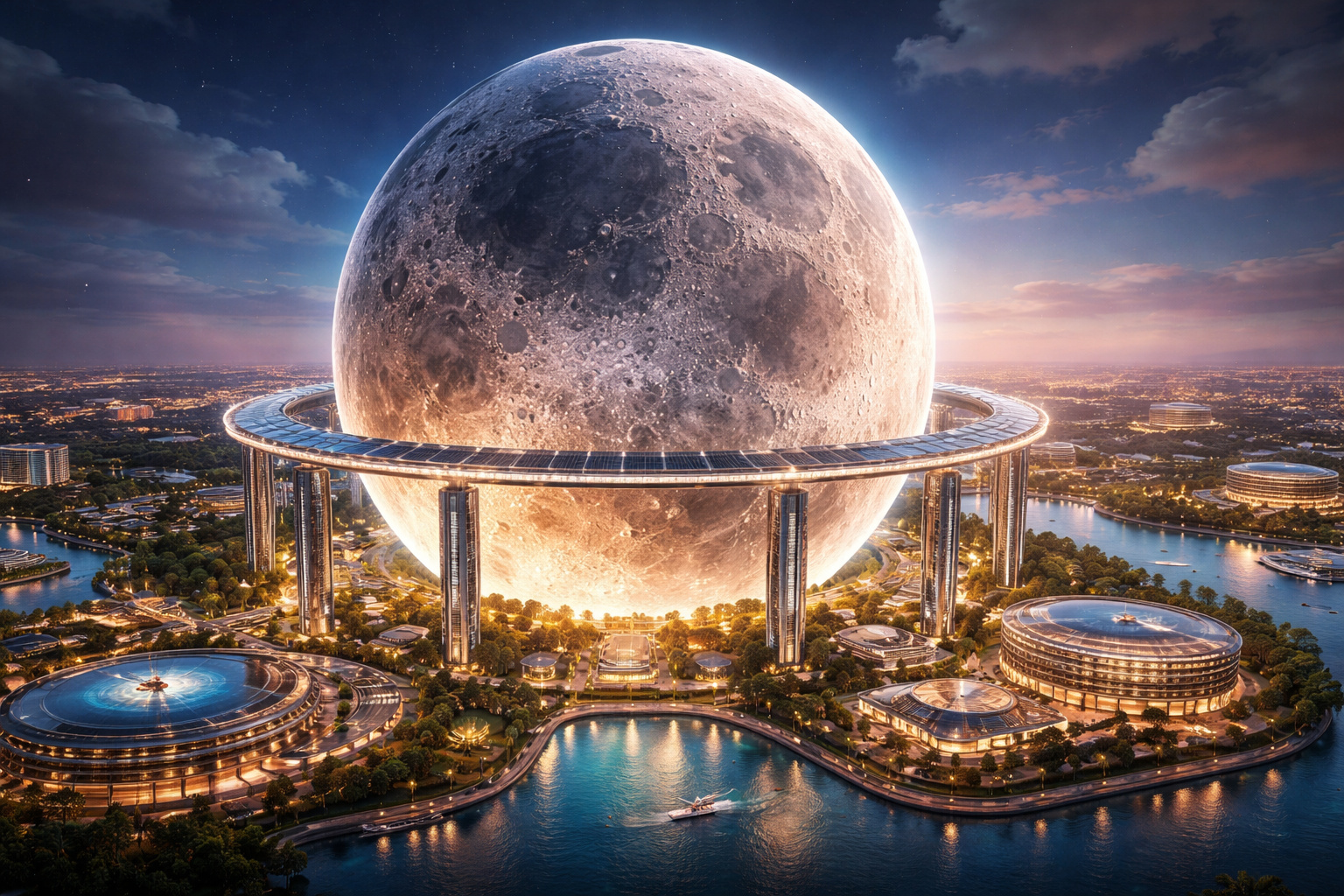

The Moon Project Proposal Includes 20 Towers, Panoramic Walkway with Solar Panels, and a Giant Resort Inside the Sphere, with Brazil Among the Candidates to Receive the Luxurious Complex
The new race for megabuildings has gained a candidate that doesn’t fit in a cellphone photo. The Moon project aims to raise a sphere with 312 m in height and transform this into a tourist destination, urban complex, and engineering showcase.
The promise is to exceed the Sphere in Las Vegas in scale, deliver a resort with 4,000 rooms, and still sell the feeling of walking on the Moon, but inside a closed structure.
Brazil appears on the list of potential countries to receive the venture. This changes the weight of the conversation because a project of this scale does not only test tourism appetite; it tests infrastructure, energy, licensing, and construction capacity.
-
Workers renovating a playground in northern England uncover 176 World War II bombs buried underground; training artifacts still contained explosives.

-
Brazilian Architect Transforms Waste into Sustainable Homes with Solar Power and Rainwater Systems for 40 Years

-
Security Guard Becomes Doctor at Louisiana Hospital Where He Once Worked, Studied Chemistry Between Shifts

-
Woman Rescued from Luxury Complex in Brazil Worked Without Pay for 55 Years, May Be Entitled to Over $300,000




The Fight for Attention Has Left the Screens and Entered the Era of Constructions That Compete for Records in the Real World
The immediate reference is Las Vegas. The Sphere has become a symbol of spectacle and technology, but the sphere of the Moon project was announced to be larger and taller, with 271 m in diameter and the already mentioned 312 m in height.
This competition is not just aesthetic. It impacts investment, visitor flow, event calendars, and the surrounding economy. The record functions as a marketing seal but also requires an execution standard that does not forgive improvisation.
Anyone trying to construct something of this size enters a silent competition with other cities and countries: whoever delivers logistics, labor, suppliers, energy, and continuous operation gains the advantage.
The Most Expensive Part Is Not the Sphere Shell, It Is the Infrastructure That Must Hold Everything Without Failures
A spherical structure of this scale charges tolls even before the first floor becomes visible. The project depends on suitable soil, foundation solutions, wind control, drainage, and a structural design that safely distributes loads.
Also included is what almost never appears in promotional images: a robust construction site, supply schedule, routes for heavy equipment, waste management, and a realistic maintenance plan.
There is no official number disclosed for the total investment. Without this data, it is impossible to pin down the financial scale.
Still, estimates point out that ventures with massive hospitality, event arenas, and dedicated mobility tend to require a large and lengthy chain of contracts, with direct effects on construction and industrial services.
Resort with 4,000 Rooms, Conventions, and Wellness, the Design Acts Like a City Functioning All Day Long
The heart of the Moon would be a large hotel with 4,000 rooms. On the ground floor, the plan includes a convention center, event spaces, restaurants, wellness facilities, and a smaller boutique hotel.
When a complex of this kind goes into operation, it does not depend solely on tourists. It relies on technical routines. Climate control, water, treatment, security, building maintenance, and operation teams become part of the product.
The proposal also mentions parking, a transportation center, and a structure with a heliport. This places the project in the territory of integrated mobility, with demands for safety, flow control, and urban impact.
The Simulated “Moon” Is the Promise That Holds the Click, but the Method Has Not Yet Appeared
The central attraction described is a simulated lunar surface “authentic”, designed to make visitors feel like they are walking on the Moon.
The problem is that the effect has not been explained. And this detail matters more than it seems because it defines cost, safety, capacity per hour, and repeatability.
According to experts, immersive experiences of this level usually require strict control of lighting, specific materials, and block operation to maintain consistency and reduce risk. However, so far, there is no information on how the Moon intends to achieve this sensation, nor what technologies would be used.
Elevated Walkway with Solar on Top, Energy Appears as Showcase and Also as Necessity
The project describes a sphere surrounded by 20 towers, which would support an elevated panoramic walkway around the exterior. From the conceptual images, this walkway seems topped with solar panels.
If this solar layer moves from concept to a functioning system, it can serve two purposes. One is a clean energy narrative for the public. The other is pragmatic, as reducing consumption in a complex of this scale can alleviate costs and pressure on the grid.
With Brazil on the List of Possible Hosts, the Real Dispute Is Who Can Support the Construction and Operation
The announcement mentions a yet-to-be-defined location and lists potential candidates: Australia, Brazil, China, Egypt, India, Poland, Spain, Thailand, the United States, and the United Arab Emirates.
This ignites a competition that goes far beyond tourism. It involves infrastructure, regulatory environment, licensing capacity, and availability of production chains.
Moon World Resorts claims that an inauguration could happen as early as 2032 if everything goes well. The project still seems conceptual at this stage, so what separates headlines from concrete is the financing package, partners, and approvals that make a project of this size viable.
In the end, what drew attention was the combination of gigantism and technological promise, with one technical detail still open.
When a company places Brazil on the map of a venture like this, it also introduces a public test: who can deliver a giant project, with energy and operation at the level required, enters the game.
Comment below: Would it make sense for Brazil to compete for this host, or would the infrastructure bottleneck overshadow it at the beginning?


