





 English
  Francês
  Alemão
  Italiano
  Japonês
  Norueguês
  Portuguese
  Spanish
  9 min of reading
  0 comments


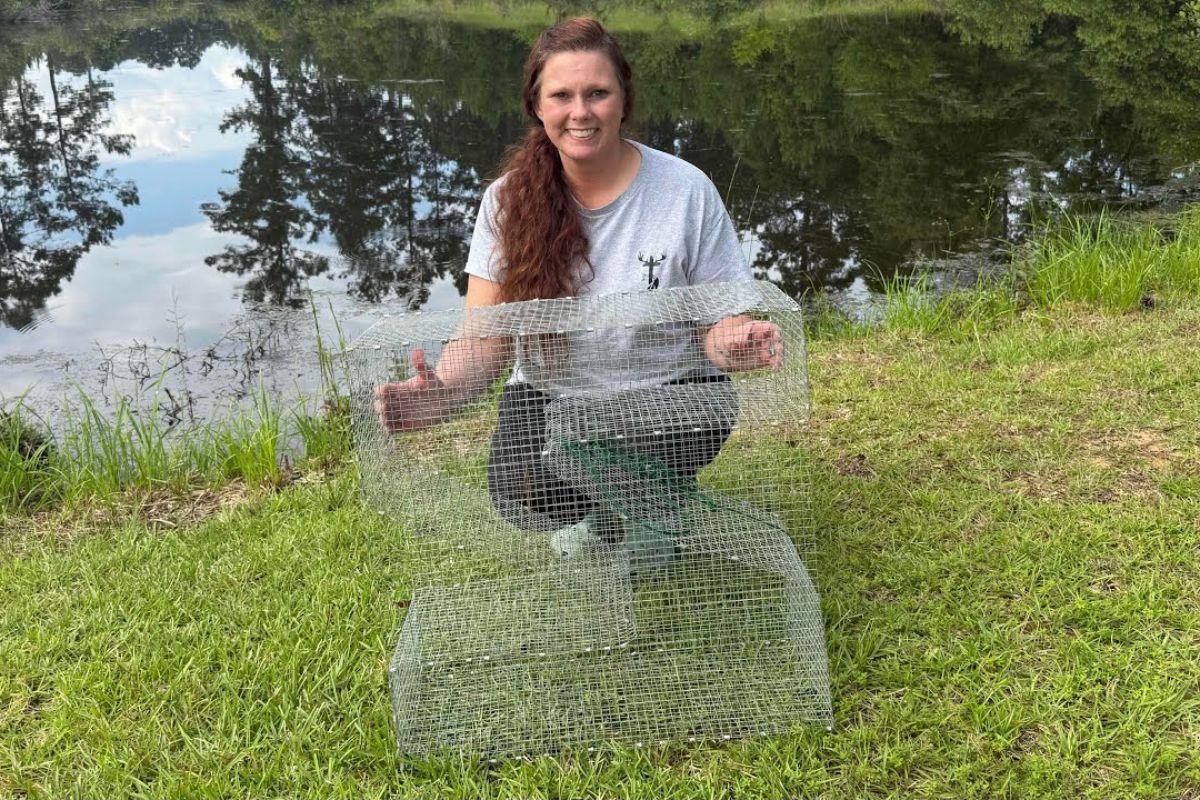
Practical Tests Show How the Z Trap, Made with Simple Wire Mesh, Outperformed Other Bait Traps by Concentrating Small Fish, Crawfish, and Even Snakes in a Farm Pond, Revealing Unexpected Efficiency for Those Looking to Catch Catfish and Porgies with Live Bait in a Short Time in Their Fishing Routine
As soon as the Z Trap entered the water of a small farm pond in rural Louisiana, the behavior of the fish made it clear that its shape differed from traditional cages. In less than 24 hours, the improvised device began to accumulate bluegills, small perch, and other species used as bait, while round and rectangular models set up alongside showed much lower yields.
The experience was conducted by an angler accustomed to targeting large catfish, who relies on live bait in quantity to set up waiting lines and rods in succession. When comparing the Z Trap with circular and rectangular traps that he had used for years, he concluded that the “Z” design was not just a geometric curiosity. In practice, it became the centerpiece of the strategy to fill the bait tank with less waiting time and more stable results.
A Z Trap that Breaks the Mold

The first difference of the Z Trap compared to classic cages is in its structural design. Instead of a cylinder with entrances at both ends or a rectangular box with openings on the sides, the angler adapted a wire mesh measuring 24 by 24 inches to form a body that, when viewed from the side, resembles a “Z” or a lying “N.”
-
Kawasaki surprises by revealing a 140-ton aircraft capable of winning wars without a single shot and bets on ultra-secret technology to protect Japan by 2027.

-
A trick with a fan and a PET bottle goes viral in the extreme heat of 2026 and promises to cool the environment while using almost no electricity.
-
A 176,000-hectare farm in the Northeast is up for sale for R$ 1.2 billion, featuring a runway, fuel station, river, schools, and warehouses, and has become a phenomenon on social media due to its size, which surpasses that of Brazilian capitals.

-
Finding a 3.9 mm larva of the lionfish in the Amazon raises maximum alert and indicates that the invader may already be reproducing in the region.

This geometry creates two internal corridors and two openings, which guide the fish inside without providing an obvious exit.
The choice of this homemade solution was not random. The angler had extensive experience building circular and rectangular traps with mesh, conical openings, and access doors for retrieving bait. Even so, he reported frequent losses of small fish and irregular yields, especially when relying on these cages for stocking catfish catches in the pond and river.
The Z Trap emerged exactly from this dissatisfaction with the performance of conventional structures and the desire to test something that many fishing colleagues claimed was “the best catcher.”
How the Z Trap Was Designed for Live Bait

The construction of the Z Trap followed the same basic principle as the other cages, but with specific decisions to favor live bait. The angler cut two pieces of wire mesh measuring 24 by 24 inches to serve as the top and base and divided another strip of mesh in half, obtaining sides about 11.5 inches high.
From there, he began to outline the base, creating curves and internal angles that form the typical inclined openings of this shape.
Instead of plastic clamps, he used small metal rabbit clips applied with pliers, specifically to ensure greater durability. In addition to its sturdiness, there was concern about following local regulations: in the state of Louisiana, the spacing of the openings cannot exceed about 1 by 3 inches in certain public waters, and the length of traps is limited.
The Z Trap was sized to comply with these measures, allowing it to be used both in farm ponds and, in theory, in public water points subject to the same regulations.
Entrances, Door, and Internal Flow in the Z Trap

The final design of the Z Trap incorporated two openings positioned so that, regardless of the depth at which the fish swim, there is always a visible entrance. The openings were cut with five squares of mesh at the top and three squares wide, maintaining a similar pattern to commercial traps.
An access door, secured with a simple piece of wire, allows for inserting bait and retrieving what was caught without deforming the structure.
This internal arrangement created a particular flow. As soon as the fish enters through one of the openings, it finds a wider space but with corners and angles that make it difficult to return to the entrance alignment. In tests, the angler noticed that bluegills, green sunfish, and other small surface fish remained circulating in the central part of the Z Trap, while crawfish and other bottom organisms occupied the lower area.
This natural partitioning of the inside of the cage helps keep live bait more active and less stressed, an important condition for those who will use it later for catfishing and porgy fishing in ponds and rivers.
Comparative Test: Three Traps, One Farm Pond
To evaluate the actual performance of the Z Trap, the angler decided to compare it directly with two other structures he was already familiar with.
In a small farm pond, he set up at the same time a round mesh trap, a rectangular trap with a rigid edge, and the new Z Trap, all baited with a combination of bread, cheese, and stale tortillas. The three traps were left in the water for about 24 hours, in locations with similar depth and vegetation.
The chosen pond was not unknown. The angler knew there were bluegills, slippery perch, some presence of small catfish, and a large number of turtles, which represents direct competition for bait and food.
The intention was precisely to test the Z Trap in a challenging environment, with high pressure from turtles and the need to separate what is useful as live bait from what merely steals food and occupies space inside the cage.
What the Z Trap Caught in Practice
Upon retrieving the traps, the result was uneven. One of the traditional cages came out of the water practically taken over by turtles, without any small catfish or fish of interest for bait.
Another captured only a few modest-sized fish, insufficient to turn a night of catfishing into an operation with multiple lines set up comfortably.
In contrast, the Z Trap exhibited a distinct performance. Even in the first check, it had already concentrated a greater number of fish suitable for bait, particularly small perch, sunfish, and other forage fish.
In later tests, setting up the same model in different pools and sections of the pond, the angler recorded captures of water snakes and even a king snake, in addition to crawfish in quantity.
The pattern observed was that the Z Trap, when positioned correctly, maintained a constant flow of live bait, while the round and rectangular traps had irregular performance and were more susceptible to turtle domination.
Large Catfish, Right Bait, and the Role of the Z Trap
Behind this effort lies a simple logic of catfishing and porgy fishing in freshwater environments. These fish respond better to well-presented live baits, such as bluegills, small tilapia, or other forage species, robust prey that can stay active on the hook longer.
The more bait of this type the angler has, the greater the chance of sustaining several lines set simultaneously in pond and river.
The Z Trap fits precisely into this point of the chain. With the ability to gather a set of small fish and crawfish in a few hours, it feeds bottom lines, waiting lines, and branch rods without the need to spend part of the night just sifting bait with light rods or hand nets.
By transforming each catch of large catfish into a direct result of an efficient bait production system, the Z Trap ceases to be just a homemade curiosity and becomes an integral part of the strategy for those seeking consistency in catfish and bottom fish catches.
How the Z Trap Reacts with Turtles and Other Species
Not every result was positive. In one of the tests, a small trap with a rigid edge came out completely overrun by turtles, while the Z Trap, placed in a different spot, maintained a more favorable ratio between bait and unwanted animals.
Even so, the angler noted that the pond was heavily dominated by turtles, meaning any type of trap is subject to this kind of accidental capture.
The most striking case involved the presence of two chicken snakes and a king snake inside the same Z Trap. The scene drew attention because the king snake is known for predating on other snakes, but in this episode, all three remained side by side.
Situations like this expose an inherent limit of the Z Trap: no matter how efficient it is for concentrating live bait, it also reinforces the need for careful handling, with heightened attention when opening the door and discarding species that will not be used for fishing.
Regulations, Ethics, and Risks of Using the Z Trap
Although the experience was conducted on private property, in a farm pond, the angler himself mentioned Louisiana’s rules for constructing and using traps, especially in public waters. There are limits on the size of the structure, requirements for maximum openings in the mesh, and guidelines for identifying the device.
These parameters vary from state to state and from country to country, but the logic is repeated: any use of the Z Trap in public rivers, lakes, or ponds must comply with local fishing and wildlife legislation.
There is also an ethical dimension. Accidental captures of turtles, snakes, or protected fish require quick and careful return to the water, reducing unnecessary suffering and mortality. In the case of the Z Trap, this means checking the equipment frequently, avoiding leaving it for days without verification, and choosing points that minimize interaction with sensitive species.
For those intending to use the model specifically to supply catfish and porgy fishing with live bait, this fine-tuning of location, depth, and waiting time is as important as the Z design itself.
What Experience Reveals About Bait Trap Efficiency
The comparison among three different models in the same pond indicates that it is not just a matter of “personal preference.” The shape of the Z Trap influences how bait enters, distributes, and remains inside, reduces the chances of escape, and better takes advantage of the curiosity of forage fish.
In scenarios with high pressure from turtles and the presence of multiple species, this gain in efficiency can make the difference between having enough bait for a night of fishing or not.
At the same time, the experience reinforces that the Z Trap is not a magical solution. The outcome depends on the quality of the bait placed in the cage, the correct choice of location, the reading of the local fish behavior, and frequent checks to avoid overcrowding or unintended capture of non-target animals.
It is precisely in this combination of a well-thought-out design and responsible use that the Z Trap consolidates itself as an efficient tool for those constantly hunting bait for catfish and porgies in ponds and rivers.
Conclusion: Does the Z Trap Fit into Your Fishing Style?
The journey of adapting the Z Trap in a farm pond shows that even with common materials and simple techniques, it is possible to redesign the way to capture live bait with greater stability and less trial and error.
In about a day of testing, the angler saw a homemade trap outperform models he had been using for years and transform the bait supply into a more predictable process.
At the same time, the experience brings to light responsibilities: observe local laws, treat non-target animals well, choose points thoughtfully, and understand that any trap is a direct intervention in the aquatic environment.
In your opinion, in what type of catfishing and porgy fishing situation in a pond or river would a Z Trap truly make a difference in your routine, and in what scenarios would you still prefer to rely on light rods, seine nets, or hand nets to catch live bait?







-

-

-

-

-

-

94 pessoas reagiram a isso.