





 Portuguese
  English
  Spanish
  3 min of reading
  0 comments


Canadian Astronomer Warns: Pieces of Rockets Are Falling to Earth and the Risk of Space Debris Accidents Grows Every Year
When pieces of a SpaceX Dragon rocket’s trunk fell on a farm in Canada in 2024, astronomer Samantha Lawler felt firsthand a warning that scientists had already been giving. The largest fragment weighed 36 kilograms and measured 2.4 meters. “If that hit your house, it would go straight through,” Lawler stated. She witnessed the discreet collection of the debris by SpaceX employees.
The case raised a red flag. With more launches and satellites in orbit, the risks of accidents with space debris are also increasing.
Lawler asserts that situations like Canada’s “are going to become much more common” and that, at some point, “someone is going to die because of this.”
-
They were brilliant! Scientists discover that our ancestors in China were already making super advanced tools 160,000 years ago, changing everything we knew.

-
Scientists unveil 3 million years of climate secrets hidden in the ice of Antarctica.

-
Ancient farmers created “aggressive plants” that changed nature forever.

-
Astronomers find a “backward” solar system that ignores all the rules of space and leaves scientists scratching their heads!


Satellites and Excess Objects
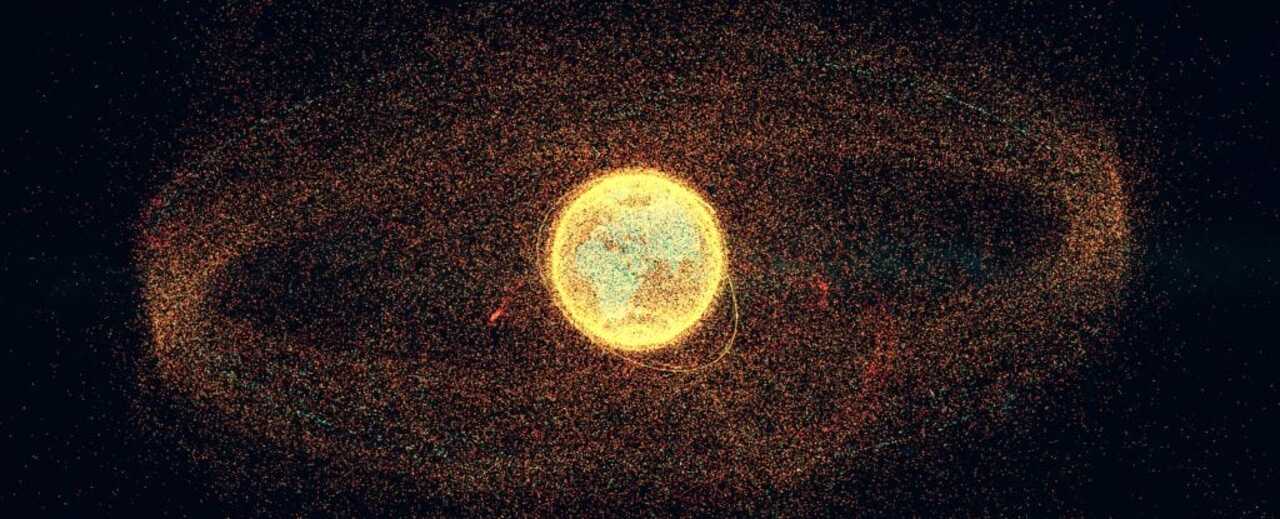
Low Earth orbit is becoming increasingly congested. According to the European Space Agency, there are over 50,000 objects larger than 10 cm in diameter and 9,300 active satellites.
The majority of these launches are linked to satellite internet offerings. SpaceX, for instance, has already placed over 11,000 Starlink satellites in orbit since 2019. Amazon and China are also following the same path.
This increase results in more objects returning to Earth. In 2024, around 1,200 re-entered the atmosphere, with at least 120 doing so in an uncontrolled manner — meaning without knowing exactly where they would land.
Debris has already been reported in countries like India, Indonesia, Australia, Kenya, Ivory Coast, Poland, and the United States.
Danger in Space and in Air Routes
The risks are not limited to the ground. There is also a threat of collisions in orbit. In 2009, two satellites collided at an altitude of 800 km, generating thousands of new fragments. The International Space Station had to divert from space debris several times in 2023.
Another point of concern is commercial aviation. A 2024 study indicates that there is over a 25% chance each year that a piece of rocket will fall in areas with heavy air traffic.
In 2022, France and Spain temporarily closed their airspaces due to the uncontrolled re-entry of a 20-ton Chinese rocket.
Although the individual risk is low, astronomer Aaron Boley warns: “The collective risk grows every year.”
Invisible Environmental Impact
Even when they do not fall to Earth, satellites still cause problems. The burning of these objects in the atmosphere releases aluminum oxide, which can affect the ozone layer. Additionally, launches use fossil fuels, generating pollution.
SpaceX claims that its satellites are designed to completely disintegrate upon re-entry, with “effectively zero risk” to people. But astrophysicist Jonathan McDowell is skeptical. “We are using the upper atmosphere as an incinerator. Over a thousand Starlink satellites have burned up so far,” he states.
Obsolete Laws
The legal framework regulating space activities is outdated. The main document is the Outer Space Treaty of 1967, which defines countries’ responsibilities.
However, it does not impose rules regarding controlled re-entries nor limits the number of launches. “The current norms are good for what we had 20 years ago,” says McDowell. “Today, they are outdated.”
Experts advocate for changes. One of them would be to require that only rockets with controlled re-entry can be launched.
Solutions in Testing
Some ideas to tackle the problem are already being developed. The Japanese company Astroscale created a prototype of a space debris removal truck.
ClearSpace, from Switzerland, plans missions to recover defunct satellites, with support from the European Space Agency. China has also conducted a test to push a decommissioned satellite to a higher orbit.
For the future, one alternative could be recycling in orbit. “We will need space stations that repurpose parts from old satellites,” proposes McDowell.
Another simpler solution would be to reduce the number of launches and increase the durability of satellites. “We need to build more durable equipment with longer lifespans,” asserts Lawler. “That is the real challenge — and no one is truly facing it.”
With information from Smithsonian Mag.







Seja o primeiro a reagir!