





 Portuguese
  English
  Spanish
  3 min of reading
  9 comments


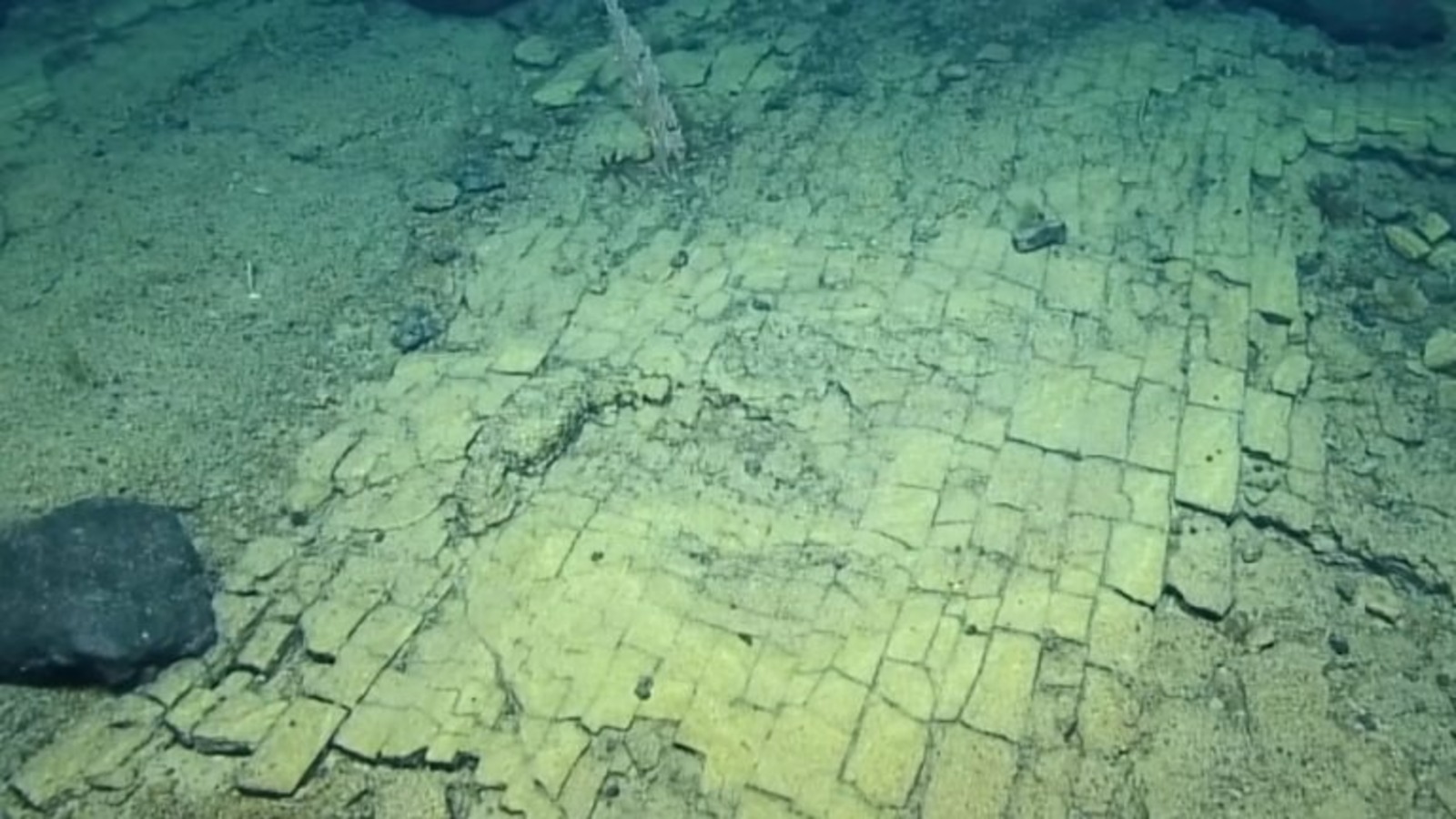


Structure Similar to the Yellow Brick Road is Recorded Thousands of Meters Deep in the Pacific Ocean During Scientific Expedition of the Nautilus Ship in a Protected Area Near Hawaii
A rocky pattern similar to a paved road was identified thousands of meters deep in the Pacific Ocean during a scientific expedition in 2022, revealing a rare geological formation known as yellow brick road in the ocean.
The structure was observed during a mission of the research vessel Nautilus, operated by the Ocean Exploration Trust, while scientists mapped the Liliʻuokalani Ridge, located north of the Hawaiian Islands.
The visual phenomenon drew attention for resembling a paved road formed by aligned blocks.
-
Scientists have finally discovered where the plastic that disappeared from the oceans went, and the answer is frightening: it fragmented into such tiny particles that they became invisible and now there are 27 million tons of nanoplastic just in the North Atlantic.
-
The Artemis II mission will take the Orion capsule back to the vicinity of the Moon with four astronauts, a private bathroom with a curtain, a system adapted for men and women, and a level of comfort that highlights how the Apollo era operated at the rawest limits of space exploration.

-
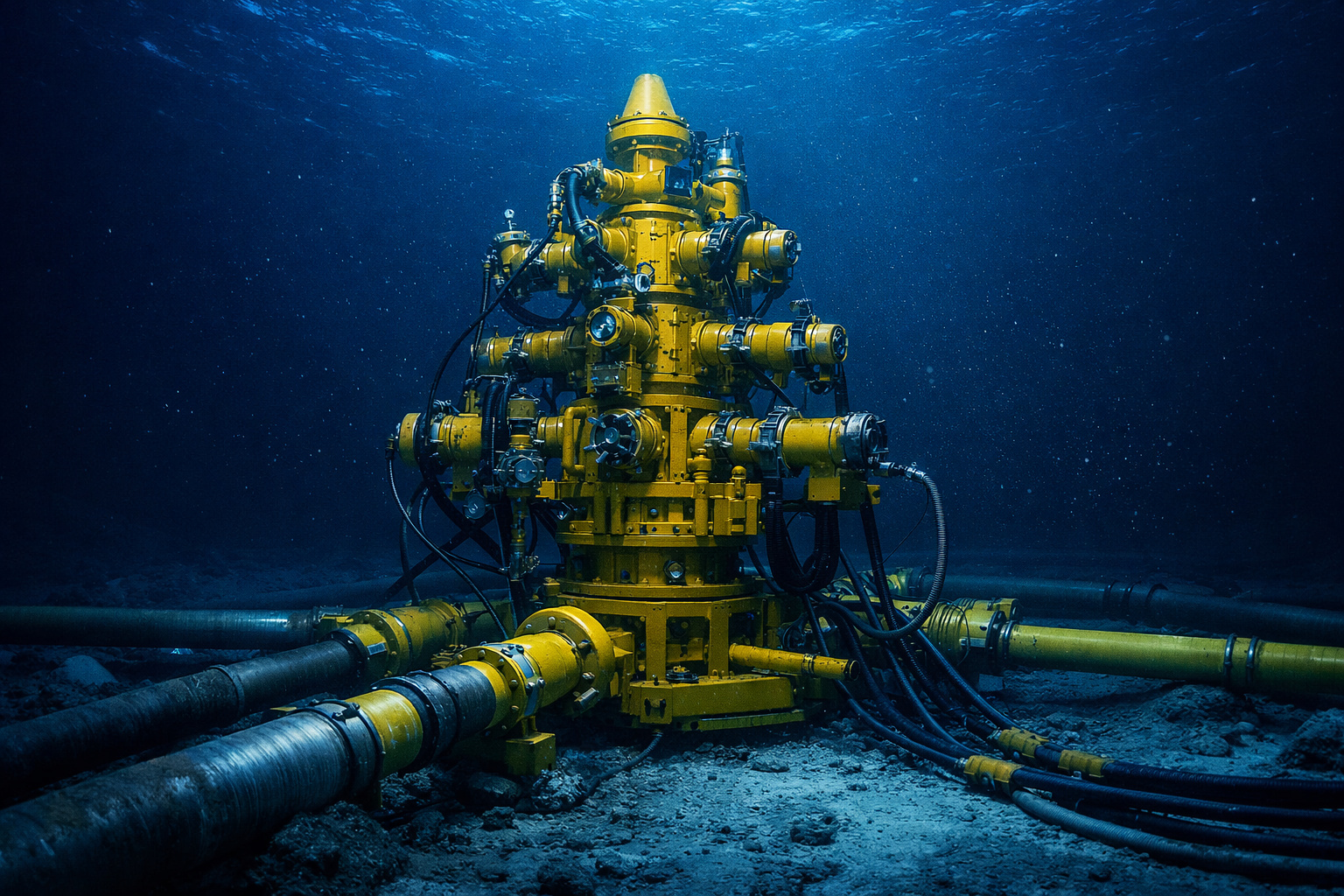
Giant structures on the seabed precisely control oil and reveal how high-tech underwater valves work.
-
China has just tested a giant drone the size of a fighter jet with a wingspan of 25 meters that carries 6 tons, flies for 12 hours, and the most frightening part: it can launch entire swarms of smaller drones directly from the air.


Scientific Expedition Records the So-Called Yellow Brick Road in the Ocean
The recording took place inside the Papahānaumokuākea Marine National Monument, one of the largest marine conservation areas on the planet.
Even though it is a protected and monitored region, much of the local seabed still remains unexplored.
During the mission, researchers identified regular fractures in the rocky bed that produced a visual pattern resembling a paved path.
The formation appeared on the summit of one of the seamounts that are part of the ridge.
The pattern drew attention for emerging in an environment typically associated with irregular shapes and chaotic geological processes.
Formation Found in the Bed of an Ancient Submerged Lake
At the discovery site, scientists found the dry bed of an ancient lake that is now submerged. The soil exhibited straight and continuous fractures organized in nearly orthogonal patterns.
The regularity of the lines produced an appearance similar to aligned pavement blocks, creating the visual effect that led to the comparison with a road.
This type of geometric organization is uncommon on the ocean floor.
The appearance of the terrain reinforced the visual illusion of the so-called yellow brick road in the ocean, although the phenomenon has purely natural origins.
Recording Was Made by a Remotely Operated Underwater Vehicle
The formation was documented by a remotely operated underwater vehicle during the scientific expedition. The images were transmitted in real time to the research team monitoring the operation.
The audio captured during the recording shows reactions of surprise from the scientists in response to the unexpected pattern. Despite its organized appearance, there was no evidence of human intervention at the site.
The discovery reinforced the unusual character of the yellow brick road in the ocean, whose formation is explained by natural geological processes.
Geological Explanation Involves Lava and Rapid Cooling
According to researchers, the formation is composed of hyaloclastite rock. This type of rock forms when hot lava comes into direct contact with seawater.
Rapid cooling generates internal stresses in the rock structure. Over successive eruptions and thermal cycles, these stresses cause fractures that can organize at angles close to 90 degrees.
This process creates surfaces that resemble aligned blocks, producing the visual effect observed in the yellow brick road in the ocean.
Discovery Highlights How Little We Know About the Ocean Floor
The find gains relevance in light of recent estimates indicating that less than 0.001% of the Earth’s ocean floor has been directly observed by scientists.
Even protected and studied areas like Papahānaumokuākea have had only a small fraction of their seabed explored to date.
The formation recorded in the Pacific does not lead to any mythical destination but highlights how little we know about the largest environment on the planet.
The episode illustrates how surprising discoveries can arise in regions of the ocean that are still little investigated.
With information from Revista Fórum.






Pelo que sabemos ou nos foi passado e que o mundo acabou em agua desta forma sei la
Nadava mais um pouco e chegava na cidade das esmeraldas pôkkkkkk
Anúncio demais
Insuportável, né?