Portuguese
  Spanish


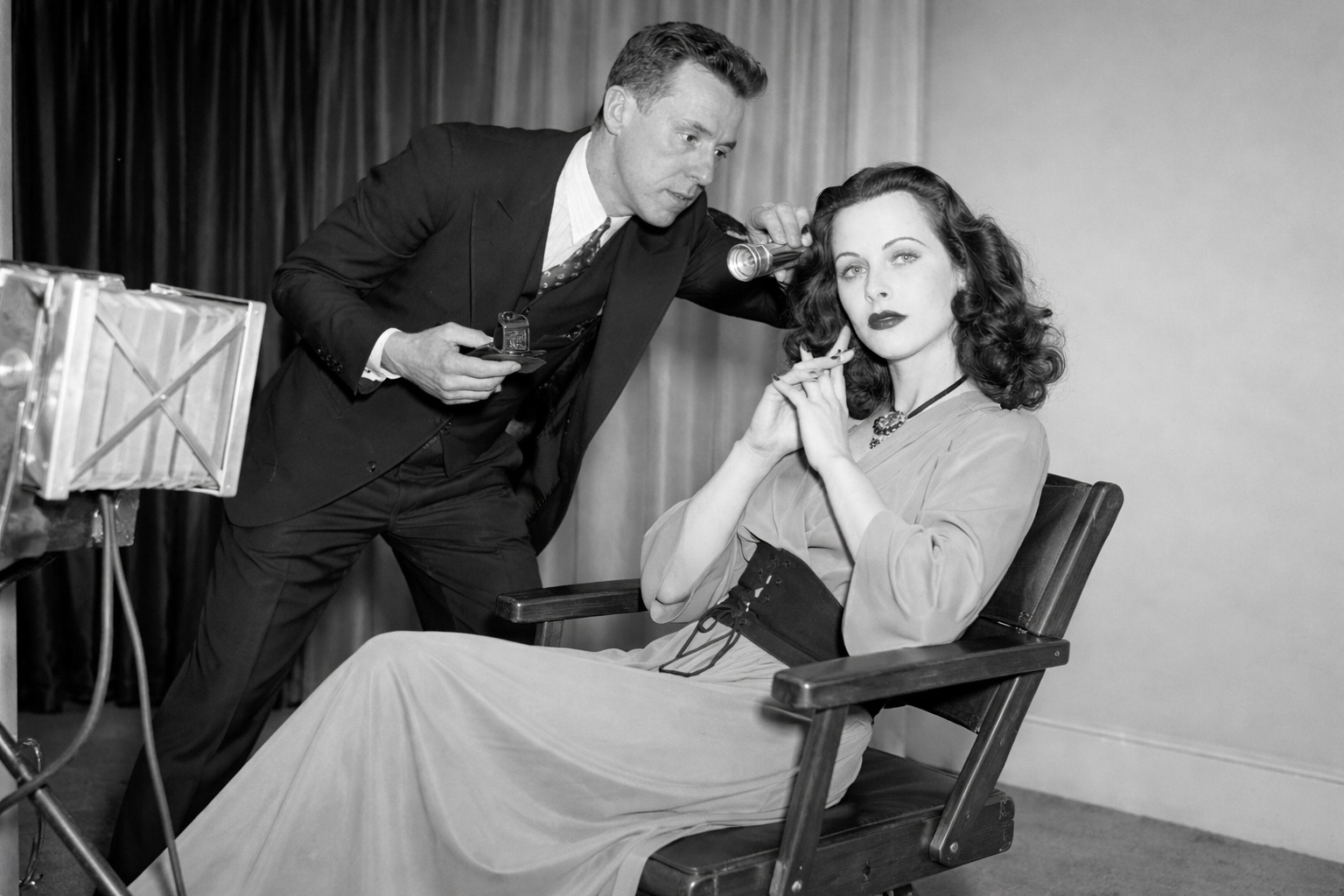

Hollywood actress developed frequency hopping system in 1942, technology that today supports wireless networks used around the world
A story that connects cinema and science has returned to the center of discussions by revealing how Hedy Lamarr helped build the foundation of modern telecommunications. Even during World War II, in the 1940s, the actress developed an innovative communication system, which would later give rise to technologies such as Wi-Fi, Bluetooth, and GPS. Furthermore, according to historical studies, such as those by Lisa A. Marovich, the invention was considered too advanced for its time, which delayed its practical application and recognition.
Origin of Hedy Lamarr and early signs of genius
Initially, Hedy Lamarr was born on November 9, 1914, in Vienna, then part of Austria-Hungary, and from an early age, she showed a strong interest in science and engineering. However, despite this talent, she was directed to follow social standards focused on aesthetics and artistic life, a common reality for women at that time.
Later, in the 1930s, she began her career in European cinema, gaining notoriety with the film “Ecstasy” (1933), directed by Gustav Machatý. Consequently, the success led her to international fame and then to marriage with Fritz Mandl, a businessman in the arms industry.
-
Couple Sold Everything to Restore a 300-Year-Old Abandoned Mansion, Uncovering Ancient Books and Untouched Rooms

-
Couple Builds Sustainable Home from Straw Bales, Wood, and Clay in Brazil
-
At 64, Grandma Sônia Turned Homemade Recipes into a Family Business, Growing Casa de Bolos to Over 600 Locations and Expanding to Portugal

-
Brazilian Couple Builds Underground Bunker in Santa Catarina Amid Fears of Crises and Shortages, Spending $10,000 and Learning Construction from Scratch, Videos Go Viral


However, although she lived in an environment of luxury, Lamarr had direct access to discussions about military technology and armaments, which broadened her technical vision. Thus, in 1937, in light of the rise of anti-Semitism in Europe, she decided to leave the continent and move to the United States, where her trajectory would take new directions.

Rise in Hollywood and parallel involvement in science
Shortly after, according to records from the film industry, Lamarr was hired by MGM after meeting Louis B. Mayer during a transatlantic trip. Then, in 1938, with the film “Algiers”, she established herself as one of the great stars of Hollywood’s Golden Age, participating in several successful productions.
However, alongside her fame, she maintained a constant interest in technological inventions, discreetly working on ideas that could have practical applications. In this context, with the onset of World War II in 1939, Lamarr began seeking solutions to military problems, especially related to the security of communications.
The creation of frequency hopping and the 1942 patent
In this scenario, in 1940, Lamarr met composer George Antheil, who also showed interest in technology. From this partnership, they developed the concept of “frequency hopping”, which consists of the constant changing of radio signals to avoid external interference.
Moreover, the idea was designed to prevent radio-controlled torpedoes from being intercepted or blocked by enemies, such as the German forces during the war. In 1942, according to records from the National Inventors Council, the duo registered the patent for the “Secret Communications System”, formally consolidating the innovation.
However, despite its potential, the United States Navy chose not to use the technology at that time, mainly because it was beyond the technical capabilities available at the time.

From military use to the foundation of modern technologies
Later, during the Cold War, the concept developed by Lamarr and Antheil was re-evaluated by the armed forces of the United States. According to Kenneth T. Klima and Adriana Klima, in the 1960s, frequency hopping began to be incorporated into military systems, expanding its strategic relevance.
Additionally, as the technology remained classified until the 1980s, the public recognition of the invention was significantly delayed. Still, with the advancement of telecommunications, the concept evolved into widely used civilian applications, including:
• Wi-Fi
• Bluetooth
• GPS
Therefore, although initially little recognized, Lamarr’s contribution became fundamental to modern global communication, being present in billions of devices around the world.
Late recognition and historical impact
Despite this, for decades, Hedy Lamarr did not receive credits, royalties, or recognition proportional to the importance of her invention, while her film career declined in the 1950s and 1960s.
Only later, at the end of the 20th century, she began to be recognized by the scientific community, being honored alongside George Antheil. According to official records, Lamarr was inducted into the National Inventors Hall of Fame of the United States, after her death in 2000.
At the same time, in 2015, the UN established International Day of Women and Girls in Science, reinforcing the importance of trajectories like hers.
Thus, her story highlights how an invention created amidst war ended up shaping global communication for decades, raising an inevitable reflection: how many essential contributions remain invisible in the history of science?