





 Portuguese
  English
  Spanish
  4 min of reading
  0 comments


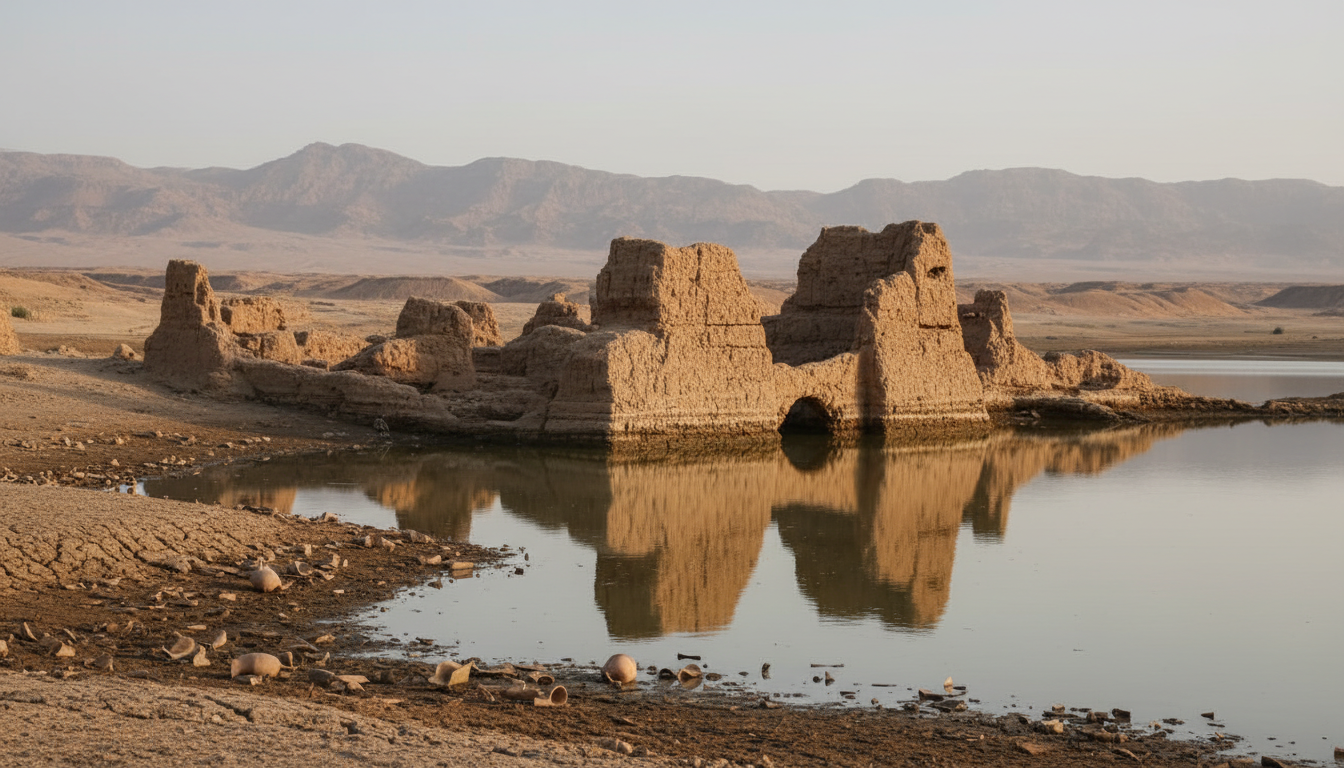
The sunken city in Iraq that lay underwater for 40 years has emerged with walls, a palace, and over 100 cuneiform tablets from an empire that dominated Mesopotamia between 1550 and 1350 BC.
A sunken city in Iraq surprised the world by emerging from the Mosul reservoir in early 2026. At 3,400 years old, the city of Zakhiku is considered one of the centers of the mysterious Mittani Empire, which rivaled the Egyptians, Hittites, and Assyrians. According to a report by CNN Brasil, a joint team of Kurdish and German archaeologists excavated the site in January and February 2026, racing against time before the waters rose again.
No one expected to find what the drought revealed. Walls made of mud bricks, defensive towers, a multi-story building, and five jars containing over 100 handwritten clay tablets — all preserved by an earthquake that, paradoxically, destroyed and protected the city at the same time.
Therefore, this sunken city in Iraq is not just a collection of ruins — it is a window into an empire that nearly vanished from human memory.
-
Astronomers have found signs of a planet hidden for decades in forgotten telescope data, and if it really exists, it will be the first new world in the solar system in over 170 years.

-
Scientists have caught a star 450 light-years from Earth, only 200 years old, spewing gas and energy in bursts, and no one knows for sure what is happening with it.

-
After being stalled for seven years in the desert, the 1 km skyscraper in Saudi Arabia has resumed construction, rising one floor every three days, and is now on track to surpass the Burj Khalifa by 2028.

-
Scientists create a “molecular sponge” that transforms dirty water and even water from the Dead Sea into potable water using only sunlight and without consuming any electrical energy.


An earthquake destroyed the city 3,400 years ago — and that is what preserved it
What makes Zakhiku extraordinary is the way it was preserved. Around 1350 BC, a devastating earthquake struck the region and caused the collapse of the upper walls of buildings, constructed with sun-dried mud bricks. In this way, the debris formed a protective layer over the lower structures, sealing them for millennia.
Thanks to this natural layer of protection, archaeologists found walls with defensive towers, a complete fortification, a multi-story storage building, and even murals painted in an exceptionally preserved state.
Still, the most impressive find was inside five ceramic jars: over 100 cuneiform clay tablets, dated to the Middle Assyrian period (1350 to 1100 BC). Consequently, these records survived not only the earthquake but also over 40 years submerged after the construction of the Mosul Dam in the 1980s.
What the 100 tablets from the sunken city in Iraq may reveal
The cuneiform tablets are considered the most valuable find of the excavation. Written on raw clay, they were found inside jars that protected them from water erosion — something that researchers described as “almost miraculous.”
The texts, which are still being deciphered, may reveal details about:
- The daily life of the inhabitants of Zakhiku during the Mittani Empire
- The impact of the earthquake that destroyed the city around 1350 BC
- The transition to Assyrian dominance in the region after the Mittani collapse
- Administrative and commercial records from the Middle Assyrian period
Moreover, similar discoveries at sites like the medieval city on the Silk Road in Uzbekistan show how archaeology continues to reveal entire civilizations that conventional history has forgotten.

Who were the Mittani — the empire that rivaled Egypt
The Mittani Empire is one of the least known civilizations of antiquity, despite its importance. Formed by Hurrians — a people who were neither Semitic nor Indo-European — it dominated northern Mesopotamia between 1550 and 1350 BC, controlling vast areas between the Tigris and Euphrates rivers.
The Mittani were powerful enough to negotiate diplomatic marriages with Egyptian pharaohs and wage wars against the Hittites of Anatolia. However, the empire rapidly declined around 1350 BC and was absorbed by the Assyrians, who dominated the region in the following centuries.
Therefore, the tablets found in this sunken city in Iraq are so valuable: they date precisely from the transitional period between Mittani and Assyrian rule, potentially clarifying how and why an entire empire disappeared.
Climate changes reveal — and threaten — the sunken city in Iraq
The drought that revealed Zakhiku was not an isolated event. Climate changes have exposed archaeological sites around the world — such as the city of Hasankeyf in Turkey, submerged by a dam in 2020, and ruins in Lake Mead in the United States, which emerged in 2022 during a megadrought.
In the case of the Mosul reservoir, water was partially extracted to irrigate crops during the water crisis, which accelerated the exposure of the site. The team from the University of Tübingen and the Kurdistan Archaeological Organization worked under adverse conditions — rain, hail, and freezing temperatures — to document as much as possible before the water rose again.
After the excavations, the ruins were sealed with plastic covering for protection against erosion, but the solution is temporary. Prolonged submersion for over 40 years has already caused damage, and future water fluctuations pose a constant threat to the integrity of the site. Just like the ancient iron factory discovered in Senegal, Zakhiku demonstrates that ancient civilizations achieved levels of sophistication that still surprise modern science.

There is still much to confirm
Despite the excitement, researchers warn of important limitations. Identifying Zakhiku as the city of the Kemune site is considered likely, but still depends on the complete deciphering of the cuneiform tablets. Additionally, the 2026 excavation was limited by the rapid rise of water after February, allowing only an initial mapping.
The dates of the Mittani Empire vary among sources — some cite 1500 to 1360 BC, others 1550 to 1350 BC — and the exact age of the ruins ranges from 3,000 to 3,400 years. Finally, comprehensive analyses of the tablets and ceramic finds are still underway, and definitive results may take years to be published.







Seja o primeiro a reagir!