






 Portuguese
  Spanish


World’s Largest Statue of the Virgin Mary, the Mother of All Asia is 98.15 meters tall, located in the Philippines, and has a habitable internal area.
According to the Montemaria International Pilgrimage & Conference Center, the Mother of All Asia, Tower of Peace is the tallest statue of the Virgin Mary in the world, measuring 98.15 meters from the ground to the tip of the cross on top of the crown. The monument is located in Batangas City, in the Philippines, atop a hill facing Batangas Bay.
The construction, completed in 2021, was designed by Filipino sculptor Eduardo Castrillo and gained international prominence for combining faith, engineering, and religious tourism in a single structure. According to ChurchPOP, the image was made of concrete and steel and surpassed in height world-renowned monuments, including the Christ the Redeemer in Rio de Janeiro and the Virgin of Peace in Venezuela.
What is the Mother of All Asia, the 98.15 meters statue dedicated to the Virgin Mary
The Mother of All Asia, Tower of Peace is located in Montemaria, an international pilgrimage and conference center situated in Pagkilatan, in Batangas City.
-
Reaching 12.7 trillion reais and growing 2.3% in 2025, Brazil’s GDP confirmed the fifth consecutive year of expansion, driven by the extractive industry and services that supported household consumption.

-
Norway towed to the North Sea a platform weighing 656,000 tons made with 245,000 m³ of concrete and 100,000 tons of steel, creating the heaviest movable object ever constructed by humans.

-
While the mirrored facade made the 241-meter tower reflect the Boston sky, 227-kilogram windows plummeted, wood filled the gaps, and engineers had to replace 10,344 panels.
-
Instead of demolishing a 7,600-ton building that was blocking an avenue, engineers cut the structure in half, moved each part 55 meters, and kept 80 families inside the apartments.



The monument was conceived as a symbol of unity and peace for Asia and the world, according to the institutional presentation of the sanctuary itself.
The official height of 98.15 meters, or 322 feet, includes the base built under the image and is measured up to the cross on top of the crown. This detail is important because the structure functions not only as a sculpture but as a vertical complex that combines a religious image, pedestal, and internal tower.
Tower of Peace combines religious statue and habitable building in the same monument


The most unusual aspect of the work lies in its structural concept. According to the Montemaria International Pilgrimage & Conference Center, the Mother of All Asia is considered the only habitable statue in the world, with an internal gross area of approximately 12,353 m².
This means that the monument was not designed just to be observed from the outside. The structure has internal spaces distributed over several levels, allowing for visitor circulation and use of internal areas associated with the religious and tourist complex.
This feature differentiates the work from traditional colossal statues. The Mother of All Asia functions as a sacred image, architectural landmark, and accessible tower, combining religious language with a vertical building solution.
Largest statue of the Virgin Mary in the Philippines was erected on a hill of 148 meters
The chosen location also reinforces the visual impact of the monument. According to Montemaria, the Tower of Peace was built at the highest point of a plateau situated 148 meters above sea level, overlooking the Verde Island Passage and Batangas Bay.
This position makes the image seen as a landmark for the coastal landscape of the region. The sanctuary itself describes the statue as facing vessels entering and seeking shelter in the calm waters of Batangas Bay.
The location also enhances the monument’s tourist appeal. Besides the religious dimension, the visit is associated with the panoramic view of one of the most important maritime areas in the Philippines.
Verde Island Passage reinforces the environmental and tourist value of the monument
The Verde Island Passage appears in Montemaria’s official description as an area reputed as the “center of the center” of global marine biodiversity. This reference has made the surroundings of the monument an essential part of the local tourist narrative.
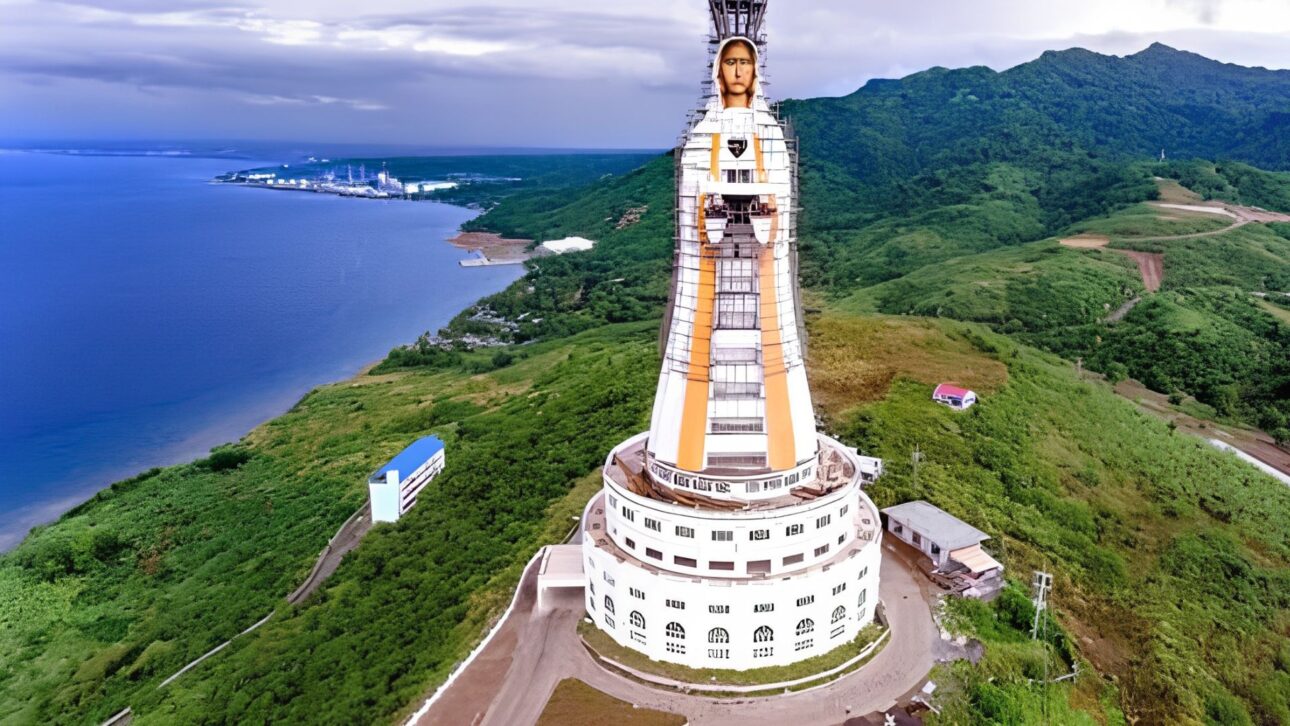
From the top of the tower, visitors find a landscape that combines sea, mountains, vessels, and coastal areas of Batangas. This setting helps explain why the site has attracted not only pilgrims but also tourists interested in the view and scale of the construction.
The presence of the statue at this point creates a rare overlap between religious tourism and landscape tourism.
The work does not rely solely on size to draw attention but also on its strategic position facing a maritime passage recognized for its ecological importance.
Religious symbols appear at the height of 33 floors and in the crown with 12 stars
The project incorporated explicit religious references in its numbers and details. According to Montemaria, the height of the statue is equivalent to a 33-story building, a number associated with the 33 years of Jesus Christ’s life on Earth.
The crown of the image has 12 stars, presented by the sanctuary as a reference to the 12 apostles. This type of symbolism reinforces the intention to transform architectural elements into religious language.
Thus, the work was not designed merely as a monumental monument in scale. Its shape, height, and ornamentation were used to communicate messages of faith, unity, and Marian devotion.
Work was completed in 2021 during the celebrations of 500 years of Christianity in the Philippines
According to ChurchPOP, the statue was completed in 2021, a year marked by the celebrations of 500 years since the arrival of Christianity in the Philippines. The date reinforced the symbolic weight of the work in a predominantly Christian country with a strong Catholic tradition.
The construction of the image began years earlier and went through a final phase marked by the covid-19 pandemic. The completion, even in this context, was highlighted by religious outlets as a milestone for faith tourism in the country.
The monument came to represent, at the same time, a historical celebration and a strategy to strengthen Batangas as an international pilgrimage destination. The scale of the structure helped project the name of Montemaria beyond the Philippines.
World’s largest Marian statue also boosts religious tourism in Batangas
Religious monuments of this magnitude often have an impact that goes beyond devotion. The Mother of All Asia has become an attraction point for pilgrims, local visitors, and foreign tourists interested in great works of faith and architecture.
The Montemaria area was planned as a larger complex, with circulation spaces, support structures, and a development proposal focused on religious tourism. The aim of the enterprise is to transform the hill into a hub of pilgrimage, contemplation, and visitation.
Statue of the Virgin Mary in the Philippines unites faith, engineering, and habitable architecture
The Mother of All Asia stands out because it is not just a religious image on a gigantic scale. It also functions as a tower with usable internal space, built with concrete and steel, positioned on a hill and facing one of the most well-known maritime regions of the Philippines.

The height of 98.15 meters, the internal area of 12,353 m², the equivalence to 33 floors, and the crown with 12 stars have transformed the monument into a combination of faith, engineering, symbolism, and tourism.
In the end, the uniqueness of the work lies precisely in this fusion. The largest statue of the Virgin Mary in the world was not conceived just as a sculpture to be seen from afar, but as a vertical structure that can be walked through inside and that has repositioned Batangas on the international map of religious tourism.


