





 Portuguese
  English
  Spanish
  6 min of reading
  12 comments


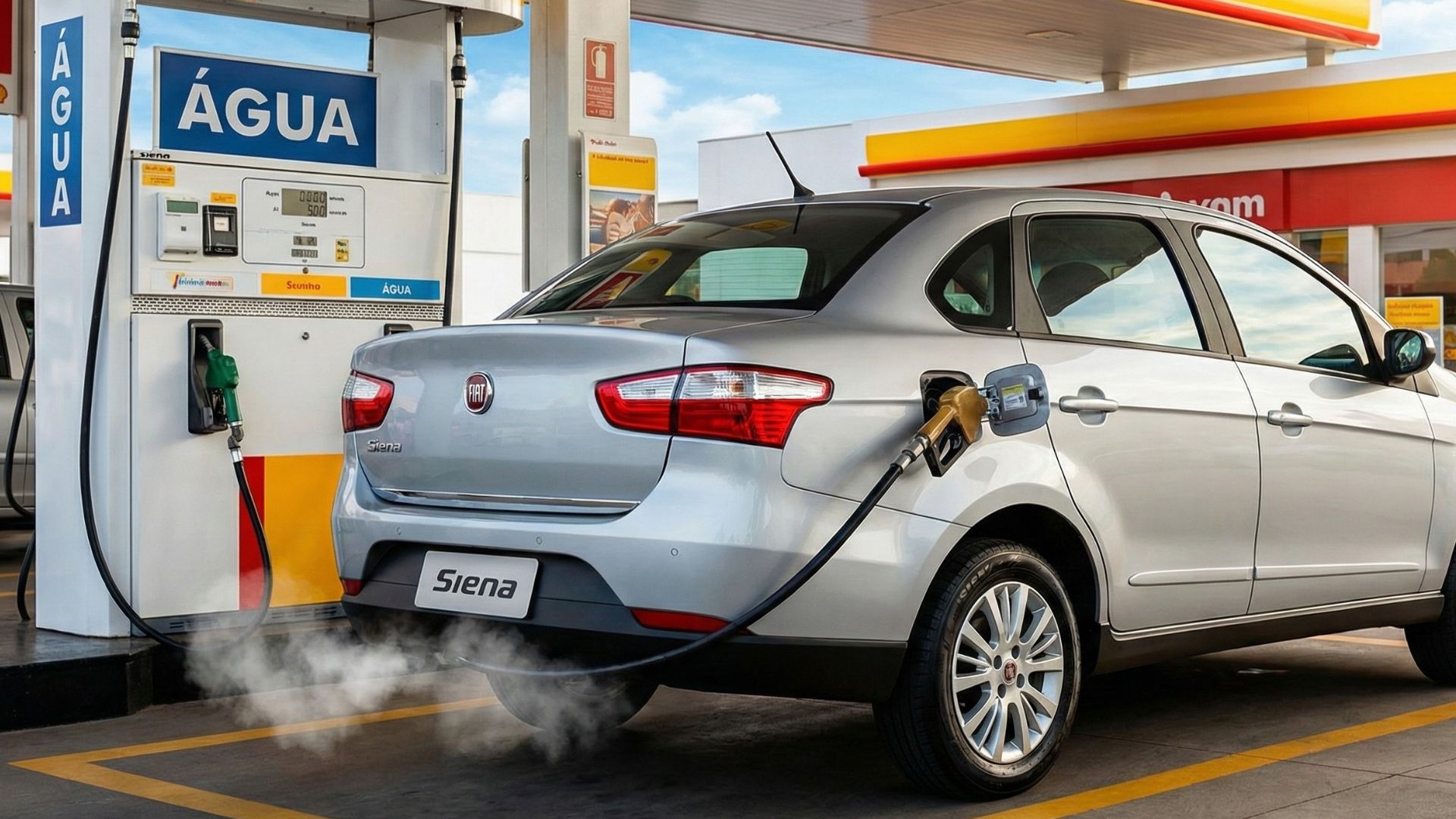


Brazilian Experiment Transforms Popular Sedan Into Mobile Laboratory, Using Hydrogen In Conventional Engine, Without Fuel Cell, With Pressurized Storage And Dedicated Electronic Management, Paving The Way For New Applications Of Clean Fuel In Existing Vehicles.
A Fiat Siena equipped with the original 1.4 Fire engine has been converted to burn hydrogen in an internal combustion engine and now operates as a research demonstrator in Rio Grande do Sul.
The project was developed under the University of Santa Maria (UFSM) and maintains the central mechanical set of the car, with changes focused on the storage, supply, and electronic management system of the fuel.
The expression “water-powered,” often used in headlines, is an analogy that helps popularize the subject but requires technical clarification. The vehicle does not fill up with water nor “draws energy” from it.
-
Less than a Tera TSI, up to 710 km of range and charging in 9 minutes: the new BYD Song Ultra expands the Chinese brand’s bet on increasingly faster, more technological, and competitively priced electric SUVs.

-
With a 1.0 engine producing 75 hp and costing less than R$ 70,000, Fiat’s car returns to the podium as the cheapest in the country; a temporary promotion for the 2026 Like version reduces the price of the Fiat Mobi.
-
With a mild hybrid system of 48 V, 176 hp and a price of R$ 175,990 in the Sahara version, the new Jeep Renegade changes mostly on the inside, improves slightly in fuel consumption, and remains almost the same car.
-
With a 293.5 cm³ engine and a range of up to 400 km with a 14.1-liter tank, the Honda CB 300F Twister 2026 has up to 24.7 hp, an initial price of R$ 25,150, and already exceeds R$ 29,000 in the Fipe Table.

What happens is that, in the combustion of hydrogen, the main product released in the exhaust is water in the form of vapor, which supports the popular association with the idea of a “water car.”
Hydrogen In Combustion Engine, Not In Electric Cell
A large portion of hydrogen vehicles known abroad uses a fuel cell, a technology in which the gas reacts with oxygen to generate electricity and power an electric motor.

In the Siena converted by the UFSM team, the logic is different and closer to traditional automotive engineering.
In this case, hydrogen enters directly as fuel in the combustion engine and replaces gasoline or ethanol during the combustion phase.
This choice changes the type of adaptation needed, as it dispenses with electric motors and batteries, concentrating work on ignition calibration, injection, and system safety.
Choice Of Siena Tetrafuel And Preservation Of Fire Engine
The starting point of the project was a Siena Tetrafuel, a version that came factory-equipped with a CNG kit.
Despite this, the experience with natural gas did not represent a technical shortcut.
According to the project description, no component of the original CNG system was reused in the conversion, as hydrogen imposes its own requirements for materials, sealing, connections, and control strategies.
Still, the team prioritized preserving the mechanical set whenever possible.
The engine did not need changes to the compression ratio or combustion chamber, remaining essentially the same internally.
The changes were concentrated in the fuel pathway to the engine and in the electronic control responsible for ensuring stable operation.
Academic Research And Institutional Support

The conversion was carried out by the Research Group on Engines, Fuels, and Emissions (GPMOT), linked to the Technology Center of UFSM.
The vehicle is part of a sequence of academic studies developed by the group over the past few years.
The most recent phase was associated with the undergraduate thesis of student Augusto Graziadei Folletto, from the Mechanical Engineering course, titled “Adaptation And Calibration Of An Internal Combustion Vehicle Using Hydrogen As Fuel.”
The development received support from funding institutions and companies that provided technical support for the project.
Hydrogen Storage At 150 Bar In The Trunk
Hydrogen is stored in a specific cylinder for this gas, as its molecule is small and can pass through materials suitable for other gaseous fuels.
In the UFSM demonstrator, storage occurs at 150 bar, a lower pressure than that used by fuel cell vehicles in other markets.
In the trunk, there are also the pressure regulator and the connections that lead the gas to the engine compartment.

For safety, the system includes solenoids that release the flow of hydrogen only when the ignition is on, reducing risks in case of shutdown or failure.
Programmable ECU And Specific Calibration For H₂
The stable operation required the use of a programmable ECU, responsible for adjusting injection and ignition timing to the specific characteristics of hydrogen.
In this type of conversion, electronic management ceases to be a secondary component and becomes the core of the project.
The fuel demands its own strategies for starting, dosing, and combustion control.
During the calibration phase, the car received additional instrumentation for data acquisition and analysis, including sensors in the intake and exhaust systems.
Part of this set was installed only for testing and validation.
The proposal is for the additional hardware to be removable after calibration is complete.
Power, Energy Density, And Technical Limitations
Hydrogen presents high energy per unit mass.
The challenge arises when the comparison is made in terms of volume, especially in systems that operate at lower pressures.
Professor Mario Martins, the work’s advisor, explains this point by comparing liquid and gaseous fuels:
“As the engine is a volumetric machine and hydrogen is admitted into the manifold at low pressure, the most relevant parameter is the volumetric energy density, which in the case of H₂ is very low. Under ambient conditions, it is around 0.01 MJ/L, while gasoline has about 32 MJ/L and ethanol approximately 21 MJ/L.”

“This characteristic imposes challenges to the project and results in a reduction of the original power, which can be mitigated with the use of appropriate supercharging technologies — which was not the focus of this initial project.”
In practice, the power loss is also observed in vehicles converted to CNG.
The main objective of the hydrogen Siena, at this stage, is to validate the technical feasibility of burning the gas in conventional engines.
Emissions And Care With The Zero Pollution Concept
The combustion of hydrogen does not produce carbon dioxide as a direct byproduct of the fuel.
According to the project material, the exhaust releases water or water vapor, with elimination of carbon monoxide and strong reduction of other harmful gases.
Still, in internal combustion engines, the presence of air in combustion can lead to the formation of nitrogen oxides, depending on temperature and calibration.
For this reason, the idea of “zero pollutants” requires technical contextualization.
In the case of the converted Siena, the project itself describes the emissions as virtually zero, within the objective of research and demonstration of viability.
Infrastructure Limits Use Outside Of The Research Environment

Even with the proof of concept operational, adoption outside the academic environment is hindered by the available infrastructure in the country.
The logistics of hydrogen production, storage, and distribution in Brazil is still in development.
There is difficulty finding refueling options at higher pressures and with national reach.
Therefore, the converted Siena continues operating as a mobile laboratory, restricted to testing and studies.
The project also serves as a basis for future research, including the possibility of converting more modern vehicles.
If infrastructure improves and hydrogen costs decrease, could the adaptation of conventional engines become a viable alternative for part of the Brazilian fleet?








Já existe carros movidos por hidrogênio no Brasil a muito tempo.estou aguardando condições para instalar no meu velho Renault scenic.
A depender das vantagens (incentivos do governo e, a curto prazo, economia com combustíveis), vale a pena até trocar de carro qdo o motor for para o espaço. No mais, tudo.de.bom q existe hj, passou por dificuldades e até apontamentos críticos, porém, com ajustes e aperfeiçoamentos ao longo do tempo, tornou-se viável. Pq q nos tempos de hj, onde diversas Tecnologias/Ciência estão avançadas (bem.diferente daquele Nômade…ou daquele querendo o Fogo…a Roda), não vai ser possível viabilizar o veículo a hidrogênio??
Em qq continente. É só questão de tempo!!
Tenho um colega que colocou um desses kits milagrosos onde a pessoa coloca água e roda pra ****. Só que depois de algumas centenas de km rodados ele teve de retificar o motor, porque esse sistema deixa um resíduo semelhante a lama e **** com o motor todo.