





 Portuguese
  English
  Spanish
  3 min of reading
  0 comments


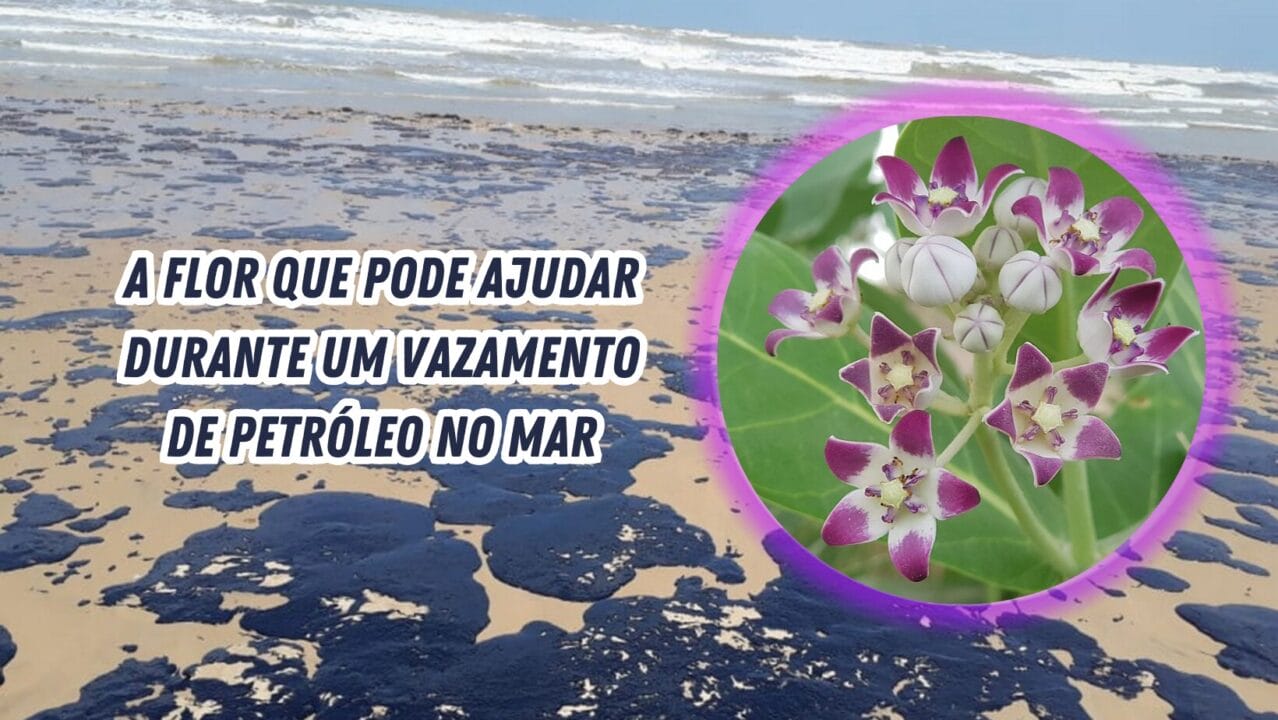
Calotropis procera, known as candle flower, emerges as a sustainable solution for oil spills in the Brazilian Northeast. Researchers reveal its absorption capacity, surpassing synthetic absorbents.
The Calotropis procera, also known by various common names including: candle flower, bombardeira, and saco-de-velho. According to some studies, this flower has stood out in the Brazilian environmental scenario as an effective solution to combat oil spills in the Northeast. Native to Africa and Asia, this plant arrived in Brazil in the 19th century and has since thrived, especially in the northeastern region.
Candle Flower: A Sustainable Alternative for Containing Oil Spills
A recent study conducted by Brazilian researchers revealed that the natural fiber of the candle flower has remarkable capacity to absorb oil.
According to the results, 1 gram of this fiber can remove 76 grams of oil, while the modified fiber can absorb over 180 grams, surpassing the efficiency of commercially available synthetic absorbents.
-
What if the Sun disappeared suddenly? Simulation shows Earth in darkness within minutes, extreme cold, and rapid collapse of life on the planet.

-
A 2,400-year-old iron foundry has been discovered in Senegal with 100 tons of slag, 35 furnace bases, and signs of nearly eight centuries of continuous metallurgical activity.

-
Four humans are flying towards the Moon inside the Orion capsule launched by the SLS rocket, and on April 6, Artemis II will disappear behind the far side of the Moon without communication with Earth for nearly an hour.

-
Worlds covered by water, atmospheres filled with hydrogen, and the possibility of life beyond Earth: ocean planets are rewriting the map of cosmic search and forcing scientists to rethink where to look.


Oil spills are considered serious environmental issues, threatening marine life by contaminating plankton and other organisms that make up the food chain.
Moreover, these spills can result in suffocation, poisoning, and loss of thermal insulation in animals of various species, making the environment toxic.
Brazil faced one of the worst episodes in September 2019, when extensive oil slicks hit the beaches of the Northeast.
Investigations at the time revealed that the spill was caused by a Greek tanker.
With limited technologies, local residents joined forces to clean the contaminated beaches.
Study Reveals the Capacity of Calotropis procera in Oil Absorption
In an article for the platform The Conversation, scientist Raoni Batista dos Anjos from the Federal University of Rio Grande do Norte (UFRN) highlighted some ways to remediate oil spills.
Among them: in-situ burning, bioremediation, and mechanical recovery, the latter exemplified by the candle flower plant.
Anjos emphasizes that mechanical recovery is the most common and effective technique for removing oil resulting from spills, without causing secondary pollution.
Currently, the focus is on developing oil absorbent materials based on plant fibers and agricultural waste.
In addition to the candle flower, corn husks, sumaúma fiber, rice husk, and sawdust have been considered biodegradable options that do not exacerbate environmental impact.
Studies on the candle flower, initiated with the doctoral thesis of researcher Larissa Sobral Hilário from UFRN in 2019, continue to advance.
A recent study published in the journal BioResources and led by scientist Raoni Batista dos Anjos describes an experiment in which the natural fiber was chemically modified, resulting in a remarkable ability to absorb oil.
The researchers advocate that the plant, abundant and easy to cultivate in Brazil, could be a viable option for the industrial-scale production of absorbents, with potential application in various oily substances.










Seja o primeiro a reagir!