





 Portuguese
  English
  Spanish
  3 min of reading
  1 comment





Do You Know the Gasifier? Discover the History of Wood-Powered Cars, Highlighting Their Crucial Role During Fuel Shortages in World War II and Examining Their Potential as a Sustainable Alternative in Contemporary Energy Challenges.
In an era where the search for alternative fuels is becoming increasingly urgent, the history of the gasifier, a system that allows vehicles to be powered by the gasification of wood, gains relevance. The wood-powered car, which reached its peak during World War II due to fuel rationing, may seem like a relic of the past, but its lessons are more relevant than ever.
How Does the Gasifier Work?


The gasifier is a device that converts wood into combustible gas through a process called pyrolysis. This system, made up of a cylinder where wood is burned and converted into gas, allows vehicles to be powered by a renewable energy source. Pyrolysis occurs at high temperatures, transforming organic matter into gas, rich in nitrogen and carbon monoxide, which is then filtered, cooled, and used to fuel the vehicle’s engine.
Advantages and Disadvantages
The main advantages of the gasifier include the use of wood, a renewable and easily accessible resource, and the low emission of pollutants compared to fossil fuels. However, the wood-powered car has significant disadvantages, such as the need for a large apparatus that increases the vehicle’s weight, the delay in starting operation, and the frequent maintenance required. Additionally, the low energy efficiency results in a power loss of approximately 30% due to the low calorific value of the produced gas.
-
With a 1.0 engine producing 75 hp and costing less than R$ 70,000, Fiat’s car returns to the podium as the cheapest in the country; a temporary promotion for the 2026 Like version reduces the price of the Fiat Mobi.
-
With a mild hybrid system of 48 V, 176 hp and a price of R$ 175,990 in the Sahara version, the new Jeep Renegade changes mostly on the inside, improves slightly in fuel consumption, and remains almost the same car.
-
With a 293.5 cm³ engine and a range of up to 400 km with a 14.1-liter tank, the Honda CB 300F Twister 2026 has up to 24.7 hp, an initial price of R$ 25,150, and already exceeds R$ 29,000 in the Fipe Table.

-
With a 1.3 engine, nearly 700 km of range, and Turbo 200, the Fiat model surpasses Polo, Tera HB20, and Onix, becoming the best-selling car in March; see the numbers for the Fiat Strada and others.

The Historical Popularity of the Wood-Powered Car
The gasifier was not just a temporary solution to fuel shortages during the war. In Brazil, for example, President Getúlio Vargas encouraged its adoption through the establishment of the National Gasifier Commission. Companies like Ford, General Motors, and other local firms adapted to produce and install these systems. The technology also became popular in tractors, trucks, buses, and even trains.
With the end of rationing and the return of conventional fuel availability, the use of gasifiers significantly declined. However, the oil crises of the 1970s and 1980s rekindled interest in this alternative technology, demonstrating its viability during times of scarcity.
Although the gasifier seems like a solution of the past, its history highlights the importance of innovation and the search for alternatives to fossil fuels. At a time when sustainability is becoming increasingly critical, revisiting and learning from technologies like the gasifier can inspire new solutions for today’s energy challenges. The journey of the wood-powered car reminds us that sometimes the answers for the future can be found in the past.
But Who Came Up with the Idea of Creating the Wood-Powered Car?
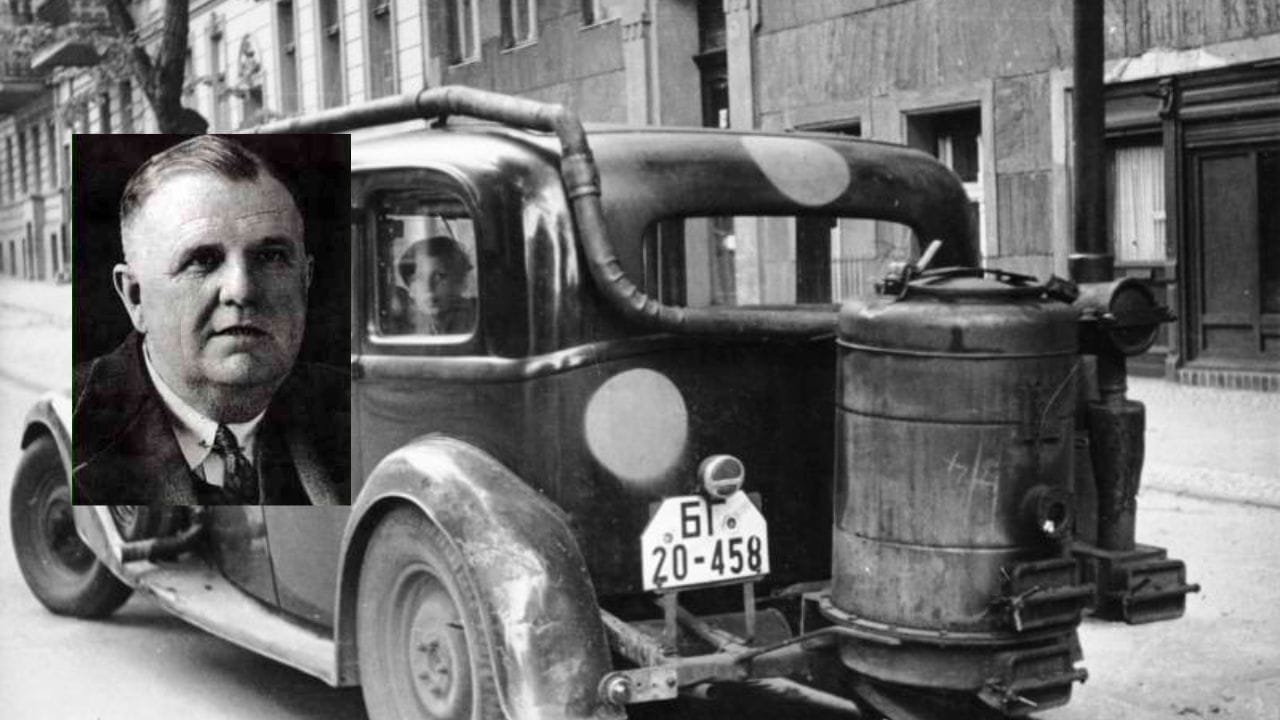
The invention of the gasifier, a milestone in the history of alternative fuels, has its roots in France, with two notable figures contributing to its development. Georges Imbert, a visionary inventor, created the “Imbert gasifier” around 1920, an innovation that stood out for its efficiency in producing gas from wood. Later, in 1936, Louis Libault patented the charcoal gasifier “Gazauto”, expanding the possibilities of using this technology. These contributions were fundamental to the advancement of alternative fuel systems and marked the beginning of an era of exploring the potential of gasifiers.
Gasifier fuel, also known as syngas, is primarily composed of carbon monoxide and hydrogen. Its production can be achieved through various methods, including steam reforming of natural gas or liquid hydrocarbons to generate hydrogen, coal gasification, and biomass. This versatility makes the gasifier a promising alternative to fossil fuels, especially in scenarios where sustainability and energy renewal are priorities.
The history and production methods of the gasifier illustrate not only human ingenuity in seeking alternative energy solutions but also the importance of continuing to explore and refine technologies that can lead us to a more sustainable future. The inventions of Imbert and Libault, although developed in a specific historical context, remain relevant as an inspiration for the continuous development of systems for renewable and less polluting energy.









Bring back the hasten!/ sarcasm
This might have been useful in severe shortages but now the idea is too stupid for words. Use gasoline or diesel.