





 Portuguese
  English
  Spanish
  10 min of reading
  0 comments


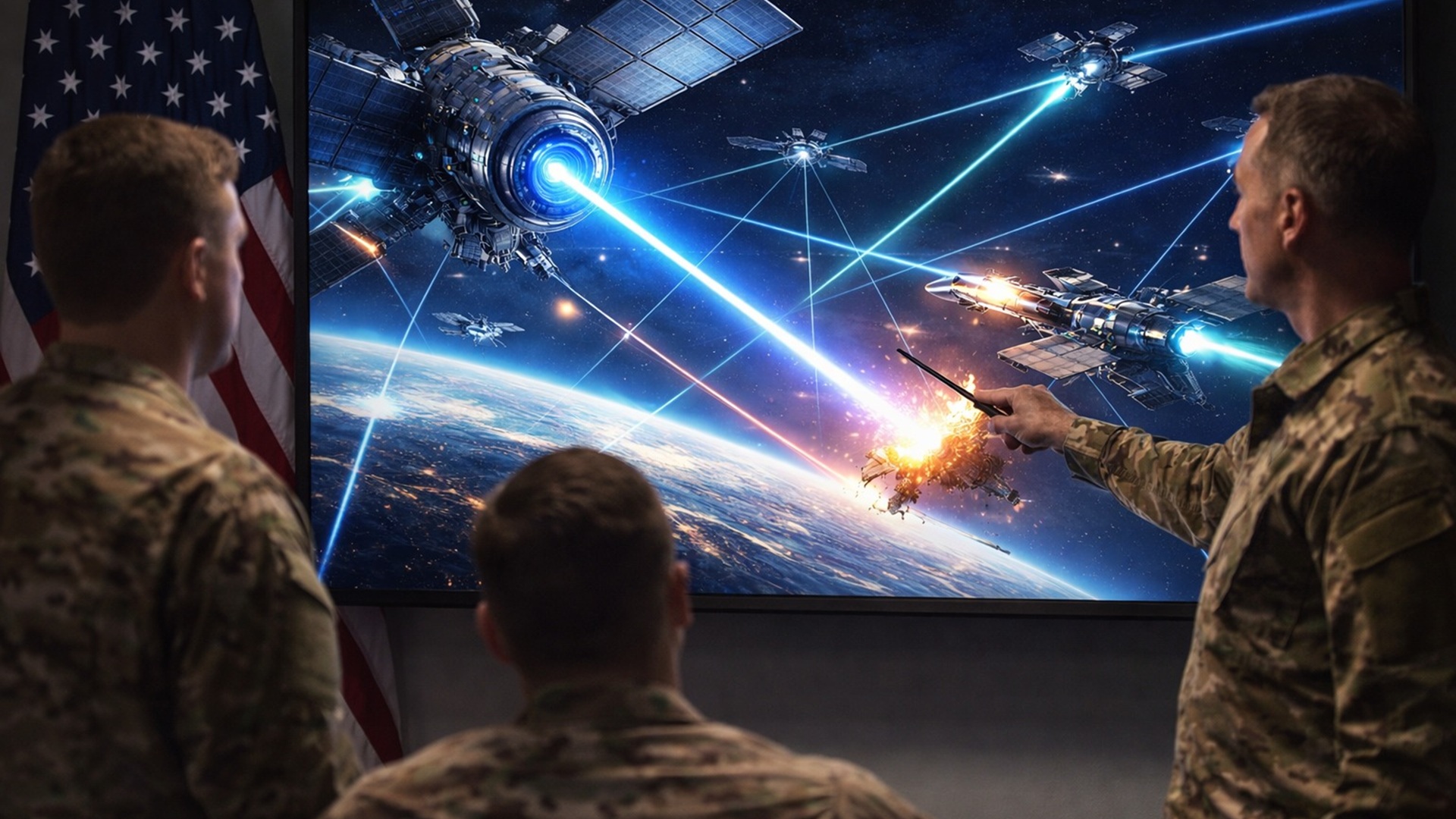
Announced in 1983 by Ronald Reagan, the Strategic Defense Initiative foresaw a space-based missile defense shield, with satellites armed with lasers, beams of particles and orbital sensors, projected costs above US$ 1 trillion and strong impact on the strategic balance of the Cold War.
Forty-three years after the March 1983 speech, the Strategic Defense Initiative marked relations between the U.S. and the Soviet Union by proposing space-based missile defenses, influencing nuclear negotiations, straining the ABM Treaty and shaping the debate on militarization of space during and after the Cold War.
This year marks the 40th anniversary of President Ronald Reagan’s unexpected call for scientists in the United States to use their talents to develop a capability that would make nuclear weapons “impotent and obsolete.” The statement, made in March 1983, placed outer space at the center of the global strategic debate.
Less than a year after the speech, the White House formally established the Strategic Defense Initiative, known by the pejorative nickname “Star Wars.” The program was designed to research a wide range of advanced technologies aimed at ground and space missile defense.
-
Scientists have finally discovered where the plastic that disappeared from the oceans went, and the answer is frightening: it fragmented into such tiny particles that they became invisible and now there are 27 million tons of nanoplastic just in the North Atlantic.

-
The Artemis II mission will take the Orion capsule back to the vicinity of the Moon with four astronauts, a private bathroom with a curtain, a system adapted for men and women, and a level of comfort that highlights how the Apollo era operated at the rawest limits of space exploration.

-
Giant structures on the seabed precisely control oil and reveal how high-tech underwater valves work.

-
China has just tested a giant drone the size of a fighter jet with a wingspan of 25 meters that carries 6 tons, flies for 12 hours, and the most frightening part: it can launch entire swarms of smaller drones directly from the air.


Since the initial announcement, the very idea of a missile defense system generated immediate international controversy. Experts questioned the technical feasibility of the project and debated its effects on the strategic balance between the nuclear superpowers of the time.
Beyond technical doubts, the Strategic Defense Initiative exacerbated fears related to the intensification of the arms race in space. The program came to be seen as a catalyst for new military disputes in a domain that had previously been regulated by fragile agreements.
With the progressive opening of thousands of documents in the United States, Western Europe, and the former Soviet Union, it became possible to examine more precisely the origins of the SDI and its evolution during the last years of the Cold War.
Historical analysis indicates that, in fundamental aspects, the SDI emerged from the intensification of the militarization of space that began in the 1970s. During this period, space was no longer treated as an isolated environment for strategic disputes.
Although it was never fully implemented, the prospect of space-based missile defense became, in the 1980s, one of the main obstacles to the advancement of dialogue on strategic arms control between Washington and Moscow.
Four decades later, the Strategic Defense Initiative continues to influence debates on international strategic stability. Its legacy is identified as a central part of the genealogy of current concerns over growing insecurity in outer space.
Not A Sanctuary
In the decade prior to the creation of the SDI, the United States and the Soviet Union were already promoting significant changes in how to use space for military purposes. The commitment to the “peaceful use of outer space” coexisted with reconnaissance, communications, and early warning nuclear activities.
During the period of détente in the 1970s, space technologies played an important role in verifying arms control treaties. At the same time, they symbolized an attempt at cooperation between Moscow and Washington.
In 1972, Soviet Prime Minister Alexei Kosygin and American President Richard Nixon signed a space cooperation agreement. This process culminated in 1975 with the Apollo-Soyuz joint mission.
The meeting between astronauts and cosmonauts after the docking of the spacecraft was meant to represent the pinnacle of détente. However, less than a year later, the Soviet Union resumed testing antisatellite weapons systems.
Meanwhile, both countries began to integrate satellites more deeply into military operations, including for precise targeting of targets. This evolution reduced the separation between civil and military uses of space.
In light of this scenario, a special panel commissioned by President Gerald Ford concluded that treating space as a sanctuary was neither viable nor verifiable. The assessment influenced subsequent strategic decisions.
In the last 48 hours of his term, Ford approved a new U.S. antisatellite weapons program. The decision consolidated the perception that space would be an integral part of future military disputes.
Upon taking office, Jimmy Carter attempted to curb a space arms race. He advocated for the inclusion of limitations on antisatellite systems in ongoing arms control negotiations.
Between 1978 and 1979, Soviet and American representatives held several rounds of negotiations aimed at this goal. Conceptual divergences over what should be restricted prevented concrete progress.
These differences made it impossible to include limits on antisatellite weapons in the second Strategic Arms Limitation Treaty, signed in June 1979. The political context worsened months later.
The Soviet invasion of Afghanistan in December 1979 paralyzed progress on arms control. Even before Reagan took office, strategic competition in space was already intensifying.
Gaining The High Ground
After taking office, Ronald Reagan began to highlight space technologies as a central element of the United States’ national strategy. His administration argued that space projects would strengthen American international prestige and military power.
Unlike previous administrations, Reagan explicitly emphasized the military role of space activities. The first space policy of his administration, unveiled in 1982, reflected this approach.
The document advocated for the rapid deployment of an antisatellite weapon capability to deter threats to the space systems of the United States and its allies. The language indicated a clear change in posture.
During the early years of his term, Reagan increasingly viewed space as a domain of direct military competition. Internal studies reinforced this perception.
A report initiated in December 1982 started with the premise that the Soviet Union sought to gain a strategic advantage in space. This assessment influenced subsequent presidential decisions.
After receiving intelligence reports on Soviet military space research, Reagan recorded in his diary his conviction that Moscow sought military superiority in this domain.
In this context, the prospects for space arms control became increasingly limited. Key officials in the Reagan administration exhibited skepticism about the effectiveness of arms control agreements.
The president was critical of the 1972 Anti-Ballistic Missile Treaty, which, in his view, restricted American technological advances. This criticism shaped the approach to strategic defense.
In the case of antisatellite weapons, Pentagon officials argued that a control agreement would be impossible to verify. Even so, the topic remained peripheral until 1983.
Issues such as intermediate-range nuclear forces and the possible deployment of Pershing II missiles in Europe dominated the strategic debate between the superpowers during this period.
The March 1983 speech altered this balance. By calling on scientists to make nuclear weapons obsolete, Reagan placed space and strategic defense at the center of international relations.
Although the SDI was not formally established until January 1984, the nearly year-long interval was marked by intense diplomatic mobilization. The initiative became a central theme among transatlantic allies.
Days after the speech, Soviet leader Yuri Andropov accused the United States of seeking first-strike capability and militarizing outer space.
Andropov, however, overlooked that space was already widely used for military purposes. Nevertheless, his statements reflected the degree of Soviet concern.
In the summer of 1983, the Soviet Union became more openly supportive of space arms control. Andropov announced a moratorium on antisatellite weapons testing.
He also expressed interest in dismantling existing antisatellite systems, a position that contrasted with the Soviet stance at the end of the 1970s.
Western European authorities publicly supported the idea of an antisatellite arms control agreement. The support reflected regional concerns about strategic escalation.
The Soviet interest in limiting antisatellite weapons was linked to the technological relationship between these systems and missile defense. Many capabilities were considered indistinguishable.
The Reagan administration concluded that Moscow intended to use antisatellite arms control to limit the development of the SDI. This perception influenced the American posture in the negotiations.
The Nuclear And Space Negotiations
In January 1985, the United States and the Soviet Union agreed to establish three negotiation forums on strategic nuclear weapons, intermediate-range forces, and space and defensive armaments.
These negotiations, known as the Nuclear and Space Talks, arose amid expectations of a resumption of dialogue on arms control.
The process was immediately impacted by the death of Soviet leader Konstantin Chernenko in March 1985, one day before the formal start of negotiations.
Shortly thereafter, Mikhail Gorbachev took leadership of the Soviet Union at a critical moment in relations between the superpowers.
The Strategic Defense Initiative remained at the center of discussions. Soviet experts assessed the feasibility of the program and concluded that an infallible defense was not possible.
Despite this, Soviet authorities remained concerned about the technological implications of the SDI. Advanced software and space sensors could amplify military disparities.
Analysts in the Kremlin feared that even a partial defense would undermine the credibility of Soviet nuclear deterrence. The diversity of internal opinions increased uncertainty.
The ABM Treaty became the central focus of disputes, as testing and space deployments would violate its limits. This impasse reached its peak at the Reykjavik summit in 1986.
In private meetings, Reagan stated that the SDI was strictly defensive and promised to share its benefits with the Soviet Union. Gorbachev expressed skepticism.
The Soviet distrust was based on the lack of sharing of civilian technologies between countries. The American promise was considered not credible.
Despite this, the leaders discussed the elimination of all nuclear weapons, conditioned on limiting the SDI to the laboratory. Reagan’s refusal prevented a final agreement.
Even without an agreement, the Reykjavik summit was considered a significant step toward improving bilateral relations. The dialogue opened the way for subsequent understandings.
After Reykjavik, the Politburo requested acceleration in the development of countermeasures against strategic defense systems. The response included antisatellite weapons and faster missiles.
In February 1987, Gorbachev decided to unlink the SDI from negotiations on intermediate-range forces. The decision had economic and technical motivations.
Asymmetrical countermeasures were seen as viable and less costly solutions if the United States advanced in strategic defense. This assessment reduced the immediate pressure from the SDI.
The unlinking allowed the signing of the INF Treaty in December 1987, eliminating an entire class of American and Soviet land-based missiles.
Still, the SDI remained a point of contention in strategic arms negotiations. Reagan attempted to advance proposals for limited space testing.
Gorbachev rejected these proposals, maintaining concerns about the impact of the SDI on nuclear deterrence and technological disparity. No START agreement occurred during the Reagan administration.
The Strategic Defense Initiative After The Cold War
With the inauguration of George H.W. Bush, the geopolitical context changed significantly. The diminished Soviet threat made justifying billion-dollar investments in the SDI more difficult.
By the late 1980s, program managers proposed the Brilliant Pebbles concept, based on individual interceptors with their own sensors.
The new concept sought greater resistance to antisatellite attacks but still required revisions to the ABM Treaty. Technical feasibility remained uncertain.
In September 1989, the Soviet Union abandoned the requirement for prior agreement on the SDI before progress on the START Treaty. This reduced the SDI’s role as an obstacle.
Despite Soviet reservations, the SDI ceased to block nuclear reductions. The end of the Cold War altered strategic priorities on both sides.
Supporters of the program began to justify missile defense based on the proliferation of missiles by hostile states. A scaled-down version was proposed.
Between 1990 and 1992, three tests of the Brilliant Pebbles system were conducted, all deemed failures to varying degrees. The credibility of the concept was shaken.
There was bipartisan support for limited ground-based missile defenses, but space-based interceptors were seen as technologically immature and politically risky.
With Bill Clinton’s inauguration in 1993, space-based interceptors were abandoned. Funding for Brilliant Pebbles was cut, ending the program.
Just over a decade after its establishment, the Strategic Defense Initiative was deactivated. The focus shifted to ground-based national missile defense.
The Legacy Of The SDI
George W. Bush re-established missile defense as a strategic priority and withdrew the United States from the ABM Treaty in 2002, thirty years after it came into force.
He created the Missile Defense Agency, the institutional successor to the organization that managed the SDI. The international context, however, limited space advancements.
Currently, U.S. missile defense is based on land and sea interceptors, with space sensors for threat detection.
The increase in counter-space capabilities led the Department of Defense to advocate for a greater number of tracking systems in orbit, aiming for greater resilience.
This concept harks back to plans developed under the SDI in the late 1980s. In a reduced form, elements of the initiative continue to influence current policies.
The specter of the SDI remains in the international dialogue about space security. Concerns about an arms race in space, involving multiple actors, are growing.
The technological connection between missile defense and antisatellite weapons remains a central issue. The proliferation of one implies advancement of the other.
Recent tests of antisatellite weapons, derived from missile defense programs, illustrate this interdependence. The conceptual separation remains unfeasible.
For China and Russia, the memory of the SDI shapes perceptions of the United States’ space strategy. The program is frequently cited in military analyses of these countries.
The lack of progress in space arms control in the 1980s eliminated the chance to establish regulatory precedents. This void persists to this day.
The current space environment is more complex, with a greater number of governmental and commercial actors. Unresolved issues from the SDI era continue to influence contemporary debates, revealing how decisions made forty years ago continue to impact global space security, even with occasional typographical errors like strategia or implnatação appearing in historical records.










-

-

-

-

12 pessoas reagiram a isso.