





 Portuguese
  English
  Spanish
  3 min of reading
  3 comments


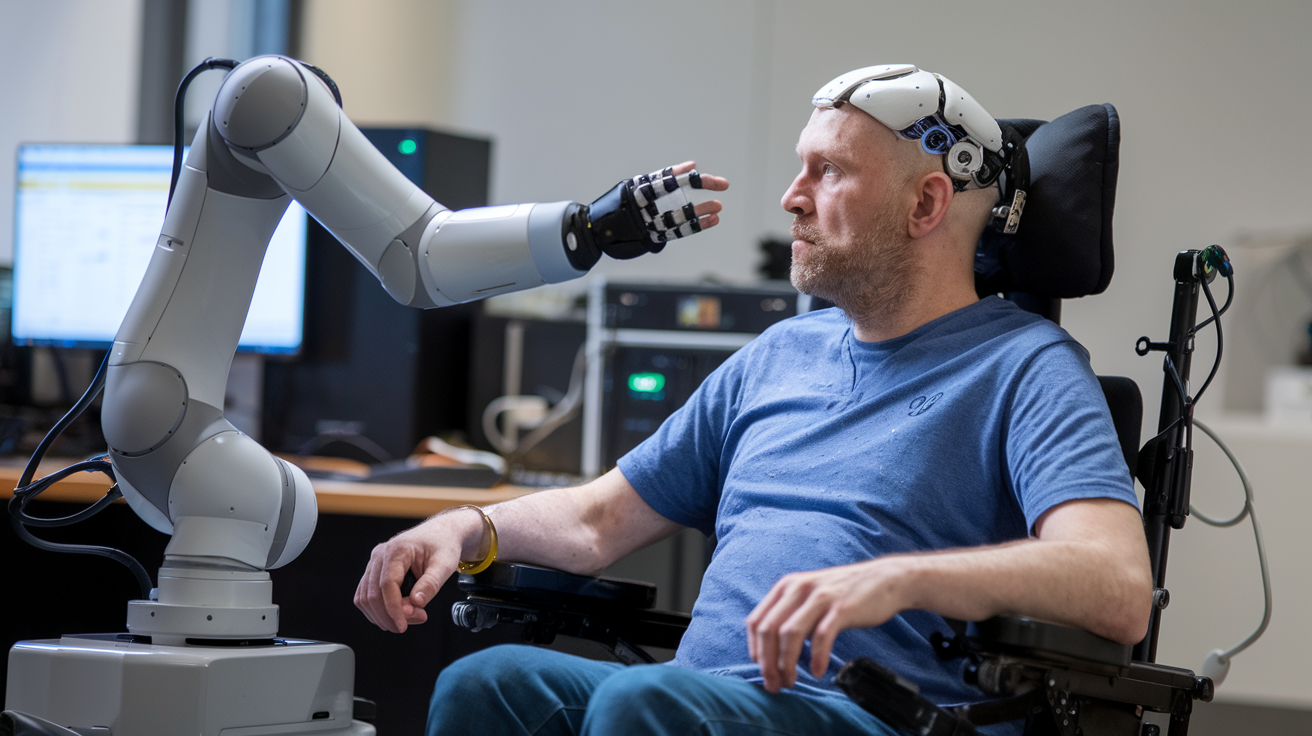


Man With Paralysis Achieves Historic Feat That Could Revolutionize the Use of Artificial Intelligence in Medicine. Study Participant Moves Robotic Arm Just by Thinking.
Researchers at the University of California, San Francisco (UCSF) created a brain-computer interface that enabled a man with paralysis to control a robotic arm using only his thoughts, changing the course of Artificial Intelligence in medicine. The thought-controlled robotic arm, which operated for a record 7 months without the need for adjustments, represents a significant advancement in a technology that previously required daily or bi-daily recalibration.
Artificial Intelligence in Medicine
The participant using the thought-controlled robotic arm, who became paralyzed after a stroke years ago and cannot speak or move, received small sensors implanted on the surface of his brain.
The sensors with Artificial Intelligence capture brain activity when he imagines performing specific movements. Through this system, the man with paralysis was able to grasp, release, and move objects simply by imagining executing those actions.
-
They were brilliant! Scientists discover that our ancestors in China were already making super advanced tools 160,000 years ago, changing everything we knew.

-
Scientists unveil 3 million years of climate secrets hidden in the ice of Antarctica.

-
Ancient farmers created “aggressive plants” that changed nature forever.

-
Astronomers find a “backward” solar system that ignores all the rules of space and leaves scientists scratching their heads!


The secret to success was discovering how brain activity changes daily as a person repeats a movement in their mind and learns to perform it more refined.
According to Dr. Karunesh Ganguly, a neurologist and professor at UCSF, this combination of human learning and artificial intelligence in medicine uses an AI model programmed to adjust to the small changes that occur in the brain as the user refines their imagined movements.
The research team found that although the brain patterns maintain their general form, their locations shift slightly each day. The variation explains why other similar devices quickly lost the ability to recognize brain commands.
Understand How the Test for Thought-Controlled Robotic Arm Works
To train the man with paralysis, the scientists had him practice with a virtual robotic arm that provided feedback on the accuracy of his visualizations. After mastering the virtual control, he transferred those skills to the real world in just a few practice sessions.
The participant was able to move the thought-controlled robotic arm to pick up blocks, rotate them, and move them to new locations.
It was even possible to open a cabinet, retrieving a cup and positioning it under a water dispenser, demonstrating a significant advancement in Artificial Intelligence in medicine. Months later, the man with paralysis could still move the thought-controlled robotic arm after a quick 15-minute recalibration to adjust to changes in brain representations since he started using the device.
The university team continues to improve the models of Artificial Intelligence in medicine to make the movements of the thought-controlled robotic arm faster and smoother, as well as planning tests in a home environment.
For people with paralysis, the ability to feed or drink independently would represent a significant change in their quality of life. The study, funded by the National Institutes of Health (NIH) and the UCSF Weill Institute for Neurosciences, was published in the scientific journal Cell on March 6, 2025.
About UCSF
The University of California, San Francisco (UCSF) is solely focused on health sciences and aims to promote health worldwide through advanced biomedical research, graduate education in life sciences and health professions, and excellence in patient care.
UCSF Health, which serves as the primary academic medical center of UCSF, includes leading specialized hospitals and other clinical programs, and has affiliations throughout the Bay Area.









Só faltou dar o devido crédito ao trabalho pioneiro do professor Nicolelis:
Miguel Nicolelis foi esquecido na matéria, sabe porquê? É brasileiro e é pioneiro no binômio interface cérebro. Como somos provincianos, mesmo quando não somos.
Falta apoio aqui no Brasil na área da Biomedicina científica. Poucos sabem , mas a Biomedicina que é a verdadeira responsável pelos estudos e criação dessas tecnologias avançadas