





 Português
  Inglês
  Espanhol
  9 min de leitura
  0 comentários


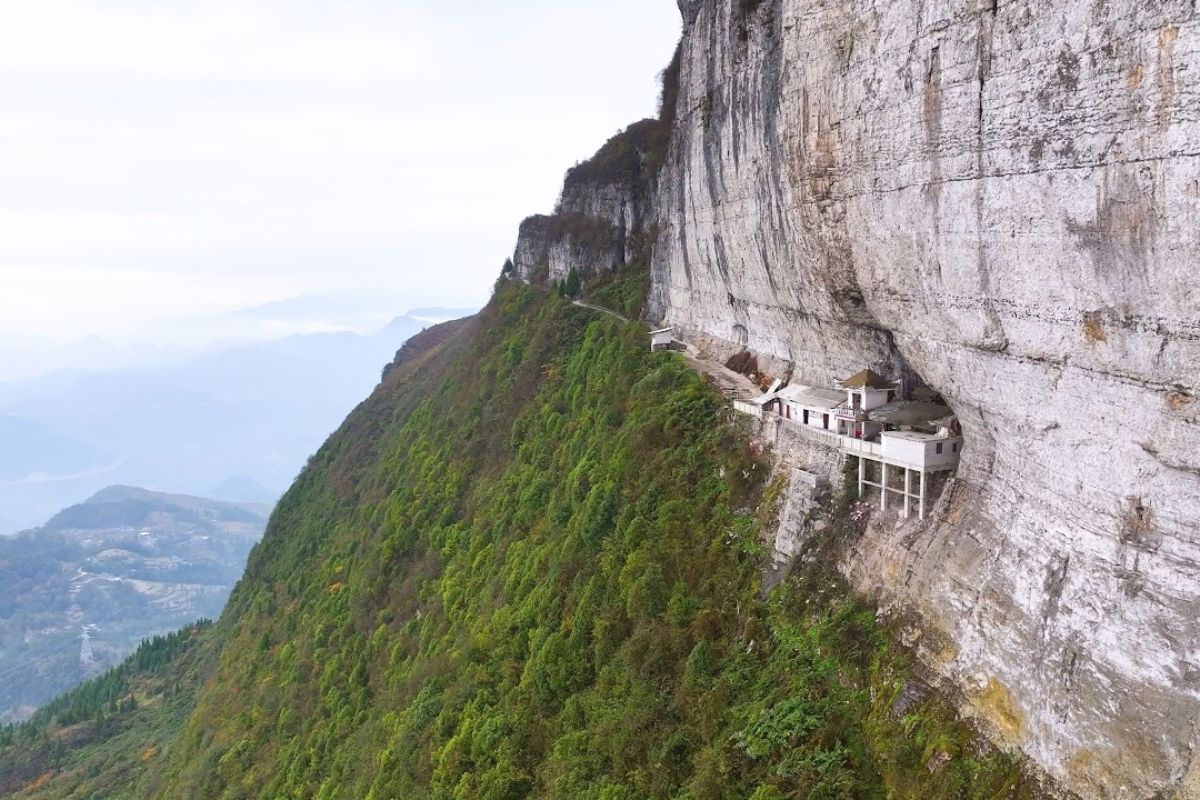
74-Year-Old Man Maintains A Temple Carved Into A Remote Cliff Over 1,800 Meters Above Sea Level In Guizhou, Living Reclusively, Self-Sufficient And Supported By Donations From Devotees Spread Across The Country
Living alone in a temple carved into a remote cliff, with no neighbors, no roads, no nearby commerce, and difficult access even for those in good physical shape, seems more like a movie script than a daily reality. In Guizhou, deep in the Tianlou Mountain, this scenario is the permanent address of a 74-year-old man who, for over three decades, has chosen to dedicate his life to caring for a religious complex hanging on the slope, where almost everything relies exclusively on his own hands.
There, faith takes the place of infrastructure. There is no conventional electricity, access is via a narrow and steep mountain road, and the cliff drops dozens of meters down to the valley. Still, visitors keep climbing to find the elder, to give thanks, ask for blessings, or simply see up close how someone manages to turn a hermitage into a routine. And every day, he wakes up, sweeps, prays, cooks, carries firewood, and receives visitors, as if each presence were part of the silent agreement that keeps the temple alive.
A Temple Carved Into The Cliff, On The Margins Of The World

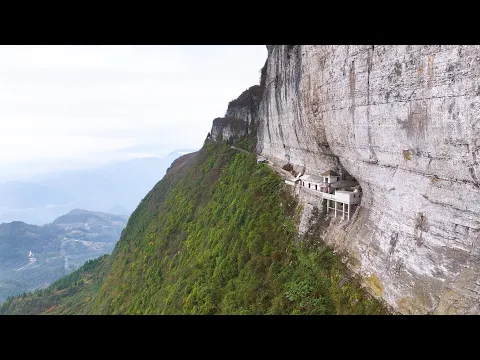
The complex known as Silver Buddha Temple is literally nestled into the rock, a temple carved into a remote cliff, in front of a drop so deep that just looking down creates a sense of emptiness. The complex faces the valley, surrounded by cliffs, low clouds, and, on clear days, a view of villages spread along the slopes and, in the distance, the county seat of Zheng’an.
-
With an unusual prize, Japan transforms office chairs into a resistance race on the streets, ISU-1 Grand Prix grows, fills stages, and pays 90 kilograms of rice.

-
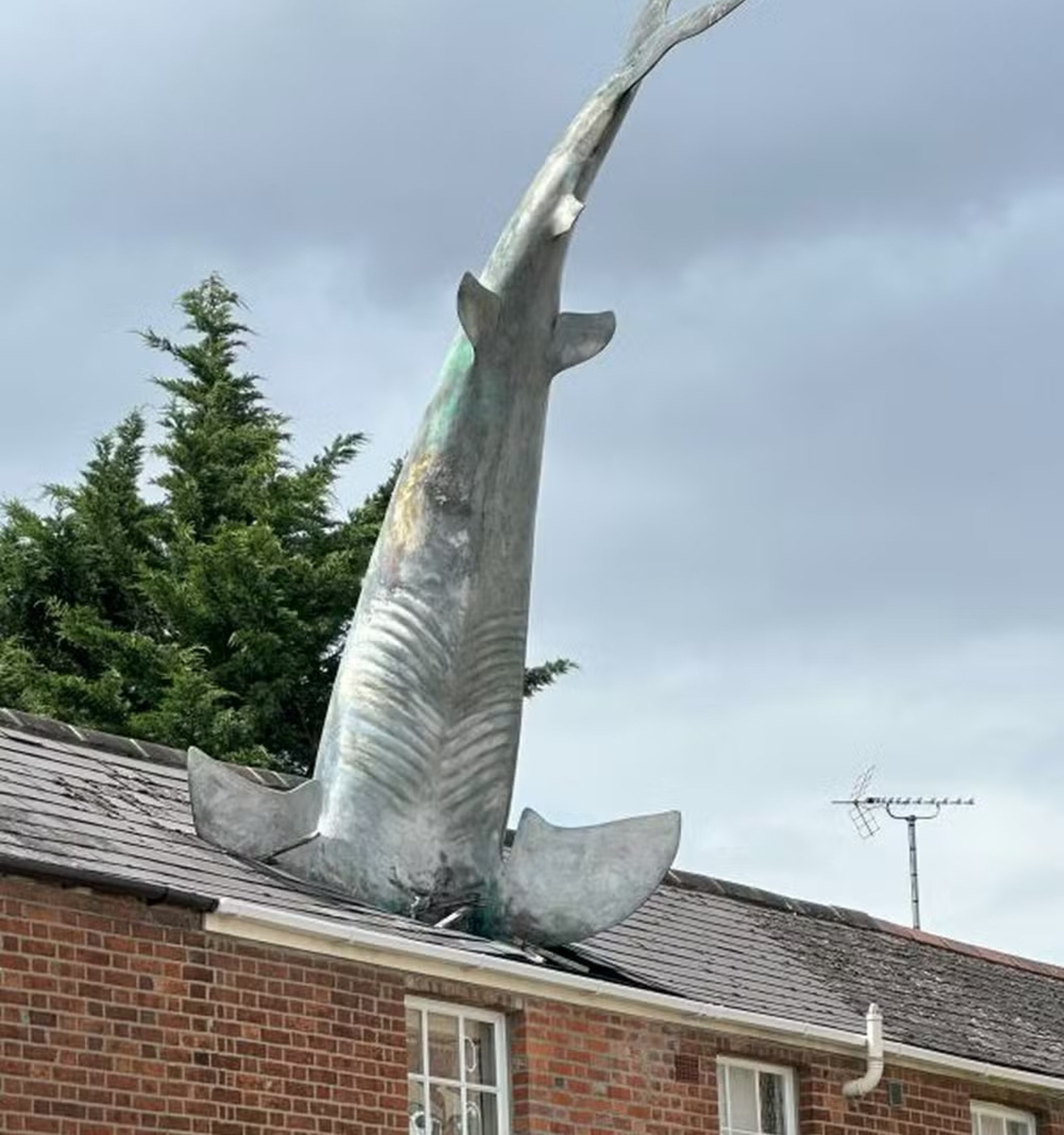
House in England with a 7.6-meter shark embedded in the roof attracts attention worldwide and becomes a curious attraction in Oxford.
-
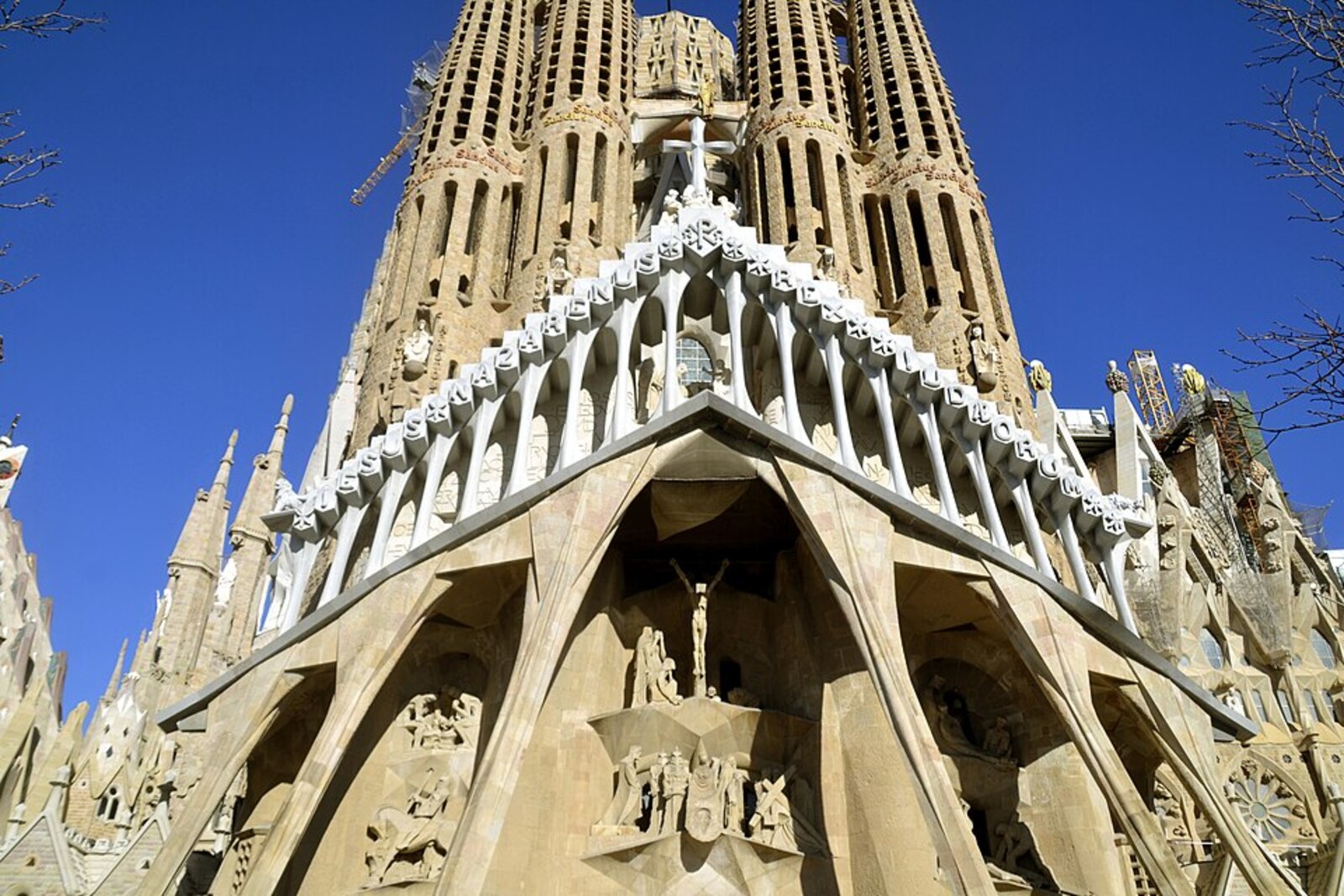
Masterpiece in Spain, under construction since 1882, receives 4.8 million visits in a year and impresses with its gigantism and architecture.
-
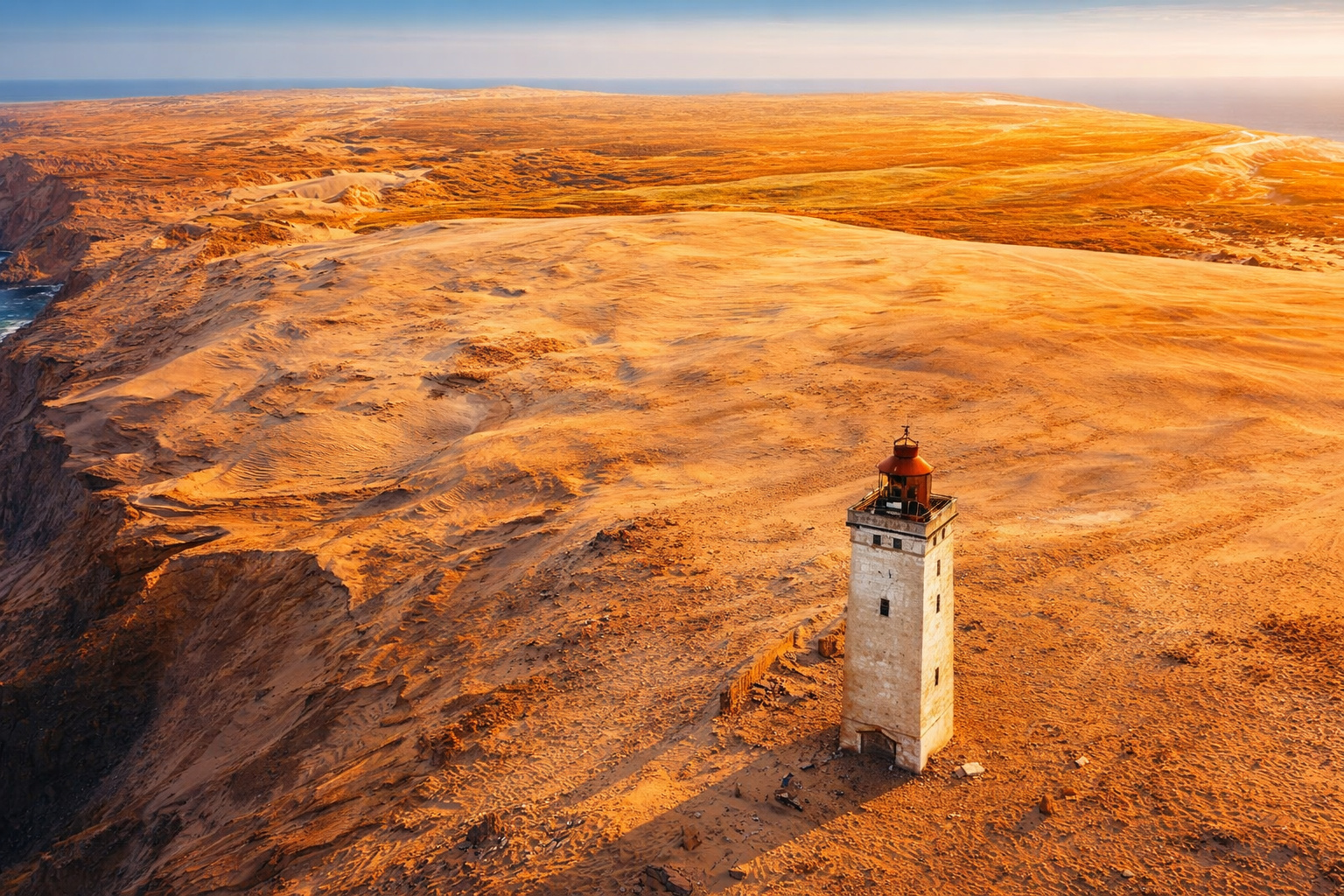
Attracting around 250,000 people a year, a lighthouse 200 meters from the sea, on a 60-meter high cliff, on the North Sea coast in Denmark, becomes one of the most impressive examples of how nature can threaten historical buildings.

The altitude exceeds 1,800 meters, with strong winds and intense cold in winter. The position on the cliff is not only scenic but strategic: according to the elder himself, a temple existed there since the time of Emperor Kangxi, during the Qing Dynasty, when a practitioner surnamed Liang chose that very rock wall to dedicate herself to a religious life. Over time, the wooden structures were replaced, renovated, demolished, and rebuilt, but the location remains the same: a protrusion on the cliff, hard to reach and easy to defend.
Today, part of the complex has been modernized with concrete, new roofs, and structural reinforcements, but there are still elements that denote the ancientness of the site, such as merit monuments with inscriptions from the 19th century and remnants of old walls reused as door frames. It is a living temple on the remnants of an even older temple, in a constant play between ruin and preservation.
Access: Hours Of Climbing, Few Missteps

Reaching the temple carved into a remote cliff is not a trivial outing. There are two main routes: a long ascent via mountain trails, which can take two to three hours, and an approach from the upper part, following a rough road and cliff sections with limited protection.
The elder recalls that, in the past, the trail barely accommodated one foot at a time. In 2011, after years of living with the risk, he decided to widen and consolidate the path. More than 200 explosive charges were used to open the passage in the rock, followed by an exhausting manual transport work of materials: cement, bricks, and other supplies were carried on backs, in trips of about two hours each, with a maximum capacity of two pieces at a time, which was around 40 kilos per load.
Today, part of the trail near the temple is hardened and equipped with handrails funded by donations from devotees and visitors, which reduces immediate risk but does not eliminate difficulty. The access road for vehicles remains precarious, with unpaved, steep, and narrow segments. Even so, the flow of people has increased: devotees from Zunyi, Guiyang, Zheng’an, and even from other provinces climb up to burn incense, make offerings, and meet the old guardian.
Solitary Routine: Faith, Firewood, And Self-Sufficiency

Daily life in the temple carved into a remote cliff is essentially an exercise in self-sufficiency. At 74, the man lives alone at the top of the mountain. He sleeps in a simple room next to the worship halls, cooks on a wood-fired stove that he cuts and stores himself, washes his own clothes, and keeps the entire complex clean, from guest rooms to common areas.
The stack of firewood piled under the cliff is also an indicator of planning: winter in Guizhou is harsh, and without electric heating, survival depends on the wood accumulated before the cold arrives. The elder chops firewood at the top of the mountain, selects, cuts, and organizes everything, planning to have enough fuel to get through the harshest seasons.
In the kitchen, the diet is simple. Rice, noodles, and vegetables come from residents and devotees who climb up to offer food. Fresh tofu, cabbage, peppers, radishes, and pumpkins arrive in periodic shipments, complemented by preserves that can be stored longer. He naturally states that he cannot consume everything he receives, revealing a discreet network of solidarity around the temple.
Water, Light, And Minimal Infrastructure

If there’s one thing that has radically changed life on the mountain top, it is running water and solar energy. For many years, the elder had to enter a nearby cave, fetch water directly from the spring, and carry buckets to the temple. Today, a piping system conducts water to a reservoir built next to the religious buildings, ensuring a constant supply for consumption, hygiene, and cooking.
Electricity did not come from the public grid, but from solar panels installed in 2021 by volunteers from Chongqing. The system is limited, dependent on sun exposure and winter with low light, but sufficient for what he considers essential: charging his phone and powering some basic lighting. There are no heavy appliances, electric heaters, or high-consumption equipment. Firewood remains the energy core of life on the cliff.
In addition to the larger panels on the roof, there are smaller modules designated only for phone charging, including the basic device of the guardian himself, which previously had to be taken weekly to the city for charging. This has made communication with the outside world simpler, without altering the isolated nature of the place.
The Temple Halls And The Continuation Of A Tradition

The complex today includes the Great Buddha Hall, the Guan Sheng Temple, the Jade Emperor Palace, the Medicine King Palace, the Guanyin Hall, and rooms for pilgrims. The images of Sakyamuni Buddha, Namo Amitabha, Guan Gong, Skanda, and Guanyin have been installed over the years based on donations and the work of artisans who produce the pieces outside the major urban temple circuits.
It is a modest but functional set. Unlike the opulent urban temples, here the altar shares space with backpacks, shoulder poles, simple tables, and everyday utensils. The elder himself explains that, in the eyes of Buddha, the images are merely symbolic incarnations; what truly matters is the sincerity of those who come to light incense or make a prayer.
In addition to its religious function, the temple preserves the memory of a more intense past. Merit monuments record the names of donors and amounts in currency, with dates ranging from 1989 and 1990 to the early 2000s. An older landmark, repurposed as a doorstop, dates back to the Daoguang period of the Qing Dynasty, reinforcing the idea of a continuity of at least three to four centuries of devotion in that cliff. However, many original inscriptions have fallen down the mountain or been destroyed over time.
A Minimal Biography: Study, Calligraphy, And Discipline
Despite having only completed the second grade of basic education, the guardian of the temple carved into a remote cliff has built, on his own, an intellectual routine. In the intervals between physical tasks, he reads books, studies poems brought by local administration, and practices calligraphy, reinforcing the idea that, for him, the temple is both a workplace and a continuous school.
The clarity with which he speaks contrasts with his lack of teeth and advanced age, something he humorously comments on. He claims that he has never stopped learning and repeats the principle of “studying until old,” as if learning were part of the same discipline that drives him to carry bricks for two hours uphill.
His personal history intertwines with that of the temple. He arrived at the mountain as a young man, spent periods when he needed to descend and stay a few years in his hometown, and then returned to lead the reconstructions of the 2000s. The works, he reports, began in 2006 with the Jade Emperor Tower, and the progress of the complex has always depended on “good men and women from all over the country”, who donate materials, money, or labor.
The Economy Of Faith: Donations, Records, And Public Gratitude
One point the elder emphasizes is the relationship between donations and transparency. Each contribution, no matter how small, is treated as a gesture of merit. He records names, amounts, and origins, plans to inscribe donors on future merit plaques, and considers this the most concrete way to express gratitude.
When someone insists on offering money, he often says that he does not want to forget the generosity of those who climbed the mountain, and that the best way to honor this gesture is to eternalize their names in stone, visible to any pilgrim who arrives afterward. Thus, the temple’s economy does not organize itself as a commercial flow, but as a system of symbolic reciprocity, where each bag of rice or solar panel transforms into a public commitment to memory.
It is this logic that keeps the minimal infrastructure functional. The reinforced path, handrails, solar panels, and even part of the new constructions are the result of small contributions accumulated over decades, organized by someone who lives with little but refuses to treat solidarity as something disposable.
Physical And Emotional Resilience In An Isolated Cliff
Living nearly alone for 30 years in a temple carved into a remote cliff requires not only faith but also a considerable level of physical and emotional resilience. Traveling to the nearest city can take hours, the daily ascent on steep terrain takes a toll on the body, and the cold of the mountain necessitates advance planning for each winter.
Despite this, the elder maintains a constant sense of humor, welcomes people with enthusiasm, offers simple meals to visitors, and repeats that he is already used to life on the mountain. For him, solitude is not abandonment but choice and responsibility.
The contrast with the outside world is evident: at a time marked by social networks, fast consumption, and constant mobility, the permanence of a single man on a cliff, caring for a 400-year-old temple, serves as an uncomfortable reminder of other ways to measure time and the meaning of an entire life.
A Fragile Balance Between Tradition And Future
What will happen to this place after him is a question that arises between the lines. The elder mentions an apprentice, receives visitors, sees young people climbing the mountain, but also knows that most new generations have migrated to cities in search of work, leaving entire villages with few elderly families.
The temple’s maintenance depends, at the same time, on his health, the continuity of donations, and someone’s readiness to assume, in the future, the same type of routine. Until then, he continues organizing the space, consolidating structures, recording names, and teaching, through daily practice, that devoting one’s life to a place is also a way of writing history, even if far from the limelight.
What This Cliff Says About Our Choices
The trajectory of the 74-year-old guardian transforms the temple carved into a remote cliff into more than just an exotic tourist spot in Guizhou. It is a living laboratory of resistance, faith, and discipline, maintained by someone who exchanges urban comfort for a routine of firewood, mist, silence, and prayers.
While the wooden house, the halls, and the stairs carved into the rock remain steadfast on the slope, the story of this old inhabitant reminds us that, even in a fast-paced world, there are still those who choose a life of few things, many rituals, and almost no spectators.
And you, if you had the chance to spend some time in this temple on the cliff, away from the city and the digital routine, do you think you could adapt, or would solitude and isolation be an insurmountable limit for your life?






-

-

-

3 pessoas reagiram a isso.