





 Portuguese
  English
  Spanish
  6 min of reading
  0 comments


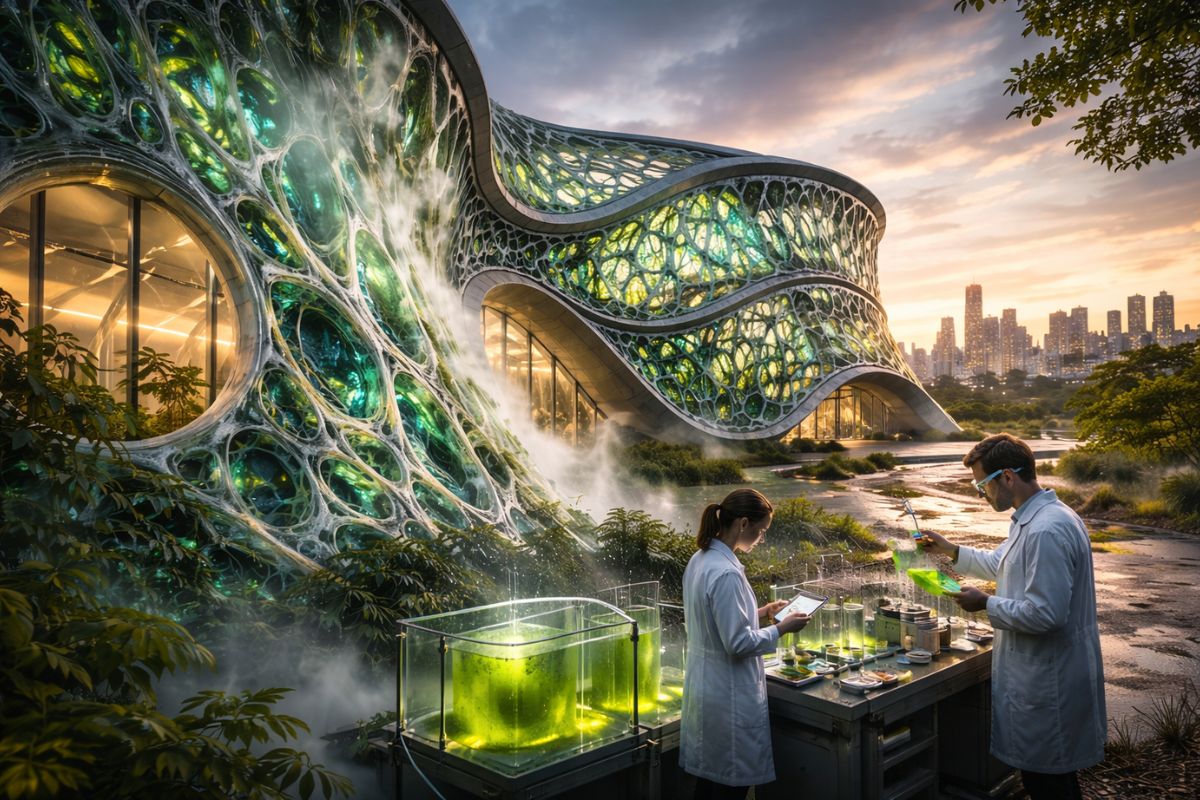
Swiss scientists used cyanobacteria and 3D printing to create a living concrete that captures CO₂ from the air, repairs its own cracks, and strengthens over time an innovation that could transform buildings into structures that breathe and clean the atmosphere.
A group of scientists from ETH Zurich in Switzerland has just presented something that seems straight out of a science fiction script, but already works in the laboratory: a living concrete that absorbs carbon dioxide from the atmosphere, self-repairs when cracks appear, and becomes more resistant over the years. The technology combines cyanobacteria microorganisms photosynthetic that have existed for billions of years with a 3D-printed hydrogel that acts as a kind of breathable skin for buildings. The research, published in the journal Nature Communications, was co-authored by researcher Mark Tibbitt.
The material is not just a laboratory curiosity. During tests that lasted 400 days, scientists demonstrated that each gram of the living concrete was able to capture about 26 milligrams of CO₂. On a larger scale, facade prototypes achieved an annual absorption of up to 18 kilograms of carbon dioxide performance equivalent to that of a 20-year-old pine tree. The proposal is straightforward: to transform building surfaces into allies in the fight against urban pollution, rather than passive sources of environmental degradation.
What the scientists created and how the living concrete works

According to the portal IG, the living concrete developed by scientists at ETH Zurich is not an improved version of traditional cement; it is a fundamentally different material. At the heart of the innovation is a 3D-printed hydrogel, a porous and water-rich matrix that houses live cyanobacteria under ideal conditions for photosynthesis. The three-dimensional design of the structure allows for the efficient circulation of sunlight, water, and CO₂, maximizing the microorganisms’ ability to capture carbon and convert it into solid minerals.
-
Ceará receives the first 100% electric 19-ton loader: the SW956E model promises zero diesel, low maintenance costs, a 3.5 m³ bucket, and fast recharging in 1 hour and 10 minutes for mining and construction.

-
Casa Tupin in Brasília seems to float with exposed concrete and prestressed beams, 12 pillars support everything and without windows, it uses floor-to-ceiling openings in glass, cobogó, and small bricks in the internal courtyard.
-
An architect transformed a hangar into a curved house with a view of the reservoir: a metal structure assembled in a week, glass doors, bold colors, toucans in the bathroom, and a design full of stories.
-
An architect transformed a hangar into a curved house with a view of the reservoir: a metal structure assembled in a week, glass doors, bold colors, toucans in the bathroom, and a design full of stories.
The process works like this: the cyanobacteria use sunlight, water, and carbon dioxide to perform photosynthesis, producing oxygen and sugars. The difference is that part of this reaction generates solid minerals that trap carbon in a stable form and, at the same time, reinforce the internal structure of the material.
It is as if the living concrete builds its own skeleton with the carbon it extracts from the air. Scientists describe the result as a material that literally grows stronger over time the opposite of what happens with conventional concrete, which progressively degrades.
Why the scientists chose cyanobacteria for this technology
Cyanobacteria were not chosen by chance. These microorganisms are among the oldest organisms on the planet, with fossil records dating back over 3.5 billion years. The scientists at ETH Zurich selected them for their exceptional photosynthetic efficiency and their ability to survive in adverse conditions essential characteristics for a material that needs to function on building facades exposed to variations in temperature, humidity, and light.
The relationship between cyanobacteria and the hydrogel is symbiotic in a functional sense. The hydrogel provides water, nutrients, and physical protection to the microorganisms, while the cyanobacteria capture CO₂ and produce the minerals that strengthen the structure.
The scientists observed that, over the 400 days of testing, the material not only maintained its properties but improved them the cracks that appeared were naturally filled by mineral growth, and the mechanical resistance progressively increased. This self-repair capability is particularly relevant for civil construction, where maintaining facades and structures represents a significant cost over the lifespan of a building.
The numbers that impressed the scientists in laboratory tests
The quantitative results of the research are what transform the idea of living concrete from an interesting concept into a viable proposal. Each gram of the material captured approximately 26 milligrams of CO₂ during the testing period, a rate that scientists consider significant when projected to the scale of entire building facades. In larger prototypes, the annual absorption reached 18 kilograms of carbon dioxide comparable to what a mature 20-year-old pine tree can sequester in the same period.
To put these numbers in perspective: the cement industry is responsible for about 8% of global CO₂ emissions. If urban building facades began to absorb carbon instead of merely resisting the elements, the environmental equation of civil construction would change structurally. The scientists emphasize that the material is not intended to replace conventional concrete in heavy structural functions, but rather to serve as an active coating for external surfaces an additional layer that transforms passive walls into carbon capture panels. In an architecture exhibition in Venice, experimental structures resembling tree trunks have already demonstrated results comparable to those of mature trees.
The role of 3D printing in the living concrete of Swiss scientists
3D printing is not an aesthetic detail in the design; it is what makes the living concrete technically possible. The scientists at ETH Zurich use three-dimensional printing to create the precise internal geometry of the hydrogel, ensuring that the channels through which light, water, and CO₂ circulate are sized to maximize the photosynthetic activity of the cyanobacteria. A poorly designed structure would leave parts of the material without access to light or nutrients, drastically reducing its efficiency.
The 3D printing technology also allows the material to be manufactured in modular formats, adaptable to different types of facades. The scientists are already working on developing panels that can be installed on existing buildings, without the need to demolish or reconstruct structures. This modularity is what separates a laboratory innovation from an applicable solution on an urban scale. If the panels can be produced in series and attached to already constructed buildings, the potential impact of the technology multiplies enormously there is no need to wait for new constructions to start capturing carbon.
What is needed for living concrete to leave the laboratory and reach cities
The scientists at ETH Zurich are transparent about the challenges that still need to be overcome. The durability of the material in real exposure conditions rain, hail, extreme temperature variations still needs to be tested outside the controlled laboratory environment. The 400 days of testing demonstrated that the concept works, but a facade coating needs to last decades to justify the investment, not just months.
To increase the longevity of the system, scientists are studying two fronts: genetic modifications in cyanobacteria to make them more resistant to adverse environmental conditions and the inclusion of slow-release nutrients in the hydrogel.
The idea is for the material to operate autonomously for long periods without the need for maintenance or replenishment. The production cost at scale is also an open variable the 3D-printed hydrogel with live cyanobacteria is, by definition, more complex and expensive to manufacture than a conventional coating. Economic viability will depend on advances in 3D printing and bioengineering that reduce the price per square meter to a competitive level.
Why this discovery could change civil engineering as we know it
The proposal from the scientists at ETH Zurich goes beyond creating a new material. They are proposing a paradigm shift: instead of buildings that degrade the environment over their lifespan, constructions that actively improve air quality while strengthening themselves. It is the difference between passive infrastructure, which merely withstands the elements, and active infrastructure, which interacts with the environment in a beneficial way.
If the technology proves viable at scale, the implications are enormous. Facades of commercial, residential, and industrial buildings could become carbon capture surfaces, complementing urban forests and parks in the fight against pollution. The scientists estimate that the combination of modular panels with optimized cyanobacteria could make buildings functionally equivalent to trees in terms of CO₂ absorption. Breathable architecture, as the researchers call it, would cease to be a metaphor and become a literal description: buildings that absorb pollution, self-heal, and grow stronger each year. Conventional concrete has a 2,000-year history. Living concrete could be the next chapter.
Scientists have transformed cyanobacteria and 3D printing into a concrete that absorbs pollution and regenerates itself. Do you believe this technology can really scale to cities, or will cost and durability challenges keep it stuck in the laboratory? Share your opinion in the comments.





Seja o primeiro a reagir!