





 Portuguese
  English
  Spanish
  9 min of reading
  0 comments


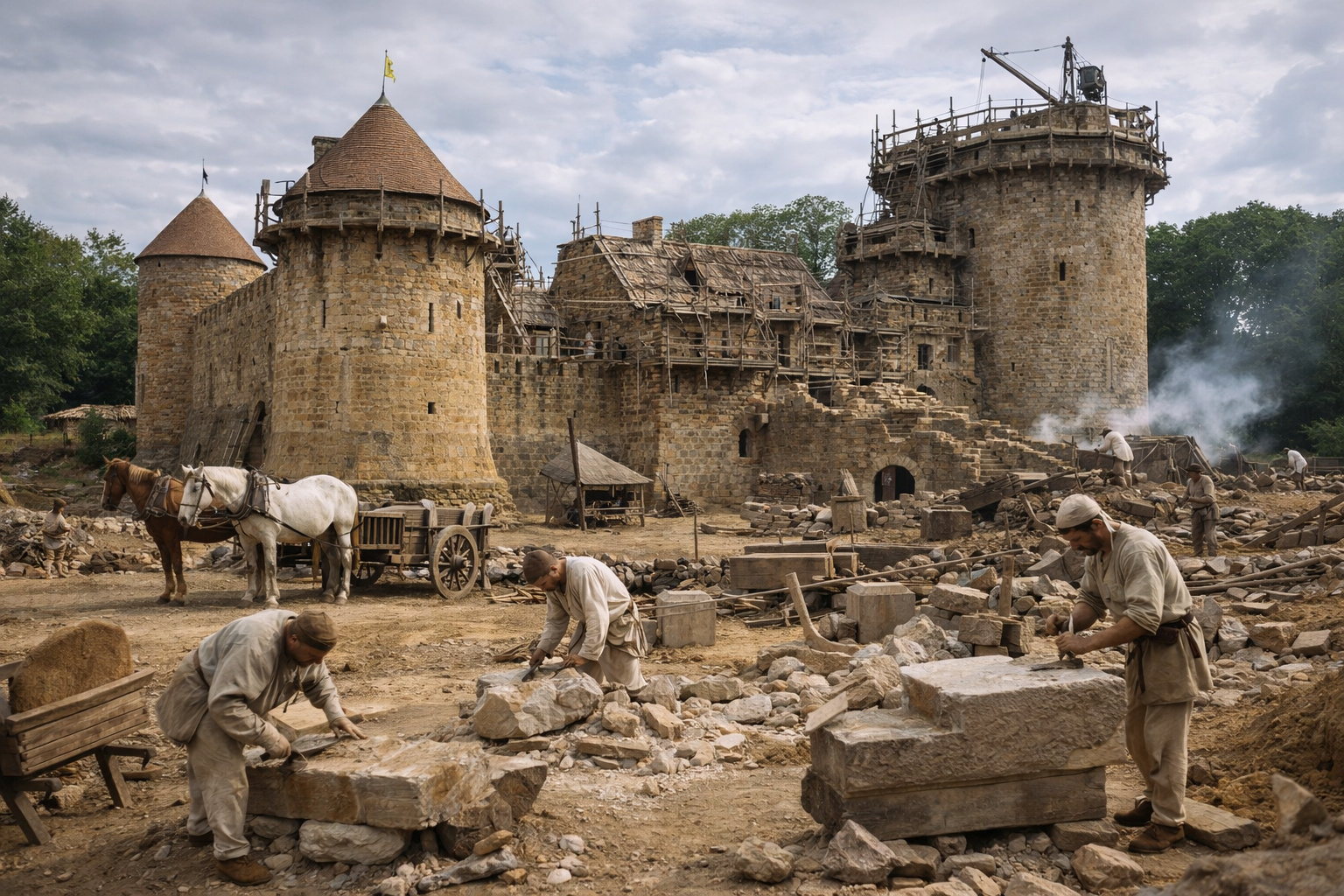
In France, artisans erect for decades a medieval castle with 13th-century techniques, rescuing historical knowledge, reducing environmental impacts, and contributing directly to the restoration of Notre-Dame Cathedral
In a clearing in the heart of the Burgundy forest, two kilometers from the village of Treigny and two hours south of Paris, a group of men and women is building a castle. They are not restoring one that existed. They are not making a replica of one that is known. They are erecting, from stone to roof, a medieval castle that never existed — using exclusively the tools, materials, techniques, and even the units of measurement available in 13th-century France.
According to the Guardian, the Château de Guédelon is “the largest experimental archaeology project in the world.” Started in 1997, the project currently employs more than 60 artisans — masons, carpenters, blacksmiths, weavers, potters, cartwrights — who work from March to November each year, without electric hammers, without concrete mixers, without store-bought screws. The stone comes from an old quarry on the site. The wood comes from the surrounding forest. The cement is lime and sand, as it was made 800 years ago. And when the techniques learned there were put to the real test in April 2019, the world discovered that they were not nostalgic archaisms. They were the only thing that could save Notre-Dame.
An idea that seemed absurd in 1995
It all started with a chance discovery. In 1979, French businessman Michel Guyot bought the ruins of the Château de Saint-Fargeau, 13 kilometers away, and began restoring it with resources generated by local tourism. Years later, during restoration work, a team of specialists found beneath the 17th-century brick walls the original medieval foundations of the castle — with a hypothetical plan of the structure it should have had in the 13th century. The final line of the specialists’ report stopped Guyot: “Reconstructing the Château de Saint-Fargeau would be an extraordinary project.”
-
Tourists on Everest were poisoned by guides who mixed substances in food to provoke false symptoms of altitude sickness while helicopter operators and hospitals charged inflated rescue fees to insurance companies.

-
Few people know this, but Neil Armstrong, one of the most famous NASA astronauts in history, survived the Korean War after jumping from the plane during his seventh combat mission aboard the USS Essex aircraft carrier of the United States.

-
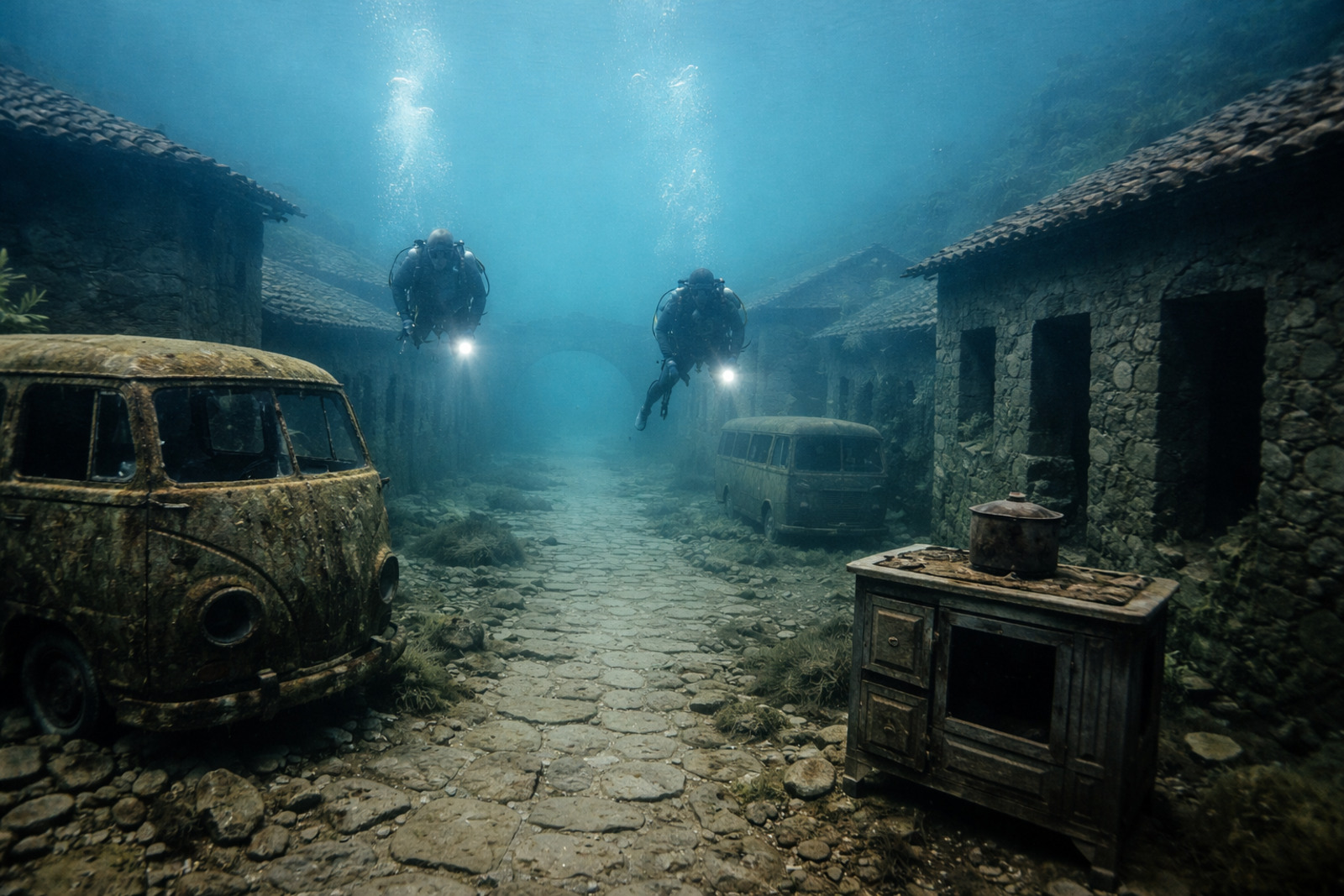
Diving with a camera in Lake Furnas reveals a submerged city with an entire street, almost intact houses, a preserved bridge, a wood stove, a Kombi, and even a bus at the bottom of the largest lake in the Southeast.
-
Iceland accidentally drilled into a magma pocket at 2,100 meters and revealed that the extreme heat beneath the crust could pave the way for a new source of continuous energy.



Guyot took the idea seriously. But instead of reconstructing the existing castle — which would involve tearing down what was standing — he and co-founder Maryline Martin began to think of a different and more ambitious project: to build an entirely new castle from scratch, as it would have been done in the 13th century. Not as a tourist attraction with costumed actors, but as a real scientific experiment. A laboratory where experimental archaeology could answer questions that no medieval text had recorded.
In 1997, after five months of fundraising that yielded €400,000 from the European Union, the French central government, and private sources, work began in an abandoned sandstone quarry in the Guédelon forest. Chief architect Jacques Moulin, who worked for France’s Historical Monuments, designed the project following the standards developed by Philip II of France in the 12th and 13th centuries. The reference date chosen was 1228 — the year of Louis IX’s reign — to ensure that no tool, technique, or material used had been invented after that moment.
The rules of the experiment
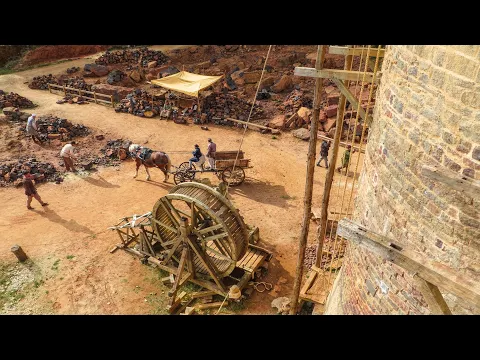
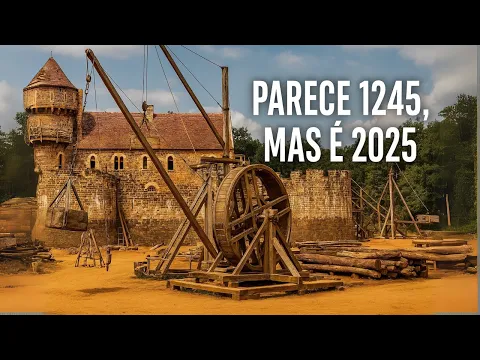
The restrictions are absolute. There are no exceptions for convenience or efficiency. The masons do not use pneumatic hammers. Chisels and wooden or forged metal mallets are the only tools for cutting stone. To lift heavy blocks — some weighing hundreds of kilos — they use a treadwheel, exactly as described in medieval engravings: two workers walk inside a wooden wheel with a central axle, turning it like hamsters, while the rope lifted by the mechanism hoists the load. The only modern adaptation is the safety brakes on the winches — a requirement of French occupational health regulations.
The carpenters do not use electric saws. Each beam is extracted from a whole oak trunk, manually hewn with an axe, respecting what medieval wood specialist Frédéric Épaud calls “the heart of the tree” — the center of the growth fibers that give the wood its longitudinal strength. Slicing the wood along the grain, rather than cutting it across, preserves this internal structure. “If we respect the internal shape of the tree, the beams will last 800 years,” Épaud told the Guardian. “Guédelon is the only place in France, and I believe in Europe, where they build this type of wooden structure.”
Authentic medieval techniques guide every stage of construction, without modern machines
The blacksmiths forge their own tools from raw iron. The roofers make the tiles in the site’s pottery, using local clay. The rope makers produce the ropes used throughout the work. The site’s garden exclusively cultivates plants that existed in medieval France — no tomatoes, no potatoes, no peppers, brought from America centuries after the project’s reference date.
The measurements are not in meters. Hands, cubits, and human feet replace the metric system, exactly as was done before the French Revolution. To ensure consistency, each artisan uses their own body measurements but calibrates them against a standard shared on site.
What 28 years of construction revealed
The initial premise of the project was simple: build to discover. The founders wanted to understand how medieval builders did what they did — not by reading descriptions, but by reproducing the process. What they did not expect was the quantity and quality of the discoveries.
One of the most relevant was about structural arches. The arches that support roofs and spans in medieval castles were long attributed by historians to a purely geometric logic — empirically calculated by master builders who passed formulas down from generation to generation. The Guédelon site confirmed this, but also revealed that the sophistication went beyond: medieval builders had an intuitive understanding of load distribution that resulted in structures of great structural efficiency, without any formal mathematical calculation being necessary. The transmission was oral, gestural, and practical — and it was lost.
The experience revealed lost knowledge, sophisticated techniques, and a surprisingly efficient medieval organization
Another discovery was about the pigments used in the internal mural paintings. Samples from real medieval castles indicated the presence of certain minerals, but the extraction and application processes were unknown. At the Guédelon site, artisans reproduced the paintings using local minerals, testing different processes until they achieved visually equivalent results. Some of the castle’s chambers now have polychrome murals that reproduce 13th-century patterns, produced with techniques that were not practiced anywhere else in the contemporary world.
The site also revealed information about medieval work organization. In the 13th century, a castle was built by a chain of highly coordinated specialists — each responsible for a specific phase, dependent on what the previous group delivered. The experimentation at Guédelon showed that the construction pace was dictated by the curing time of the lime cement: it is not possible to place new stone on a newly laid layer without the previous one hardening.
This implies that medieval sites operated at multiple points simultaneously, with groups working on different sections at different stages of curing. A logistics organization of considerable complexity, for a time without instant communication or formal project management.
Mason Baptiste Fabre, who has worked at the site since 2006, summarized the difference between what he does and what a modern mason does: “Between chiseling by hand and using an electric drill, I prefer to do it by hand, even if I worked on a modern site. You cannot compare a traditional mason like me to a modern mason. They are completely different fields. It’s like comparing a cardiologist to a neurologist. If I were put on a modern site, I would be completely lost.”
April 2019: the medieval site saves the 12th-century cathedral
On the night of April 15, 2019, a fire broke out in the roof of Notre-Dame de Paris. The “forest” — the set of 13th-century oak beams that supported the covering and gave the structure its nickname due to the density of wood — was consumed. The spire fell. The world watched the collapse live.
In the days that followed, when architects and engineers began to assess what would be needed to rebuild, an unexpected problem arose: the techniques used to build the original roof of Notre-Dame were largely unknown. The practical wisdom that allowed medieval carpenters to extract long, rigid beams from whole trunks — preserving the growth fibers that gave them structural strength — had been lost. There were descriptions in books. There were analyses in museums. But there was no one who knew how to do it. Except at Guédelon.
Maryline Martin, co-founder of the project, told the Guardian that the Burgundy site was the only place where carpenters had the necessary skills: “It is prestigious for us that Notre-Dame is being restored by many who learned their craft at Guédelon. We are a private company lost in our forest, without public subsidy. We work with many research institutes, but some dismissed us as a theme park. Now, after 25 years, we are the only ones who can understand and do what needs to be done, and they discover that we did not sell our soul to the devil.”
Guédelon became essential in rescuing decisive medieval techniques to rebuild Notre-Dame
The blacksmith from Guédelon was commissioned to forge the axes that would cut the oak beams for Notre-Dame. The carpenters from the site trained other artisans to work on the cathedral. Frédéric Épaud, a medieval wood specialist who is part of Guédelon’s scientific committee and also the committee overseeing the reconstruction of Notre-Dame, told the Guardian that the conclusion was unequivocal: “Guédelon is the only place in France, and I believe in Europe, where this type of wooden structure is built. All those who did not think it was possible did not know about Guédelon.”
For the reconstruction of Notre-Dame, more than 1,400 oaks were needed, from forests across France. The carpenters used hand-forged axes — 60 of them specially made for the project, with the cathedral’s façade engraved on the blade. They worked without electric saws. The method that the medieval site had preserved for 25 years was the method that rebuilt the cathedral. Notre-Dame reopened on December 7, 2024, after five years of work. The roof and the spire were reconstructed using medieval techniques. The beams will last, according to Épaud, 800 years.
The current state and the unanswered question
In 2025, the Château de Guédelon has the external walls completed, two of the four corner towers ready, the great hall with wooden beam structure and vault, a chapel, kitchens, and a functioning water mill. The work is now focused on the main tower — planned to be 30 meters high — the gatehouse, and the drawbridge.
Completion is projected for 2030, according to Maryline Martin. But after the main body of the castle, there will still be windows, furniture, interior finishes, and possibly a medieval village and a training center in traditional building techniques. “I don’t think I will live to see the end of this project,” said Martin, who is 59 years old. “We are far from finishing our adventure.”
The site receives about 300,000 visitors a year, generates revenue of about €3 million annually, and does not receive public subsidy. It operates as a private company — which makes it even more remarkable that it has remained true to the experiment for almost three decades, without yielding to the pressure to accelerate with modern tools.
The question that no one can yet answer is the simplest: will the castle last? The medieval techniques of lime cement, masonry to chisel, carpentry to axe — in a castle built in the 21st century, with 21st-century materials but with 13th-century methods — will produce a structurally equivalent result to the real castles that have survived 800 years? The answer will only come at a time when there will be no more of the original builders left to know it.







Seja o primeiro a reagir!