





 Portuguese
  English
  Spanish
  4 min of reading
  0 comments


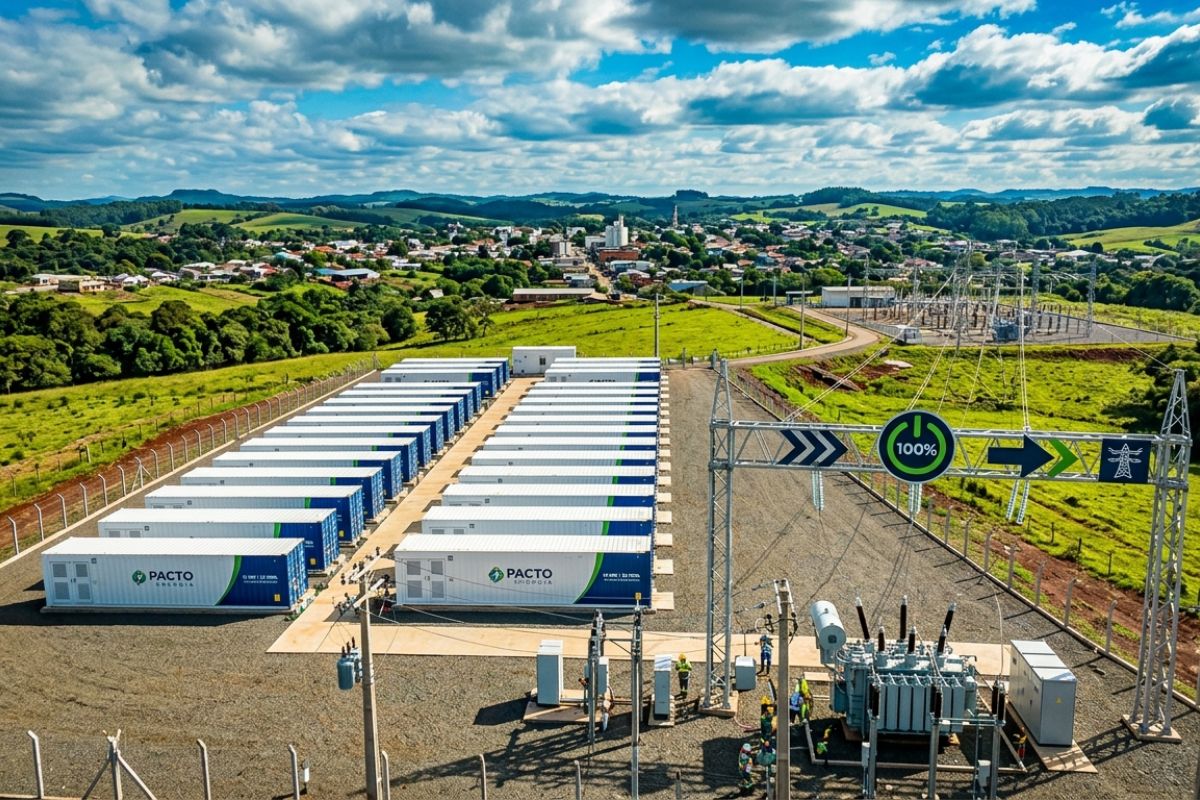
With a 10 MW and 20 MWh BES, the energy storage in batteries from Pacto Energia in Coronel Vivida was designed to modulate demand, reduce transmission costs, and secure the local tariff
In Coronel Vivida, Paraná, Pacto Energia connected the entire city to a system of batteries that can absorb 100% of the local load through a BES (energy storage system). The proposal is simple and straightforward: to solve the physical limitation of supply and turn that into a benefit for the consumer.
The installed BES has 10 MW of power and up to 20 MWh of capacity, serving about 9,000 consumer units within the concession area. In addition to the technical milestone, the declared investment was just over R$ 30 million, below the estimated cost of a new substation, and this factors into the tariff equation.
What was installed in Coronel Vivida
The project revolves around a BES sized to support the operation of the distributor without exceeding the active power limit at the connection point.
-
With a dependence of up to 80% on gas imported from the United States, Mexico is responding with a robust energy strategy, betting on shale gas, creating a scientific committee, and preparing to expand natural gas production to reduce vulnerability and strengthen its energy security in the coming years.

-
The United States proposes to Brazil a critical minerals agreement with a minimum price to combat Chinese dumping and priority for investment, but the Planalto is blocking the signing out of fear of upsetting China and due to electoral calculations in a year of competition.

-
How the world’s largest market sidestepped Trump’s tariff hike, diverted part of the cargo to new destinations, and still set a record in exports.

-
Petrobras buys back fields for billions — what no one is talking about regarding this decision and how it could impact jobs and oil in Brazil.

In practice, the system allows for modulating the city’s load, using storage to balance peaks and organize supply.
The physical structure of the system includes 10 containers dedicated exclusively to the batteries, with the conversion and connection to alternating current done externally, through the PCS (the set that interfaces between the system and the electrical grid).
Why the distributor needed this solution
According to the project report, there was a contracted demand of 13 and the region was growing, with expansion of rural, commercial, and industrial activities.
The problem was that there was not enough physical capacity to keep up with this advance in the traditional format, which pressured the operation.
In this scenario, distributed generation played an important role before and after the BES. It helped meet the need until installation and becomes even more relevant to ensure system charging, without relying solely on the early morning hours.
How the system connects to the grid
The electrical path described involves low voltage panels and transformers that raise the voltage to 13.8 kV, allowing connection to the distributor’s grid. This detail is central because the storage is not “isolated”: it communicates with the grid and operates alongside it.
Another highlighted point is the existence of two feeders, providing redundancy. If one of the lines has a problem, the other maintains the connection, increasing the resilience of service to the city.
Short deadline and logistics amid holidays
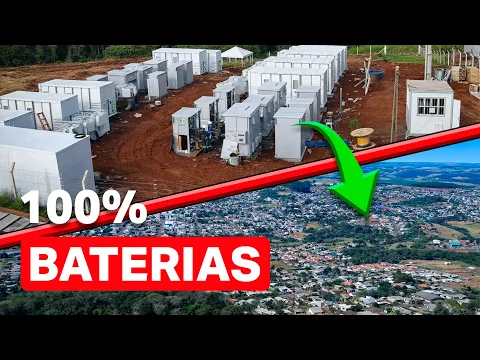

The project was presented as an execution challenge: 60 days were set to get the operation up and running. The work window spanned from December to Carnival, with holidays in between and a direct impact on supply, transport, and team mobilization.
Participation from companies and teams in the implementation was mentioned, including Solaric in construction and a strong planning front to handle execution, regulation, and logistics of materials and equipment.
Why this could reduce the tariff
The economic argument of the project is twofold:
1) Lower initial investment
It was stated that a new substation, at best, would cost around R$ 40 million or a bit more, while the battery system cost just over R$ 30 million. Lower capex tends to relieve pressure on the tariff over time, as it reduces the infrastructure cost to be recovered.
2) Lower use of the transmission system
By modulating the local load with storage, the operation begins to use the transmission network less at certain times. This, according to the project’s own explanation, reduces transmission system usage costs, and this reduction can be reflected in the final price for the consumer.
What changes for those who live and produce in the city
For the city, the promised gain is direct: more capacity to meet growth without “hitting the ceiling” of supply, with a more stable operation.
For those who depend on energy all the time, such as industries that operate 24 hours, the reasoning is to have more predictability and less operational restriction, since the charging of the BES cannot be confined to low demand periods alone.
In the end, the project was presented as a case where innovation turns into concrete benefits, uniting service expansion, redundancy, and structural cost reduction.
Quick question for you: in your city, would a system like this with batteries make a difference in the quality of supply and the electricity bill?
Content based on information presented by Canal Solar.








Seja o primeiro a reagir!