With PVC pipes, bicycle parts, and electronic components, EJA students transformed a need of the school community into a prototype that combined robotics, accessibility, material reuse, and practical learning.
PVC pipes formed the structure, bicycle wheels provided support, and repurposed vehicle parts helped with motorization.
The combination resulted in a wheelchair prototype developed by students of the Youth and Adult Education in the municipal network of São Paulo.
The project was carried out in 2025 at EMEF Manoel Vieira de Queiroz Filho, located in CEU Parelheiros, in the far south of the capital.
-
In near-freezing water, divers cross the Silfra Fissure and see walls over 100 meters high between two tectonic plates.

-
New method prints copper resistant to seawater, heat, and corrosive environments, paving the way for a new generation of cheaper electronic devices

-
A printer larger than many rooms works for 72 hours in the United States and delivers an entire boat measuring 7.62 meters, weighing 2.3 tons, with a hull made of plastic and wood fibers.

-
Used cooking oil that would clog sewage networks, contaminate up to 25,000 liters of water per liter discarded, and become invisible waste is now being collected and pre-treated as raw material for biodiesel, green diesel, and sustainable aviation fuel, and in the State of São Paulo alone, there is an annual potential of 220.2 million liters of this waste.


The construction involved concepts of programming, electrical, mechanical, sustainability, and accessibility, applied to a need identified within the school community itself.
More than assembling a motorized chair, the participants needed to figure out how to distribute weight, move the wheels, transmit the force of the motors, and transform joystick commands into movement.
The result was presented by the school as a smart wheelchair with an autonomous mode.
School need turned into an inclusive robotics project
The idea arose after conversations between students and educators about the mobility difficulties observed in the area.
At that time, about 140 of the approximately 1,200 students enrolled in the unit were identified as the target audience of special education, according to the Municipal Department of Education.
The Digital Education guiding teacher Selma Jacome encouraged the class to develop a solution related to inclusion.
“Thinking about the needs of the area, we encouraged the students to create an inclusive robotics project. The goal was to ensure equal mobility opportunities for people with disabilities, regardless of their physical conditions,” she stated.
The work was included in the Learning Technologies activities of the municipal network.
Instead of receiving a ready-made equipment to disassemble or copy, the group discussed the problem, created preliminary versions, and selected materials that could be cut, joined, and modified within the school.
The proposal also related to the Sustainable Development Goals, used in the project as a reference to address education, reduction of inequalities, innovation, and material reuse.
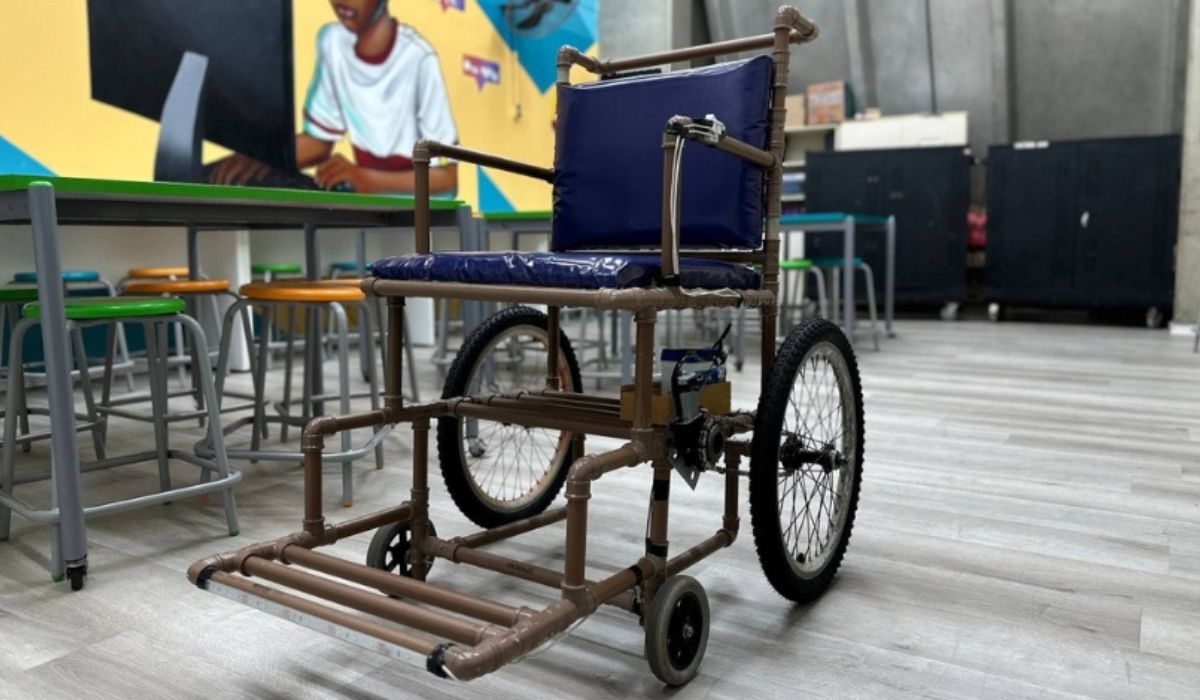
PVC pipes formed the structure of the chair
The assembly began with the base of the chair.
The students chose PVC pipes and fittings because the material could be cut and fitted with accessible tools, facilitating shape testing during classes.
The rear wheels came from bicycles, while smaller wheels were installed at the front.
Wood, fabric, and upholstery material formed the seat and backrest, and a seatbelt was also among the items recorded by those responsible for the project.
PVC did not only serve a visual function.
The structure needed to keep the seat, supports, and electronic components connected while the chair moved through the school corridors.
The documentation shows that the group conducted experiments before arriving at the presented model.
Wheels, upholstery, motors, and battery were discussed in different stages, and the prototype underwent functionality tests within the unit.
No measures such as maximum load capacity, structure resistance, speed, distance traveled per charge, or performance on ramps were disclosed.
There is also no public information about prolonged tests with users.
These absences prevent comparing the prototype with a motorized wheelchair produced for everyday use.
The value of the project documented by the school lies mainly in the learning process and the practical demonstration of a solution built by the students.

Car engines and motorcycle battery powered the prototype
The list of materials presents an unusual combination.
To move the chair, the students used motors employed in car electric window systems, along with a motorcycle battery.
Bicycle sprockets and chains were part of the mechanical transmission.
This set allowed the movement produced by the motors to be transferred to the wheels, following a principle similar to that found in bicycles: the chain transfers the rotation between parts positioned at different points.
In the electronics part, the project used an Arduino Nano, an H bridge L298N, a three-axis analog joystick, and connection wires known as jumpers.
The control was installed on the armrest of the chair.
The Arduino is a small programmable board capable of receiving signals and executing instructions.
In this type of setup, the joystick’s movement is converted into electrical commands, while the H bridge allows controlling the activation and rotation direction of the motors.
The choice of these components made it possible to study programming and electronics in an object that actually moved.
Errors in the code, wire connections, or mechanical assembly stopped being just results on a screen and appeared in the chair’s behavior.
Wheelchair operated in the school corridors
The website created by the teacher and students records the chair’s operation in the unit’s corridor.
It also gathers images, videos, a list of materials, and the steps followed during construction.
The material informs that the prototype was presented to the school community, including students, teachers, managers, staff, and family members.
The demonstration allowed the group to explain both the assembly and the concepts worked on during classes.
The Municipal Department of Education described the chair as functional, practical, sustainable, and responsive.
These classifications were released by the education network itself and do not correspond to an independent technical certification.
Selma Jacome also stated that the project helped reduce school dropout rates and increased autonomy, responsibility, cooperation, and confidence among participants.


Arduino transformed the joystick into commands for the motors
Without the electronic system, the structure could be pushed or moved manually, but it would not respond to the commands installed on the armrest.
The Arduino allowed for the insertion of a programmable layer between the joystick and the motors.
This feature differentiates a purely mechanical project from a robotics experience.
The students not only had to figure out how to assemble the structure but also how to organize a logical sequence to transform the intention of movement into action.
By moving the joystick, the user sends a signal to the circuit.
The programming interprets the command and defines how the motors should react, allowing control of movements such as forward, backward, and changing direction, according to the constructed configuration.
Technology project was presented at municipal events
The chair was exhibited on September 20, 2025, at the Special Education Seminar Together for Learning, held at CEU Carrão.
The meeting discussed service, accessibility, and learning for students with disabilities, autism spectrum disorder, and high abilities or giftedness.
The documentation prepared by the school also records the presentation at the 12th Seminar and Technology Showcase of the Municipal Department of Education, held on November 5 and 6, 2025, at CEU Rei Pelé.
The event brought together projects on maker culture, material reuse, and robotics developed in the network.
Among the activities were prototype exhibitions, challenges with programmable equipment, and debates on the use of technologies in education.
Construction brought together programming, mechanics, and sustainability
The chair concentrated tasks that normally appear separately in the curriculum.
The measurement and fitting of the tubes involved notions of geometry, while motors, battery, and circuits required basic knowledge of electricity.
Programming added logical reasoning.
The choice of reused components brought up discussions on cost, material availability, and sustainability.
Group work was also part of the pedagogical proposal recorded by the school.
The students needed to distribute tasks, test solutions, and correct problems encountered during construction.
As EJA members have different ages, professional paths, and experiences, the project also created space for knowledge acquired outside the classroom to be used in the assembly.