





 Portuguese
  English
  Spanish
  4 min of reading
  0 comments


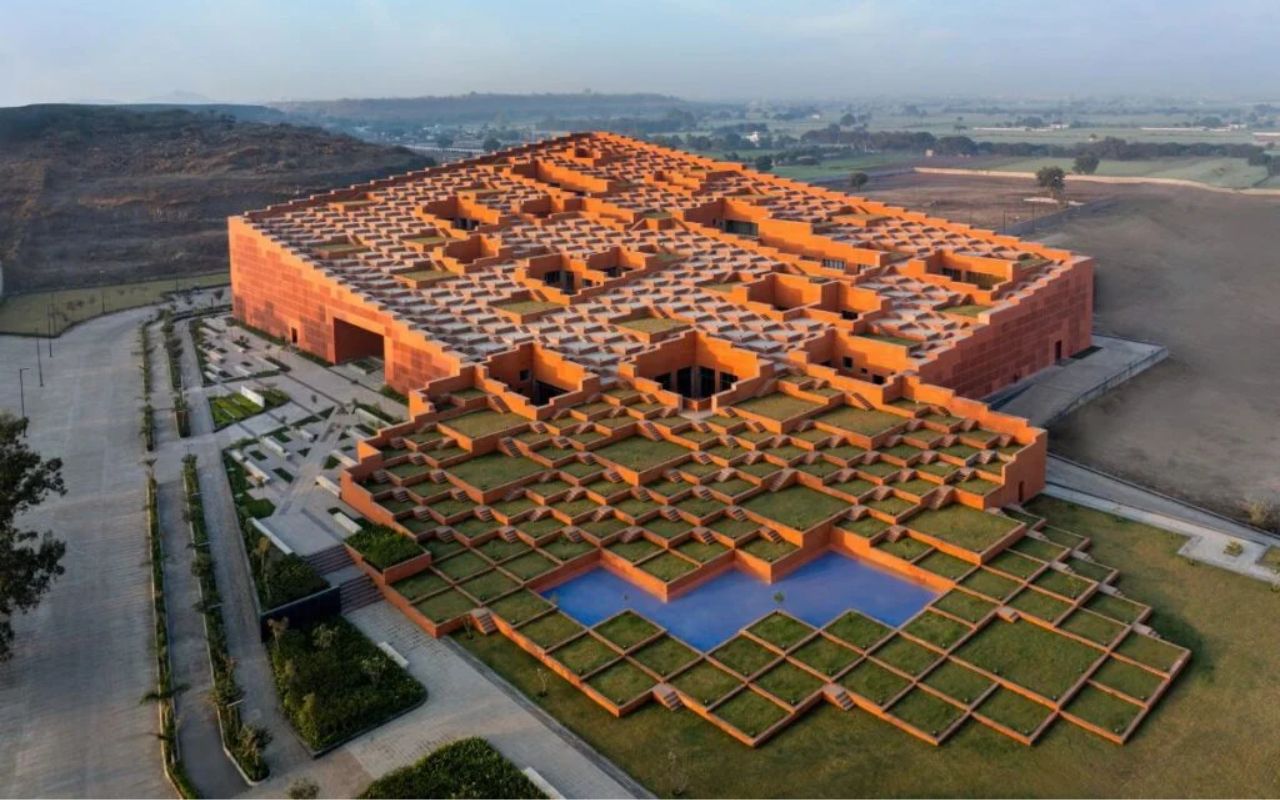
Project with stepped roof at Prestige University combines sustainability, thermal comfort, and social interaction in an innovative environment.
Inspired by ancient structures from India, an architectural project with a stepped roof has attracted attention for transforming a university campus into a large communal space. The proposal was developed by Sanjay Puri Architects for Prestige University, located on a 129,500 m² plot.
The construction, recently completed, aims to integrate sustainability, thermal comfort, and social interaction in a single environment. The central idea is to create not only a functional building but also a dynamic space that fosters gatherings, events, and collective learning.
Stepped roof is inspired by historical structures from India
The concept of the stepped roof dates back to ancient Indian stepwells, built over a thousand years ago. These structures were used both for water storage and as community gathering spaces.
-
Architects are burying plastic pipes 2 meters deep and using ducts up to 30 meters long to cool homes without electricity, with low-consumption fans and natural heat exchange that drastically cuts the electricity bill.

-
Under São Paulo, Line 6-Orange reaches 15.3 km and 15 stations, promising 23 minutes from Brasilândia to the Center and 633,000 passengers per day; with autonomous trains, it will open a partial section in October 2026.

-
Created by George Lucas with over $1 billion, a futuristic museum in the shape of a spaceship with 1,500 curved panels is about to open in Los Angeles and will house one of the largest private collections of narrative art in the world.

-
Couple shows how they built a retaining wall on their property using 400 old tires: sloped land turned into plateaus, tires are aligned, filled, and compacted with layers of soil, with grass helping in support and at almost zero cost.


The contemporary proposal revives this essence. Thus, the university building functions as a point of social integration.
Moreover, the architecture adapts this idea to the modern educational context. The result is an environment that combines tradition and innovation.
The project at Prestige University stands out for the way the stepped roof organizes the spaces. The structure gradually rises, reaching about 28 meters in height.
This elevation creates a series of interconnected platforms. In total, there are 463 levels that form a large rooftop garden.
These spaces function as areas for socializing, studying, and leisure. Additionally, they can be used simultaneously for different activities.

Open-air auditorium for thousands of students
One of the major differentiators of the stepped roof is its adaptability for events. The platforms create an open-air auditorium with a capacity for up to nine thousand people.
This allows for large-scale academic and cultural activities. At the same time, it maintains integration with the natural environment.
Additionally, the space encourages collective participation. This reinforces the role of architecture in promoting social interaction.
Another important aspect of the stepped roof is its energy efficiency. The design was conceived to maximize natural ventilation.
The presence of open courtyards allows for constant air circulation. This reduces the need for air conditioning.
Moreover, natural lighting is widely utilized. Thus, electricity consumption is minimized.
Structure responds to the hot climate of the region
The city where the university is located experiences temperatures ranging from 30°C to 40°C for much of the year. Therefore, the architectural project needed to consider appropriate solutions.
The use of specific materials, such as ventilated reinforced concrete panels, helps to reduce internal heat. This type of material prevents excessive temperature buildup.
Thus, the internal environment becomes more comfortable. This directly impacts the well-being of the students.

Stepped roof integrates green areas into the educational environment
The stepped roof also contributes to the expansion of green areas within the campus. The rooftop garden occupies about 9,000 m².
These spaces are accessible and include areas adapted for people with reduced mobility. This reinforces the commitment to inclusion.
Furthermore, the presence of vegetation improves air quality. It also helps to reduce the thermal sensation in the environment.
Internal distribution favors circulation and use of spaces
The organization of the internal environments follows a functional logic. On the ground floor, there are high-traffic areas, such as the food court and auditorium.
The first floor houses the library, connected by walkways. The second floor concentrates common classrooms.
On the upper levels, there are amphitheater-style classrooms and administrative areas. This distribution facilitates access and mobility within the building.

Stepped roof reinforces the importance of green areas in schools
The project at Prestige University gains even more relevance in light of recent studies on the school environment. A research study by the Alana Institute indicates that many schools face issues related to excessive heat.
According to the survey, about 370,000 students study in at-risk areas. Additionally, many institutions are located in regions with high temperatures.
Another concerning fact is the lack of green areas. In many schools, vegetation cover is minimal or non-existent.
In this scenario, solutions like the stepped roof become increasingly important. The integration of nature and architecture can significantly improve the school environment.
Moreover, it contributes to thermal comfort and the well-being of students. This directly impacts learning.
Finally, the project demonstrates that it is possible to unite sustainability, aesthetics, and functionality. And it points the way for the future of educational architecture.
Source: Ciclo Vivo










Seja o primeiro a reagir!