





 Portuguese
  English
  Spanish
 4 min of reading
  0 comments


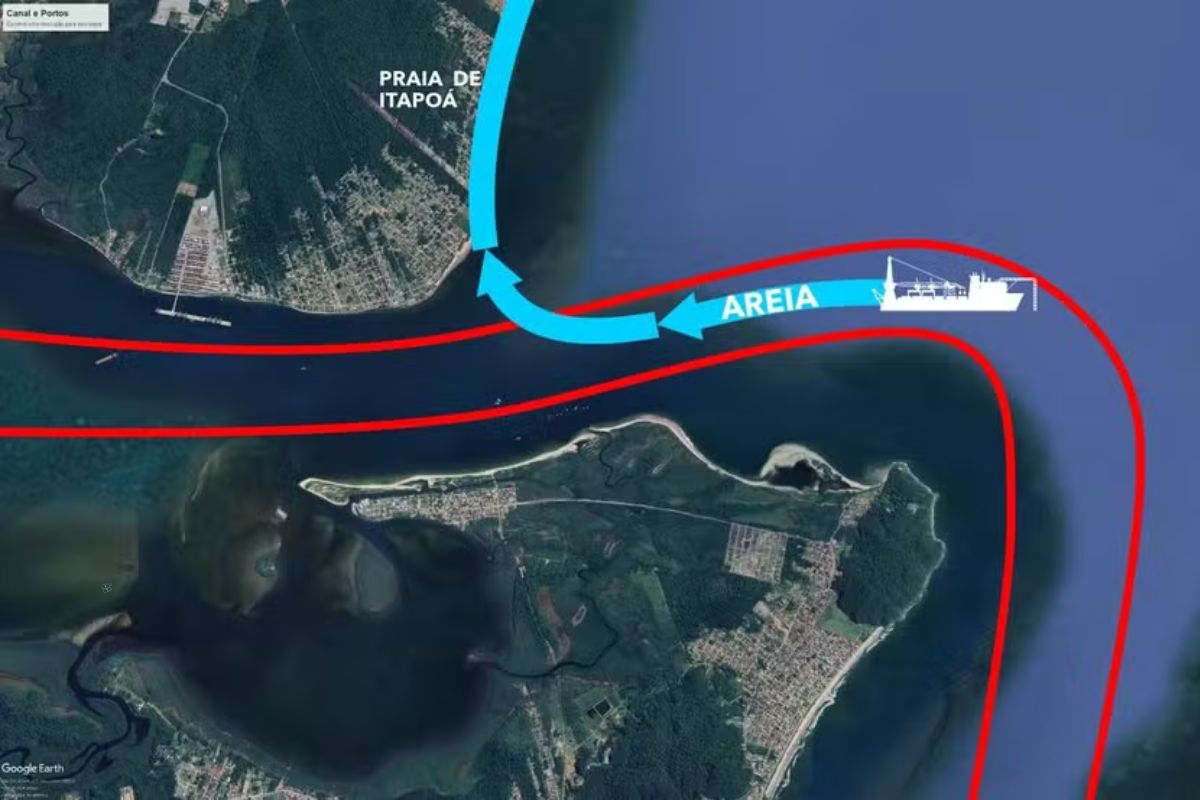
According to G1, the unprecedented project in Itapoá will deposit 6.4 million m³ of sand extracted from the dredging of the Babitonga Bay, widening the beach by up to 100 meters and impacting tourism, ports, and the environment.
The city of Itapoá, on the north coast of Santa Catarina, will be the stage for an unprecedented work in Brazil. The project aims to widen the beach by depositing 6.4 million cubic meters of sand, extracted from the dredging of the Babitonga Bay. The volume is almost three times greater than that used in the famous mega project of Central Beach in Balneário Camboriú, completed in 2021.
The initiative, signed in August 2025, is not limited to the waterfront. The dredging process also aims to deepen the estuary that provides access to the ports of Itapoá and São Francisco do Sul, allowing vessels up to 366 meters long, compared to the current limit of 336 meters. Thus, the intervention gains a dual character: touristic and logistical, transforming the city into a new development hub for the northern region of Santa Catarina.
The Billion-Dollar Investment and the Project Structure
The total budget is R$ 324 million, under a Public-Private Partnership (PPP).
-
Congonhas receives the monorail promised for the 2014 World Cup after more than a decade of delays and becomes the first airport in Brazil with integrated subway.
-
Goodbye, concrete: a new trend in civil construction reduces the weight of the structure by up to 30%, accelerates projects by up to 40%, cuts costs on steel and labor, and improves thermal insulation with EPS.
-
Russian engineers create an innovative propeller blade for aircraft that could completely change the way airplanes and helicopters operate.

-
Couple finishes building PVC chalet on the beach on the last day, with air conditioning and curtains, but discovers the bathroom drain is inverted: water escapes from the drain, risking breaking the floor, and the rush continues before the trip.

Of this amount, R$ 24 million will come from the public port of São Francisco do Sul and R$ 300 million from the private terminal of Itapoá, which will have financial returns spread until 2037.
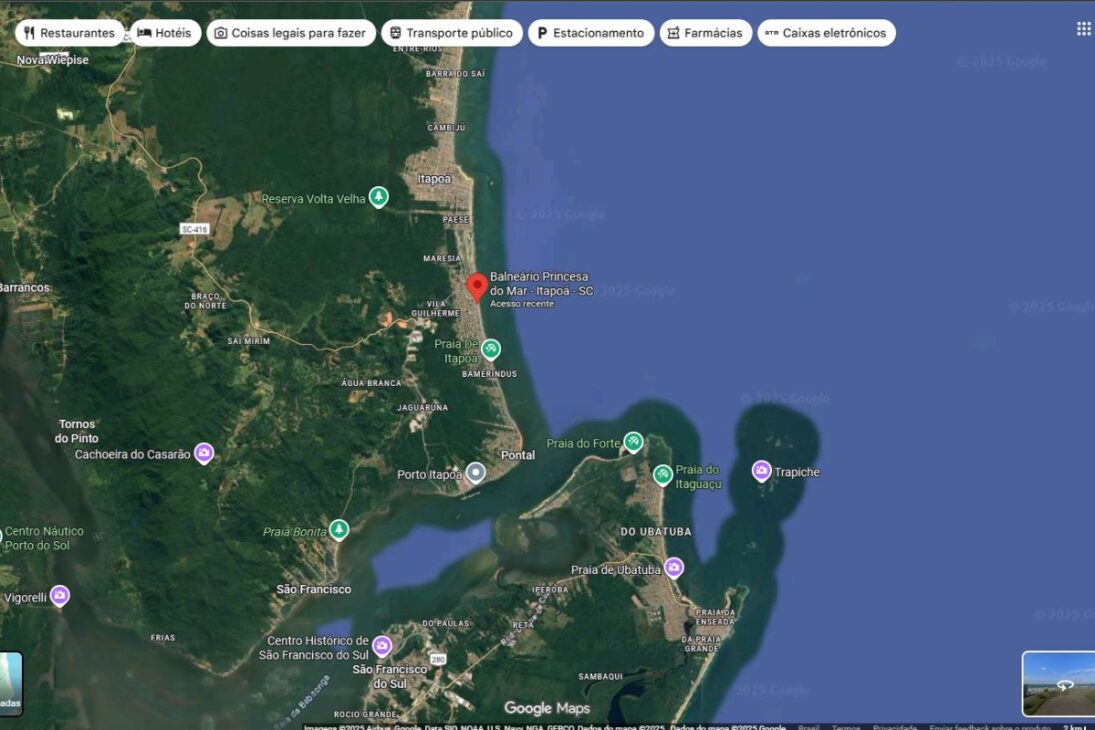
In practice, the beach area will gain at least 30 meters over a 10 km stretch, between Figueira and Balneário Princesa do Mar.
In some sections, the advance may exceed 100 meters, creating new spaces for leisure, tourism, and real estate valuation.
The city hall believes that the project will transform the city into a new postcard, further strengthening Itapoá’s title as a tourist destination, as the municipality has 32 km of coastline, the largest coastal stretch in Santa Catarina.
Protection Against Erosion and Storm Surges
The project also addresses an urgent need.
In August 2025, Itapoá declared a state of emergency after strong storm surges hit the coast, worsening the process of coastal erosion.
The expectation is that the widening will act as a coastal protection barrier, reducing the impact of waves on the waterfront and preventing damage to local properties and businesses.
According to coastal engineering specialists, interventions of this nature are effective in the short and medium term, but do not definitively eliminate the risk of erosion.
This means that while the work will bring immediate benefits, maintenance will be essential for the results to remain stable in the coming decades.
The Comparison With Balneário Camboriú
The comparison with Balneário Camboriú is inevitable. There, the beach width increased from 25 to about 70 meters after the deposition of 2.5 million m³ of sediments.
In Itapoá, in addition to the three times greater volume, the difference lies in the reuse of dredged sand from the port canal, instead of extracting it from underwater deposits.
This model makes the work even more innovative in the Brazilian context, as it combines the interest of enhancing port competitiveness with the touristic appreciation of the waterfront.
The result, if well executed, can serve as a reference for other coastal cities in the country.
Environmental Licensing and Involved Risks
Despite the expectations, the project can only begin after the release of the environmental license by Ibama and the completion of the executive project, expected in the next four months.
Researchers from the Federal University of Santa Catarina (UFSC) warn that interventions of this magnitude can generate severe environmental impacts, such as:
Changes in ocean currents;
Damage to neighboring beaches due to sediment redistribution;
Water turbidity during the work, affecting marine life;
Possible reduction in biodiversity in sensitive areas.
These points raise the alarm about the need for thorough technical studies and environmental compensation measures.
The Strategic Role of Babitonga Bay
The Babitonga Bay is the center of the largest port complex in Santa Catarina, responsible for 60% of cargo movement in the state.
In addition to the Port of São Francisco do Sul and the Port of Itapoá, there is a project to construct a third private port, from Coamo, the largest agricultural cooperative in Brazil, with an estimated budget of R$ 3 billion.
In this context, the widening of Itapoá’s beach stops being just a tourism project and gains the status of a national strategic project, capable of repositioning Santa Catarina as one of the main logistic hubs in South America.
The unprecedented work in Itapoá promises to radically transform the waterfront of the municipality, bringing urban, tourist, and logistical benefits.
However, it also raises complex environmental issues that need to be addressed with transparency and technical rigor.
And you, do you believe that the economic and tourist benefits of the work outweigh the environmental risks? Or do you think the project may repeat the mistakes of other coastal interventions in Brazil? Share your opinion in the comments — we want to hear from those who live this reality up close.









Seja o primeiro a reagir!