





 Portuguese
  English
  Spanish
  4 min of reading
  0 comments


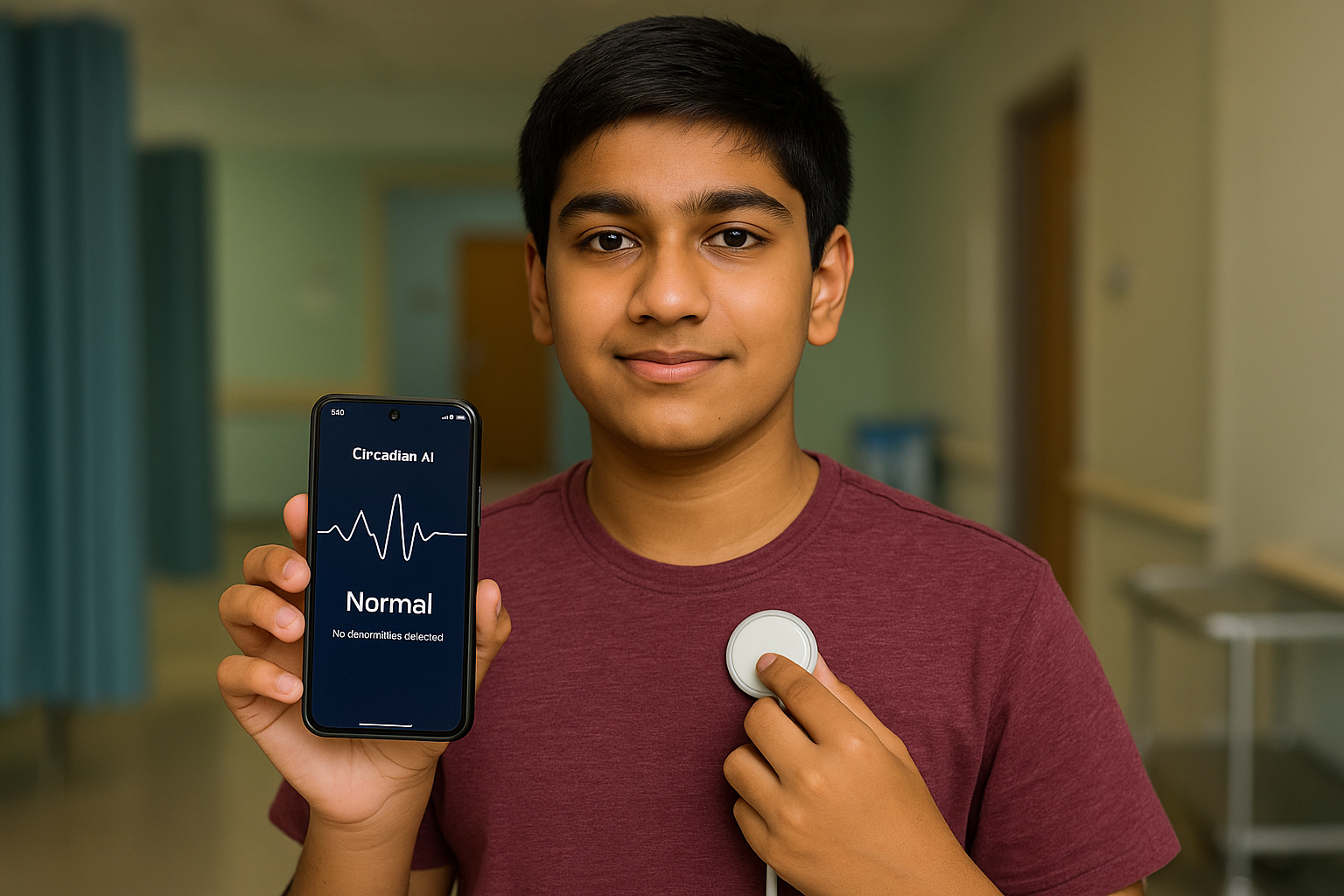
Teen Develops Circadian AI, A Screening App That Detects Cardiac Abnormalities With High Accuracy In Just Seconds, Aiding Early Diagnosis Of Cardiovascular Diseases.
A 14-year-old teenager has developed a technology capable of diagnosing heart diseases in a matter of seconds. Siddarth Nandyala, a resident of Texas, created Circadian AI, a smartphone app that can quickly identify cardiovascular abnormalities in a fast and non-invasive manner.
The Birth Of The Idea
For almost eight months, Nandyala dedicated daily hours to developing the project. His goal was to create a tool that could identify heart diseases in their early stages, when they typically do not yet show obvious symptoms.
Most cardiovascular abnormalities go unnoticed until serious events occur, such as heart attacks or strokes.
-
They were brilliant! Scientists discover that our ancestors in China were already making super advanced tools 160,000 years ago, changing everything we knew.

-
Scientists unveil 3 million years of climate secrets hidden in the ice of Antarctica.

-
Ancient farmers created “aggressive plants” that changed nature forever.

-
Astronomers find a “backward” solar system that ignores all the rules of space and leaves scientists scratching their heads!


Traditional exams, such as electrocardiograms, echocardiograms, and stress tests, usually detect the problem only when the patient is already at an advanced stage.
Nandyala explains that the main focus was to create a system capable of helping many people through simple, fast, and non-invasive screening procedures.
History Of Innovation
From an early age, Nandyala showed an interest in technology, coding, and engineering. In 2022, he developed a prosthetic arm that cost only US$ 150 in India, well below the traditional US$ 30,000.
The following year, he founded the startup STEM IT, specialized in educational kits for science, technology, engineering, and mathematics. Recognized by the Frisco Chamber of Commerce as Innovator of the Year, he received financial support and awards, including a Certificate of Recognition from the U.S. House of Representatives and a letter of congratulations from then-President Joe Biden.
In 2024, he created a highly accurate armband to detect falls in elderly individuals, surpassing the effectiveness of devices like the Apple Watch.
The Impact Of Heart Diseases
According to the World Health Organization, heart diseases remain the leading cause of death worldwide, with 19.91 million deaths recorded in 2021. In the United States alone, nearly 6.7 million adults suffer from heart failure, projected to grow to 11.4 million by 2050.
Nandyala emphasizes that even a single life saved represents a significant advance. Early detection allows for treatments to begin before the situation worsens, improving quality of life and reducing healthcare costs.
However, in many low- and middle-income countries, the lack of preventive health programs hampers early diagnosis. Approximately 80% of deaths due to cardiovascular diseases occur in these regions, according to studies.
The Development Of The App
To create a functional product, Nandyala visited several hospitals and spoke with doctors, patients, and healthcare professionals. Data collection was essential to train and refine the app’s artificial intelligence model. The process involved various adjustments until a satisfactory level of accuracy was achieved.
According to the young inventor, each interaction with specialists during the development phase was important to enhance the system.
How Circadian AI Works
The app is clinically used, operated by trained professionals. To perform the exam, the user brings the smartphone close to their chest.
The device records heart sounds, using noise cancellation techniques to filter out external sounds, allowing for accurate readings even in noisy locations.
The captured data undergo amplification algorithms and is sent to a cloud-based machine learning model.
The system then provides an overall analysis of heart health, indicating what is within the normal range and what may require medical follow-up.
The app identifies arrhythmias, early signs of heart failure, potential valve issues, and indications of coronary artery diseases.
Test Results
Circadian AI has been tested on thousands of patients both in the United States and India. In the U.S., about 15,000 people participated in the tests.
In India, the number reached 3,500. In a hospital in the city of Guntur, India, the app diagnosed approximately ten patients with cardiovascular diseases, later confirmed by traditional clinical examinations.
The accuracy rate reported by the young inventor exceeds 96%, although he acknowledges that there may be variations depending on the conditions of each examination.
Expansion Plans And Challenges
Currently, Nandyala is working to obtain the necessary regulatory approvals. With the licenses in hand, he intends to make the app widely available, both in the U.S. and in India and other countries, especially in clinics and health posts aimed at mass screenings.
Electrophysiologist Jameel Ahmed from Louisiana State University positively evaluates the project. He states that the app could benefit populations with limited access to medical care. Ahmed considers it remarkable that a 14-year-old has developed a tool with the potential to help millions of people.
According to Ahmed, technologies like this gain strength with the advancement of artificial intelligence and the decreasing costs of electronic devices.
However, he also points out limitations, especially related to the quality of smartphone microphones, which can interfere with the accuracy of readings. Traditionally, doctors use stethoscopes to assess heart sounds, but even these methods require complementary imaging tests to confirm diagnoses.
Screening Tool, Not A Definitive Diagnosis
Nandyala emphasizes that Circadian AI does not replace conventional medical examinations, such as echocardiograms or electrocardiograms. The app serves as an initial screening system, helping to identify individuals who need more detailed medical evaluation.
The intention, explains the young inventor, is to offer a preliminary analysis that can guide the patient to the appropriate care, especially in locations where access to healthcare is limited.
New Projects In Progress
Even after the success with Circadian AI, Nandyala is already working on new applications. His next goal is to adapt the technology to capture lung sounds and detect diseases such as pulmonary embolism, fluid accumulation, and pneumonia.
For the young inventor, the work is just beginning. “I don’t want to stop here,” he states, demonstrating the same enthusiasm that has guided him since the beginning of his journey.









Seja o primeiro a reagir!