






 Portuguese
 Spanish


The new convertible supercar pairs a twin-turbo V8 with three electric motors, accelerates from 0 to 62 mph (100 km/h) in 2.8 seconds and does away with the Spyder line’s traditional fabric soft top.
Lamborghini unveiled the new Temerario Spyder, a convertible supercar that combines extreme performance with a major change in the construction of its open-top models. A Quatro Rodas report published on November 20, 2026, said the car was revealed in Los Angeles, with 920 hp of combined output and a retractable hardtop developed specifically for the vehicle.
The launch retains the Temerario coupe’s plug-in hybrid powertrain, consisting of a 4.0-liter twin-turbo V8 and three electric motors. With this setup, the car accelerates from 0 to 62 mph (100 km/h) in 2.8 seconds and reaches a top speed of 213 mph (343 km/h).
-
BYD Dolphin GT Now Arriving in Brazil; Launch Set for 2027 with Flex-Fuel Plug-In Hybrid Engine

-
Volkswagen makes just R$77 per car, while Mercedes-Benz earns 350 times more

-
EV buyers in China can now order the all-electric Lexus ES from 339,900 yuan with up to 707 km of CLTC range, or pay 359,900 yuan for the 252-kW all-wheel-drive ES 500e with simulated gearshifts

-
Anyone looking for an electric car can get a brand-new 2025 Renault Megane E-Tech for R$169,990 through December 31: R$110,000 below list price and R$23,000 below the Fipe benchmark for a used model, with only 50 cars in stock


The main change, however, is not under the hood. For the first time in a Spyder model, the Italian automaker has replaced the traditional fabric soft top with an electrically retractable hardtop.
Twin-turbo V8 works with three electric motors to deliver 920 hp
The Lamborghini Temerario Spyder uses a powertrain developed to deliver high performance on both roads and racetracks.
Its combustion engine is a 4.0-liter twin-turbo V8 capable of producing 800 hp. Three electric motors supplement the system.
Together, the motors produce 920 hp of combined output and about 81.5 kgfm of torque.
This combination allows the supercar to accelerate from 0 to 62 mph (100 km/h) in just 2.8 seconds.
It reaches 124 mph (200 km/h) in 7.3 seconds, while its announced top speed is 213 mph (343 km/h).
So even with the changes required for its convertible body, the Temerario Spyder keeps performance figures close to those of the coupe.
The hybrid technology also allows power to be distributed between the axles, improving the car’s response in different driving situations.
Lamborghini Temerario Spyder debuts retractable hardtop in place of fabric soft top
The most visible change to the Temerario Spyder is its roof.
While the previous Huracán Spyder had a soft top, the new model gets an electrically operated retractable hardtop.
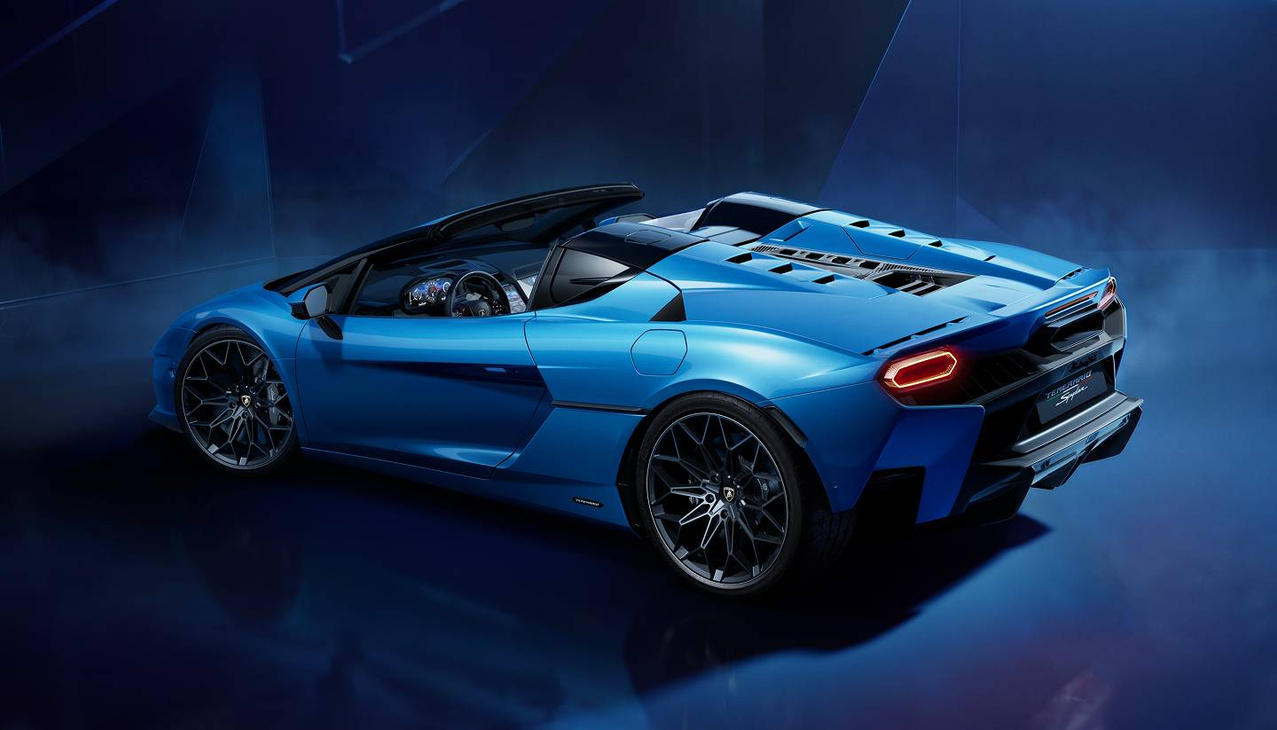
The roof uses solid panels that fold away into the rear of the vehicle.
This lets the driver switch between the open-air experience of a convertible and the closed configuration of a coupe.
Lamborghini says the mechanism was developed to preserve comfort, aerodynamics and driving precision in both configurations.
In addition, the system uses 10 electric actuators to move the assembly.
The solution eliminates the need for an electrohydraulic pump, reducing the number of components associated with this type of actuation.
Another distinguishing feature is how the roof is stowed: the panels fold vertically behind the seats.
However, the new design does not mean Lamborghini has never used hardtops on convertibles. Earlier models, such as the Aventador Roadster, already had manually removable panels.
The Temerario Spyder’s advancement is its use of an automated retractable hardtop.
V8 can reach an impressive 10,250 rpm
Another highlight of the Temerario Spyder is its engine’s ability to rev.
The twin-turbo V8 can run at up to 10,000 rpm during normal operation.
However, when using the launch system known as Launch Control, Lamborghini says the engine can reach 10,250 rpm.
The feature is activated by a button on the steering wheel, marked with a checkered flag symbol.
This puts the engine among the supercar’s most notable technical features.
In addition, the combination of electric motors and combustion power helps improve power delivery during hard acceleration.
Although electrification also appears in vehicles designed to save fuel, its application can be quite different.
In Brazil, for example, Hyundai introduced a new-generation Tucson with a 245-hp hybrid system and claimed fuel economy of up to 17.4 km/l.
In the Temerario Spyder, by contrast, the electrified powertrain is focused primarily on performance and dynamic response.
All-wheel drive and Drift Mode expand driving options
The new convertible also features electrified all-wheel drive.
The technology controls how power is distributed among the four wheels based on driving conditions.
The vehicle also offers 13 driving modes, according to the automaker.
They include Drift Mode, designed to alter the car’s dynamic behavior and allow controlled slides in appropriate conditions.
The driver can select different settings using the controls on the steering wheel.
However, these features do not eliminate the risks associated with driving at high speeds.
Performance features should be used in suitable environments, such as race tracks and other venues designed for this type of activity.
Chassis designed to maintain rigidity without a fixed roof
Turning a supercar coupe into a convertible requires more than installing a roof-opening mechanism.
That is because the upper part of the body also contributes to the vehicle’s structural rigidity.
Without that fixed structure, engineers must adapt other components to preserve stability and precise handling.
That is why Lamborghini developed a chassis specifically for the Temerario Spyder.
The automaker says the new architecture has 6% greater static torsional rigidity than the Huracán Spyder, the model it replaces.
The center of gravity is also approximately 3 millimeters lower than in the coupe configuration.
Although the difference may seem small, the position of the center of gravity is one of the factors considered when developing a sports car’s handling dynamics.
The automaker also made adjustments to preserve weight distribution and aerodynamic efficiency.
Alleggerita version uses carbon fiber to reduce weight
For buyers seeking an even more performance-focused setup, Lamborghini offers the optional Alleggerita package.
This version uses components made from lightweight materials, including carbon-fiber-reinforced polymers.
The modified parts include the front splitter, side skirts and wheels.
The changes reduce weight by about 22 kg compared with the standard Temerario Spyder.
This reduction can help improve the power-to-weight ratio.
Composite materials also make it possible to develop components with specific strength and stiffness characteristics.
Lamborghini has not yet released pricing for the Alleggerita package in Brazil.
Interior combines technology, comfort and open-air driving
The Temerario Spyder also includes features designed to make driving with the top down more comfortable.
These include a neck-heating system with three intensity settings.
The rear window is electrically operated and can be lowered independently of the roof.
This makes the engine sound more noticeable even when the car is closed up.
The cabin is also designed to accommodate occupants up to about 2 meters tall.
The front luggage compartment has a capacity of 112 liters.
The new convertible therefore aims to balance high performance with comfort features for trips and everyday driving.
Hybrids gain ground across market segments
The use of electric motors in a 920-hp Lamborghini shows how electrification has moved beyond cars designed solely to save fuel.
Automakers now use this technology in vehicles with very different goals.
While some models prioritize range and efficiency, others pair electrification with high-output combustion engines.
In Brazil, Omoda has also announced a compact hybrid SUV with about 224 hp, set to compete with established models.
That SUV’s hybrid system, however, has different characteristics from the plug-in system used by Lamborghini.
The presence of electric motors, therefore, does not mean all electrified vehicles offer the same range, performance or charging requirements.
For consumers weighing these technologies, an analysis of the costs of driving electric and hybrid cars in 2026 shows how the choice depends on driving habits and related expenses.
The Temerario Spyder, however, is primarily focused on performance and the driving experience of a luxury supercar.
How much will the Lamborghini Temerario Spyder cost in Brazil?
Lamborghini has not yet confirmed the Temerario Spyder’s price in Brazil.
However, there is an important benchmark for estimating where it will be positioned.
The Temerario coupe arrived in Brazil in December 2025 with a starting price of R$5.8 million.
Because convertible versions often require additional components and specific structural solutions, the Spyder is expected to cost more.
However, there is no official price list for the convertible in Brazil.
The automaker has also not confirmed a domestic launch date for this version.
Therefore, any price quoted at this point would be only a projection, not a price set by Lamborghini.
Lamborghini Temerario Spyder ushers in a new era for convertible supercars
The Temerario Spyder’s launch marks an important evolution in the Italian automaker’s open-top supercar lineup.
In addition to replacing the Huracán Spyder, the new model combines 920 metric horsepower, a top speed of 343 km/h and an automated retractable hardtop.
Lamborghini also developed a dedicated structure to preserve body rigidity and offer different driving configurations.
The Alleggerita package expands the options for buyers interested in reducing the vehicle’s weight.
However, the price and arrival date in Brazil still await official confirmation.
For now, the Temerario Spyder shows how the automaker plans to combine high-revving engines, electrification and new engineering solutions in its next supercars.
Which suits this type of supercar better: a retractable hardtop or the traditional fabric soft top?
Sources: Quatro Rodas, a report by Mauro Balhessa published on November 20, 2026; AutoPapo, published on November 19, 2026.


