





 Portuguese
  English
  Spanish
 4 min of reading
  21 comments





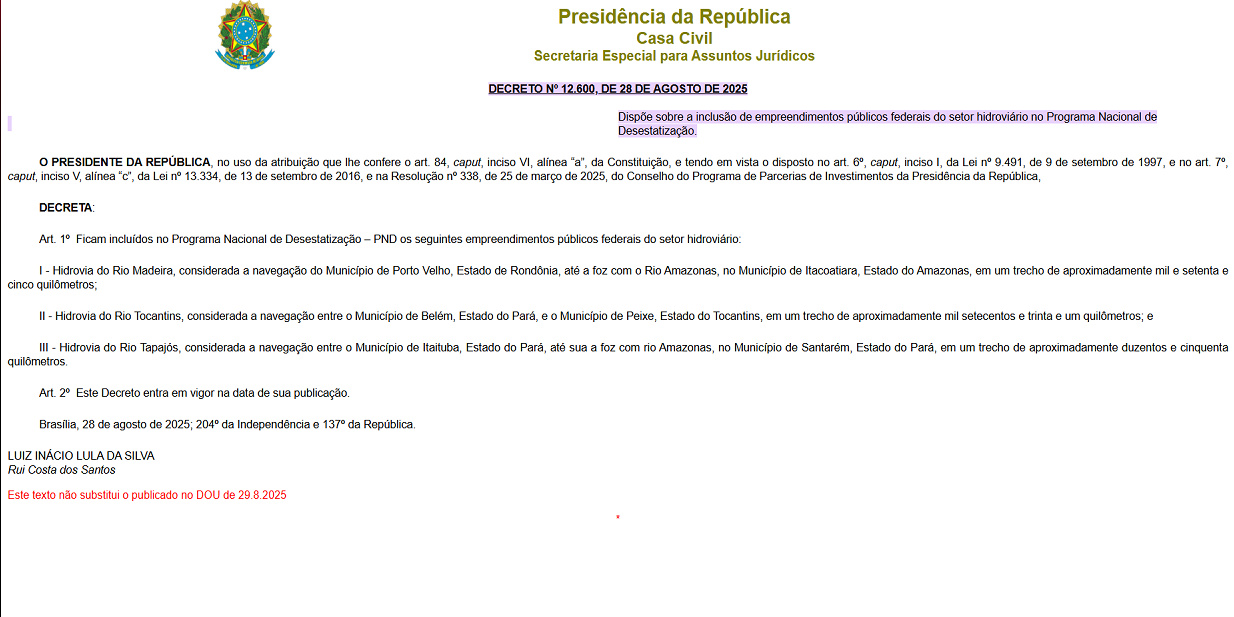
Decree No. 12,600 Includes Strategic Rivers of the Amazon in the PND; Billion-Dollar Auctions Promise to Reduce Logistics Costs and Transform the Northern Arc.
On August 29, 2025, the federal government published Decree No. 12,600, signed by President Luiz Inácio Lula da Silva. The measure includes the waterways of the Madeira, Tocantins, and Tapajós rivers in the National Privatization Program (PND) and paves the way for private concessions through billion-dollar auctions. In practice, this means that some of the most strategic rivers in the Amazon are now viewed as market assets, intended to attract large logistics groups and agribusiness operators. For the government, this is a bold step towards modernizing national infrastructure. For critics, it is a handover of natural and strategic assets to private capital.
The Strategic Rivers of the Amazon at the Center of the Dispute
The decree places three waterways vital to Brazilian logistics under privatization:
- Madeira River: a stretch of 1,075 km between Porto Velho (RO) and the mouth in the Amazon.
- Tocantins River: about 1,731 km, connecting the interior of Tocantins to the port of Belém (PA).
- Tapajós River: 250 km in Pará, connecting Itaituba to Santarém.
These routes are part of the so-called Northern Arc, a logistics corridor that has been gaining prominence by shortening the distance to international markets by up to 30%. Access the full text of the decree here
-
IPTU exemption for seniors in 2026: see how to secure the benefit.

-
The institute that trained the greatest aerospace engineers in Brazil has just opened its first campus outside São Paulo after 75 years: ITA Ceará will have R$ 445 million, new courses in energy and systems, and classes are expected to start in 2027.

-
Luciano Hang, owner of Havan, goes to Juiz de Fora after the tragedy in February, brings R$ 1 million, hands out R$ 2,000 cards, and donates up to R$ 15,000 to victims in the region.

-
The Brazilian passport allows legal residence in dozens of countries without the need for a prior visa, and most Brazilians are unaware that they can apply for residency directly upon arriving in nations in South America, Africa, and even Europe.

The Official Discourse: Efficiency and Cost Reduction
The government’s justification is pragmatic: reduce logistics costs and increase the competitiveness of Brazilian agribusiness. Studies indicate that the full utilization of these waterways can cut transportation costs by up to 40% and significantly reduce the time to transport soy, corn, and minerals to Amazonian ports.
“Every 25 barges is equivalent to 500 fewer trucks on the roads,” emphasized the Minister of Ports and Airports, Silvio Costa Filho, defending the decree as key to a more modern and sustainable logistics.
From the official perspective, the advancement of concessions will allow for fewer trucks on the roads, lower CO₂ emissions, and greater efficiency in the transportation of millions of tons of commodities that sustain Brazil’s trade surplus.
The Other Side: Sovereignty and Heritage at Stake
While the government sees progress, environmentalists, academics, and social movements are sounding the red alert. The central critique is that by handing over Amazonian waterways to private capital, Brazil may compromise its sovereignty over strategic routes, allowing external interests to dictate the pace of exploitation.
Concerns do not stop there: dredging and large-scale interventions in Amazonian rivers may alter ecosystems, harm riverside communities, and disrupt fishing cycles that sustain thousands of families. In practice, rivers that have always been sources of life risk becoming mere corridors for grains and minerals.
Billion-Dollar Auctions on the Horizon
With the decree, the expectation is that the first auctions will occur by 2026, starting with the Madeira River. The projected investments exceed R$ 100 million just in dredging, signaling, and infrastructure works, with potential to handle over 30 million tons of cargo per year.
The private sector’s interest is intense. Large agricultural trading companies and logistics operators are already monitoring the process, eyeing a market that could redefine national waterway transportation.
The Northern Arc as a Promise of Transformation
Until recently seen as a distant alternative, the Northern Arc is gaining strength as the new backbone of Brazilian agribusiness. If today nearly 70% of agricultural exports still depend on ports in the South and Southeast, it is expected that the participation of the North will grow exponentially with the waterways coming into full operation.
This logistical realignment could shift the center of gravity of national production, increasing the relevance of the Amazon not only as a biome but as a global export hub.
Amazon Waterways — Billion-Dollar Logistics — Sovereignty at Stake
Decree No. 12,600 is not just an administrative measure: it is a landmark that places Amazonian rivers at the center of a battle involving economic development, environmental preservation, and national sovereignty.
On one side, the promise of logistics efficiency, cost reduction, and international prominence in commodity trade. On the other, the fear that handing over strategic assets to private capital will turn the Amazon into a mere export route, sacrificing communities and ecosystems.
The future of the Madeira, Tocantins, and Tapajós will be decided in the coming auctions. And with them, much more than logistics is at stake: it is about defining the role of the Amazon in the 21st century, whether to remain just an export corridor or become a territory of sustainable and sovereign development.








O Rio Tocantins está sob risco de passar por processo de remoção do leito por explosão e dragagem para transformá-lo em hidrovia voltado ao escoamento de soja. Isso beneficia tão somente um grupo, o agronegócio. A comunidade, centenas de milhares de pessoas, bebem, comem, tiram seu sustento, do rio. Centenas de espécies de animais dependem do rio em um equilíbrio do ecossistema. Privatizar os rios é Matar a vida em detrimento do lucro. Bebemos agua, e comemos peixe, não dinheiro.
Eu penso que se faça uma consulta prévia entre os órgãos competentes,comunidade ribeirinhas e Governo Federal ,dizendo o seguinte: Vocês tem que fazerem as dragagens no limites ,sem que haja prejuízo para o meio ambiente e as comunidades que vivem das pescas.Quem deve ditar as regras sempre será o Governo Federal,quando houver discordância das empresas perante um assunto. Que se faça remanejamento das famílias que eventualmente vier ser afetadas,indenizada e que fique recebido um valor justo para seu sustento com o lucros do agronegócio etc e tal
Ladrã