





 Portuguese
  English
  Spanish
 3 min of reading
  0 comments


Equatorial Margin Should Boost Self-Sufficiency and Sustainable Development of Brazil
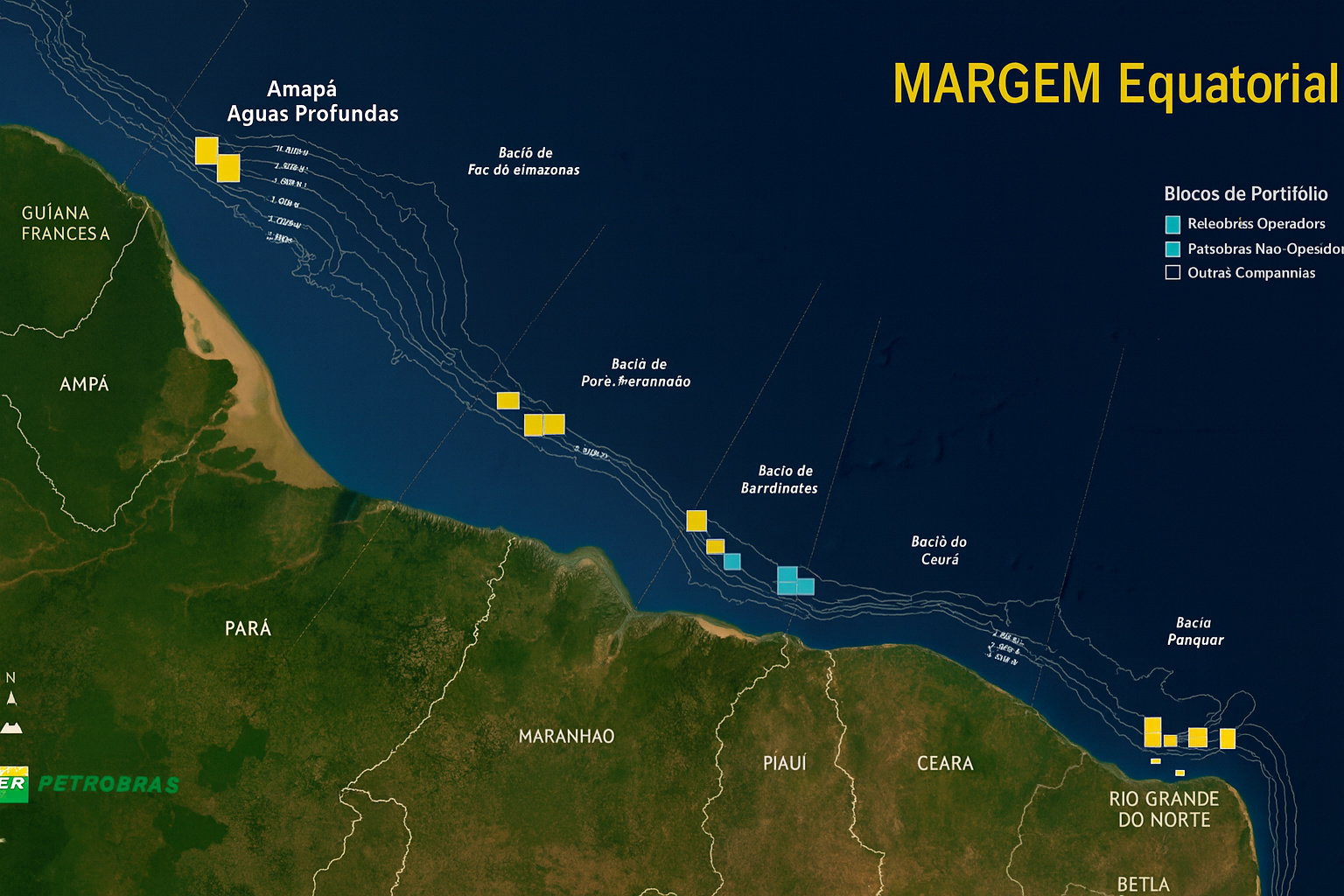
Petrobras estimates that the exploration of the Equatorial Margin, located between Rio Grande do Norte and Amapá, could add US$ 419 billion to Brazil’s GDP. Additionally, it could generate 2.1 million direct jobs, reinforcing its economic and social impact.
The study was presented by Petrobras’ General Manager of Environmental Licensing and Environment, Daniele Lomba, during a lecture at Fundação Getulio Vargas (FGV) on October 17, 2025, according to Estadão Conteúdo.
During the event, Lomba highlighted that the basins of the Equatorial Margin are larger than those in the Southeast, such as Campos, Santos, and Espírito Santo. These basins have sustained oil production since the 1950s and represent an important pillar of the national energy matrix.
According to Lomba, “from Rio Grande do Norte to Amapá is a larger area than the basins in the Southeast, so it is essential to know this potential”. Therefore, she emphasized that the development of the region is fundamental to ensuring energy self-sufficiency and enhancing national security.
New Frontier and Energy Security
In alignment with Petrobras’ president, Magda Chambriard, Daniele Lomba argued that energy addition is essential to strengthen the global security of the sector, and not just an energy transition.
She highlighted that “oil is indispensable for the planet’s energy security, and no major producer has ceased production for environmental reasons”. Thus, according to Lomba, it is necessary to balance production and environmental preservation in a strategic and responsible manner.
The executive also emphasized that the Equatorial Margin could reduce energy poverty and strengthen the Brazilian economy. Therefore, the exploration of this new frontier becomes vital to consolidate Brazil as a global energy powerhouse.
ARTICLE CONTINUES BELOWSee also
Petrobras surprises the world again by announcing a new discovery in the pre-salt with excellent quality oil.

Offshore industrial demand in Macaé skyrockets with the recovery of oil and gas and could grow by up to 396% by 2026 in the Campos Basin.
Offshore industrial demand in Macaé surges with the recovery of oil and gas and could grow by up to 396% by 2026 in the Campos Basin.
Brazilian giant expands borders in the Southeast: Petrobras confirms new oil discovery in ultra-deep waters in the pre-salt of the Campos Basin.

Billion-Dollar Impact and Job Creation
Petrobras’ study presents optimistic projections regarding the economic impact of the region. Inspired by the experience of Guyana, which currently produces about 700,000 barrels of oil per day, the simulation indicates that Brazil can achieve substantial results.
According to the survey, the full exploration of the Equatorial Margin could generate 2.1 million direct jobs and add US$ 419 billion to the national GDP. Additionally, an estimated revenue of US$ 25 billion in taxes and US$ 20 billion in royalties and special participations is anticipated.
These figures reinforce the role of the region as a driver of economic growth and increased public revenue. Thus, Petrobras strengthens its goal of ensuring energy security and sustainable development.

Sustainable Development Perspective
The survey indicates that the Equatorial Margin is one of the main vectors of energy self-sufficiency and sustainable growth of the country. Moreover, the project seeks to balance environmental responsibility and economic return.
For comparison, the GDP of Amapá in 2025 is approximately US$ 23 billion, a value far lower than the impact estimated by Petrobras. This contrast demonstrates the size of the economic potential of this new frontier.
The company states that all activities will follow stringent environmental standards, in accordance with the requirements of the Brazilian Institute of Environment and Renewable Natural Resources (IBAMA). Thus, the project reinforces the state-owned company’s commitment to sustainable practices.
Geographic Context and Licensed Operation
The Brazilian Equatorial Margin encompasses an extensive stretch of the coast of the North and Northeast, extending from Rio Grande do Norte to Amapá. This region has attracted great technical and economic interest from both Petrobras and the federal government.
In October 2025, Petrobras obtained an operation license from IBAMA to begin exploratory drilling in the FZA-M-059 block, in deep waters off Amapá. The area is located about 500 kilometers from the mouth of the Amazon River and 175 kilometers from the coast, making it one of the most promising zones along the Brazilian coast.
This advancement represents an important milestone for national energy self-sufficiency and consolidates Brazil as an example of responsible and sustainable resource exploration.








Seja o primeiro a reagir!