






 Portuguese


Sabrina Gonzalez Pasterski started flying at the age of 9, built a single-engine aircraft as a teenager, and now leads research on celestial holography in Canada, seeking answers to a problem that even Albert Einstein could not solve
Sabrina Gonzalez Pasterski built and piloted her own plane before she turned 16, attended MIT and Harvard, and had her research cited in works associated with Stephen Hawking.
Currently, the American physicist leads a team dedicated to understanding some of the universe’s deepest laws.
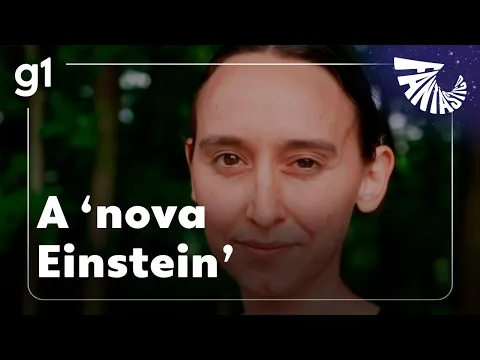
Her academic trajectory and work on gravity, particles, and space-time have earned her the nickname “the new Einstein”.
-
At 76, Businessman Revives Law Dream Nearly Six Decades Later, Graduates and Passes National Bar Exam

-
Quiet Town in Bahia Hides 17 km of Caves, Giant Halls Over 50 Meters, Crystal Clear Waters, and Rare Crystals Under the Chapada Diamantina

-
From a 485 square foot Fabric Store to a Museum: Havan’s 40 Year Journey to Success
-
From 600 Meters of Unsold Silk to One of Brazil’s Most Recognized Fashion Brands: Dudalina’s Story Began at Home with Resourcefulness, Seamstresses, and a Solution Found for Overstock


Despite rejecting the comparison, Sabrina is investigating one of the problems that challenged the German physicist: reconciling general relativity with quantum mechanics.
The “new Einstein” nickname gained international recognition
Sabrina began being called the “new Einstein” after her early scientific works gained international attention.
The comparison was bolstered by the area of research she chose. Like Einstein, she seeks to understand the fundamental laws that govern space, time, matter, and gravity.
Her early achievements also helped fuel the nickname. Before turning 30, Sabrina had already attended some of the world’s most recognized academic institutions.
However, the title has never been embraced by the scientist.
In an interview with the Perimeter Institute for Theoretical Physics, Sabrina stated that the comparison created a difficult pressure to manage.
The researcher considers the nickname exaggerated and believes it emerged mainly from sensational headlines published by the media.
The attention also drove Sabrina to increase her dedication to her studies. She wanted to demonstrate that her scientific work did not depend on that association.

Interest in the sky began in childhood
Born in Chicago, Illinois, in 1993, Sabrina grew up fascinated by aviation and space exploration.
As a child, the Harry Potter fan asked for a flying broomstick as a Christmas gift.
At that age, she did not fully grasp where fantasy ended and the possibilities offered by science began.
Her family responded to her wishes by encouraging her to learn how to fly.
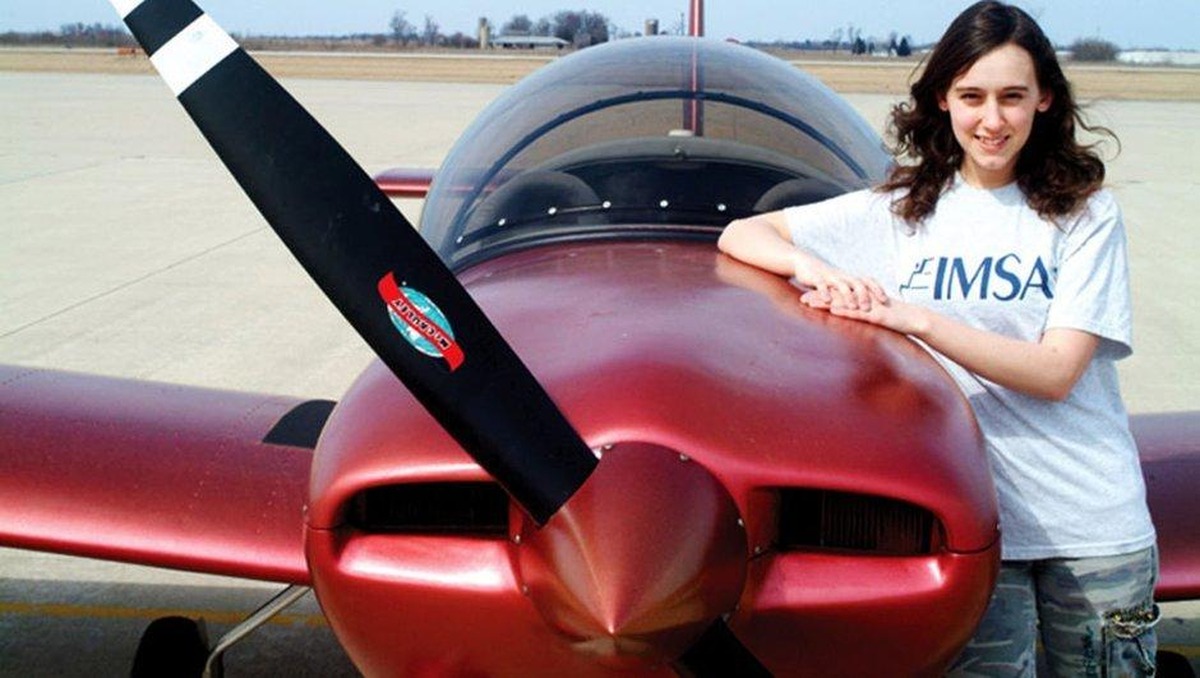
Sabrina began taking flying lessons at the age of 9. Shortly thereafter, she decided that merely flying an aircraft built by others would not be enough.
Single-engine aircraft construction began at age 12
At 12, Sabrina started assembling a single-engine airplane from a kit.
The project required hundreds of hours of work, component installation, and technical knowledge about how an aircraft operates.
Sabrina also made modifications to enhance the safety of the structure. Each stage needed to be understood before the aircraft could take off.
According to the Perimeter Institute, she completed the aircraft by the age of 14. By the time she turned 16, she had already built and piloted her own plane.
The experience transformed her childhood interest in the sky into a concrete engineering project.

Construction of the Aircraft Aided Her Entry into MIT
While assembling the plane, Sabrina recorded videos explaining physics concepts.
The content covered laws formulated by Isaac Newton, Albert Einstein, and other scientists who changed the understanding of the universe.
The project functioned as a real-world science fair.
In addition to fitting parts and testing systems, Sabrina needed to understand the forces that keep an aircraft in the air.
The experience also contributed to her acceptance into the Massachusetts Institute of Technology, MIT.
Initially placed on the waitlist, Sabrina eventually secured admission and directed her academic focus towards physics.
Graduation Completed with the Highest GPA in the Program
In 2013, Sabrina graduated from MIT with the highest GPA in the Physics program.
Her performance earned her the Joel Matthew Orloff Award, given by the university’s Physics Department.
This achievement reinforced her image as a young prodigy and fueled comparisons with Albert Einstein.
The education also paved the way for Sabrina to move beyond aviation-related projects and engage with more fundamental questions about nature.
Sabrina’s involvement in aviation led her to significant institutions in the aerospace sector.
While still young, she completed an internship at Blue Origin, the space company founded by Jeff Bezos.
She later worked at NASA’s Kennedy Space Center and in Boeing’s advanced projects division.
Sabrina also participated in research related to the CMS experiment located at the Large Hadron Collider (LHC).
These opportunities could have steered the researcher toward a career in aerospace engineering.
However, she chose to seek answers to even deeper questions.
Her interest shifted from merely constructing the aircraft of the future to understanding the very rules that govern the universe itself.
Ph.D. at Harvard Expanded Her Role in Theoretical Physics
After completing her undergraduate degree at MIT, Sabrina began her Ph.D. studies at Harvard University.
She conducted her research under the guidance of physicist Andrew Strominger, known for his work on quantum gravity and string theory.
During this time, Sabrina participated in studies on symmetries, gravitational waves, and the permanent effects induced in spacetime.
One of these studies explored the so-called spin memory effect.
This phenomenon is related to the imprints that gravitational waves may leave after passing through a certain region of the universe.
Works Cited in Research by Stephen Hawking
Research conducted by Sabrina and her collaborators has been cited in works associated with British physicist Stephen Hawking.
This reference has enhanced the young scientist’s international profile and solidified her presence in high-energy theoretical physics.
In 2019, Sabrina completed her Ph.D. with her thesis titled Implications of Superrotations.
Her education at Harvard marked the transition from a young woman known for building an airplane to a researcher dedicated to some of the greatest unresolved problems in science.
Relativity and Quantum Physics Still Don’t Fit Together
The comparison with Einstein is also related to the scientific problem Sabrina is studying.
Modern physics has two extremely successful theories, yet they do not operate together under certain circumstances.
General relativity, developed by Albert Einstein, explains gravity and describes spacetime on a large scale.
This theory allows for the understanding of the movements of planets, stars, and galaxies, as well as the behavior of phenomena like black holes.
Quantum mechanics, on the other hand, describes particles and microscopic phenomena.
Its principles are present in technologies such as computers, smartphones, sensors, and medical devices.
Both theories yield extremely precise results within their respective fields. The problem arises when both need to be applied simultaneously.
Black Holes Expose the Limits of Current Theories
Inside a black hole, gravity and quantum phenomena coexist simultaneously.
A similar condition would have occurred during the early moments of the universe when all matter and energy were concentrated in an extreme environment.
The available mathematical structures still do not provide a complete description of these situations.
Einstein spent part of his life searching for a theory capable of unifying the forces of nature. That attempt was never completed.
Sabrina is working on a new front of this search, building on scientific advancements accumulated over decades.
Celestial Holography Offers a New Approach
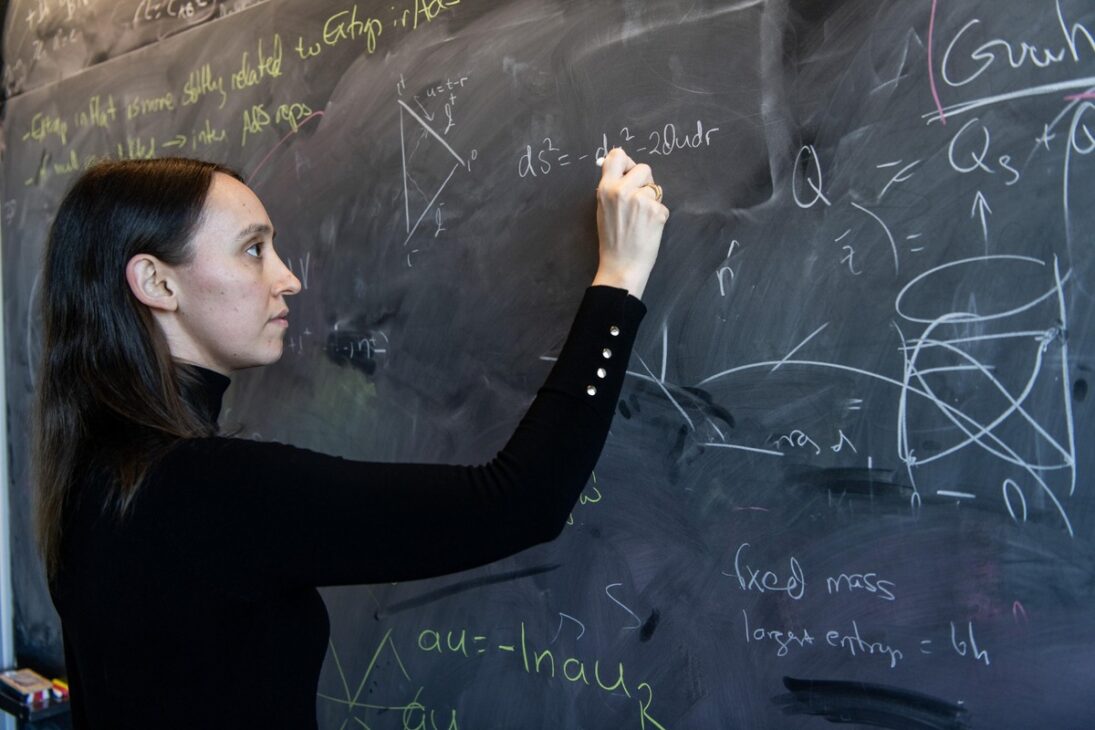
Sabrina’s current work is focused on celestial holography.
This field attempts to describe phenomena in a four-dimensional spacetime through a mathematical theory situated at a two-dimensional boundary.
The principle can be compared to how a hologram works.
The image appears three-dimensional, although the information needed to produce it may be encoded on a flat surface.
This does not mean that the universe or humans are literally holograms.
The proposal serves as a mathematical tool to represent the same reality using a different language.
This new description may make certain calculations more accessible.
In this way, physicists seek to investigate problems that are difficult to solve directly in conventional spacetime.
Harvard University describes celestial holography as an approach that connects quantum gravity, scattering amplitudes, and new symmetries.
Initiative Created in Canada
Sabrina joined the Perimeter Institute, located in Waterloo, Canada, in 2021.
At the research center, she founded the Celestial Holography Initiative.
The group brings together experts in mathematical physics, quantum fields, amplitudes, and quantum gravity.
The team investigates whether the phenomena of the universe can be mathematically described by information encoded on a celestial sphere.
According to the official profile of the researcher, Sabrina also serves as deputy director of the Simons Collaboration on Celestial Holography.
The initiative has not yet found a definitive theory capable of explaining the universe.
However, the project offers a new path to investigate questions that challenge successive generations of physicists.
Search Defined as the “Source Code of the Universe”
The nickname “new Einstein” accompanies Sabrina because her research addresses issues similar to those faced by the creator of the theory of relativity.
The comparison does not mean that she has replaced Einstein or made an equivalent scientific discovery.
There is also no official academic evaluation responsible for granting this type of title.
The expression summarizes a trajectory marked by precocity, involvement with renowned institutions, and the attempt to solve one of the greatest problems in physics.
In a report published by the MIT Department of Physics, Sabrina defined her search as an attempt to find the “source code of the universe”.
The girl who once asked for a flying broom is now building airplanes and, subsequently, formulating equations about the structure of spacetime.
Today, despite rejecting the title of “new Einstein,” Sabrina works at the same scientific frontier that made Albert Einstein one of the most famous physicists in history.
In your opinion, what stands out more in this journey: Sabrina building her own airplane before the age of 16 or now trying to unite the two major theories that explain the universe? Leave your comment.


