





 Portuguese
  English
  Spanish
  5 min of reading
  1 comment


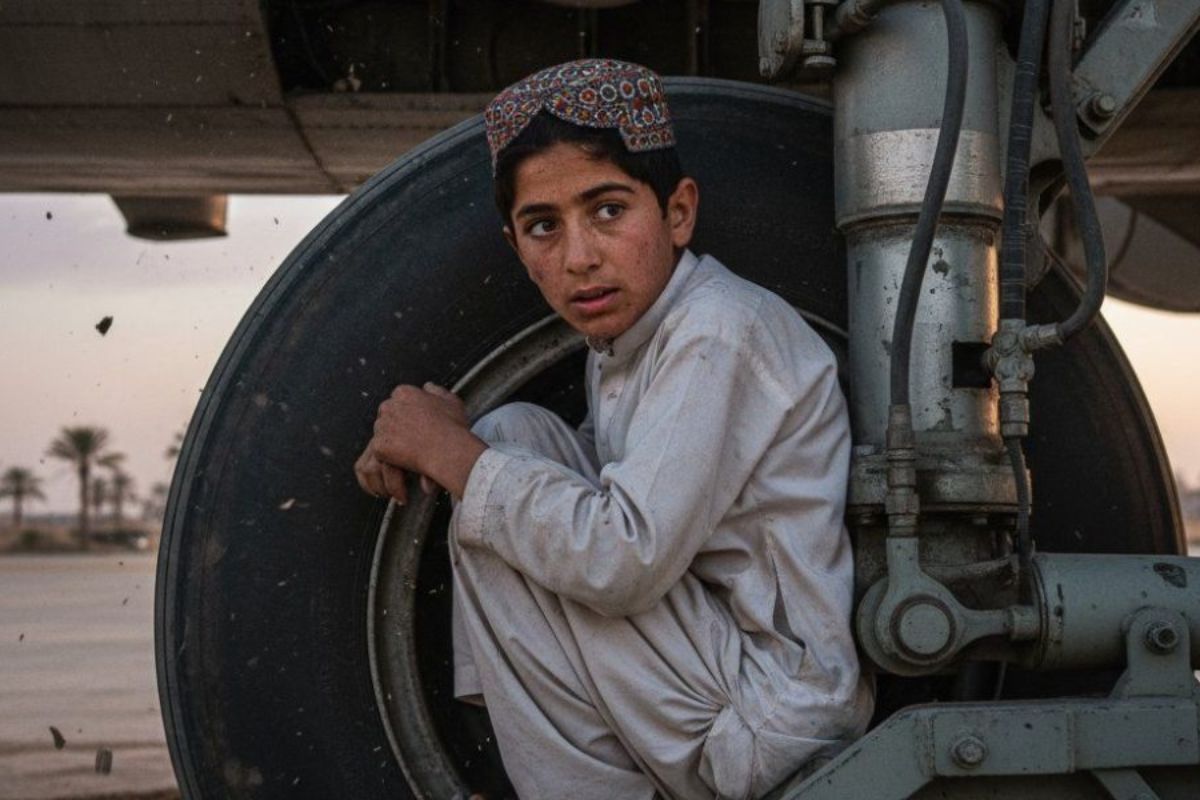


In Delhi, A 13-Year-Old Boy Disembarked From The Cabin After Being Found Dazed On The Runway Of Indira Gandhi International Airport, After A Short Flight From Come Air Coming From Kabul, Hiding In The Landing Gear Compartment, In Extreme Cold, Nearly Without Oxygen And Risk Of Death For Authorities
A 13-year-old boy starred in a rare and extreme case on the Kabul to Delhi route, traveling hidden in the rear landing gear of an aircraft and appearing alive after landing at Indira Gandhi International Airport in Delhi, India. He was not in the cabin, had no seat, and faced an environment described as almost freezing metal, strong winds, absence of heat, and minimal oxygen.
The episode occurred on a Come Air flight coming from Kabul, with a duration described as about an hour and a half. When the aircraft landed, ground and security teams noticed something unusual: the 13-year-old boy was walking dazed around the runway’s circulation area, but alive, revealing a clandestine crossing that usually ends in death.
What Happened On The Landing In Delhi

The decisive sequence occurred after touchdown on the runway in Delhi.
-
The Brazilian colonial city that stopped in time and shares territory with a rocket launch base.

-
79-year-old woman challenges limits, visits 193 countries in the world after 56 years of planning and reveals the behind-the-scenes of a global journey that few have managed to accomplish.

-
These are the drivers who may stop paying tolls on highways in a project that promises to reduce costs for those who live from transportation in Brazil.

-
(Video): Italian pilot lands plane on moving train at 120 km/h and achieves unprecedented feat in aviation, even with a narrow runway and without direct visual contact.


With the aircraft already on the ground, the ground crew and security identified the unexpected presence of the 13-year-old boy outside the normal flow of passengers.
He was not a passenger, according to the case description, and appeared on the runway after emerging from the landing gear compartment.
The scene, at an international airport, generated an immediate reaction.
The 13-year-old boy was seen as a case of extreme risk and also as an operational alert, as his presence indicated that he had managed to access a critical area of the aircraft before takeoff in Kabul.
Wheel Compartment: A Space Not Meant For Humans
The place where he hid is described as the wheel compartment, an empty space where the landing gear retracts after takeoff.
It is an area that is not intended for human travel and, when the plane ascends, the compartment can close hermetically, cutting off the airflow.
The conditions are described as severe.
The temperature can drop to -50°C, and the oxygen level is so low that most people faint within minutes.
The cited history is of similar attempts around the world with fatal outcomes, due to freezing or choking, making the survival of the 13-year-old boy statistically improbable.
Extreme Cold, Almost No Oxygen And The Short Duration Of The Flight


The crossing occurred on a flight considered routine, but with a completely out-of-standard outcome.
The journey from Kabul to Delhi was described as a short flight of about an hour and a half, a detail pointed out as a possible factor that increased the chance of survival.
Still, the scenario is narrated as almost impossible: dark, cold, with insufficient oxygen and constant risk.
The case records that it is not clear how the 13-year-old boy managed to endure throughout the journey.
Among the hypotheses raised in the account, appear the relatively shorter duration and the possibility of a young body being able to withstand the lack of oxygen better than an adult, without this being asserted as certainty.
How He Entered And What Remains Unanswered
The 13-year-old boy said he sneaked into Kabul airport and managed to climb into the landing gear without being detected.
From that point, with the aircraft already airborne, he would have been trapped in a dark and freezing space, without access to the cabin and without conditions of survival considered normal.
The case itself reinforces gaps: there is no clarity on what exactly allowed him to remain conscious and alive until landing.
The contrast between what usually happens in similar attempts and the final result in Delhi is what makes the episode exceptional and disturbing for those dealing with aviation safety.
Detention, Medical Examination And Return To Kabul On The Same Day
After being found in Delhi, security forces, including the CISF, detained the 13-year-old boy.
He was interrogated, underwent a medical examination, and, according to the report, was sent back to Kabul on the same day.
The authorities also reported the discovery of a small object in the compartment: a red speaker that the 13-year-old boy was carrying.
The item appears as a material detail that confirms his presence in that space and reinforces that it was not an “adventure,” but a desperate decision.
Kundus, Despair And The Border Crossed In The Skies
The case associates the motivation to a frame of vulnerability.
The 13-year-old boy is described as coming from Kundus, a city situated in a context of war in Afghanistan.
The account points to possibilities such as fear, poverty or hope for a better future as forces that push people to extreme choices.
The Kabul-Delhi crossing, even being a short flight, is treated as a symbol of a larger phenomenon: people risking their lives to cross borders, hidden in trucks, in boats or, as in this case, in the landing gear compartment of an aircraft.
Most do not survive, and the survival of the 13-year-old boy is described as something close to a miracle.
Airport Security And The Alert That Remains In Kabul
The episode also raises direct questions about access control at Kabul airport.
The operational question is simple and heavy: how did a child manage to escape surveillance and reach such a critical area unnoticed?
At the same time, the case pushes the debate into a humanitarian dimension.
It serves as a reminder of the emergencies that lead people to extremes, where the risk of death begins to seem acceptable in the absence of options.
What happened after the 13-year-old boy returned to Kabul remains uncertain in the account itself.
The Fine Line Between Life And Death At 30,000 Feet
The case is summarized as a direct contest between the limits of the body and hostile conditions.
The account mentions that scientists might call the phenomenon survival of hypoxia or hyperthermia, while common sense would treat it as impossible.
What remains recorded is that the 13-year-old boy endured freezing air, lack of oxygen, and the physical danger of being so close to the aircraft’s wheel.
From the icy darkness of the compartment to the illuminated chaos of Delhi airport, the journey is treated as extraordinary by experts and the public, not for heroism, but for brutally exposing what someone tries to do when they believe they have no alternatives.
Do you think that this case of the 13-year-old boy points more to security failures in Kabul or to the level of desperation that drives people to risk everything to cross borders?








Muito triste