





 Portuguese
  English
  Spanish
  5 min of reading
  4 comments


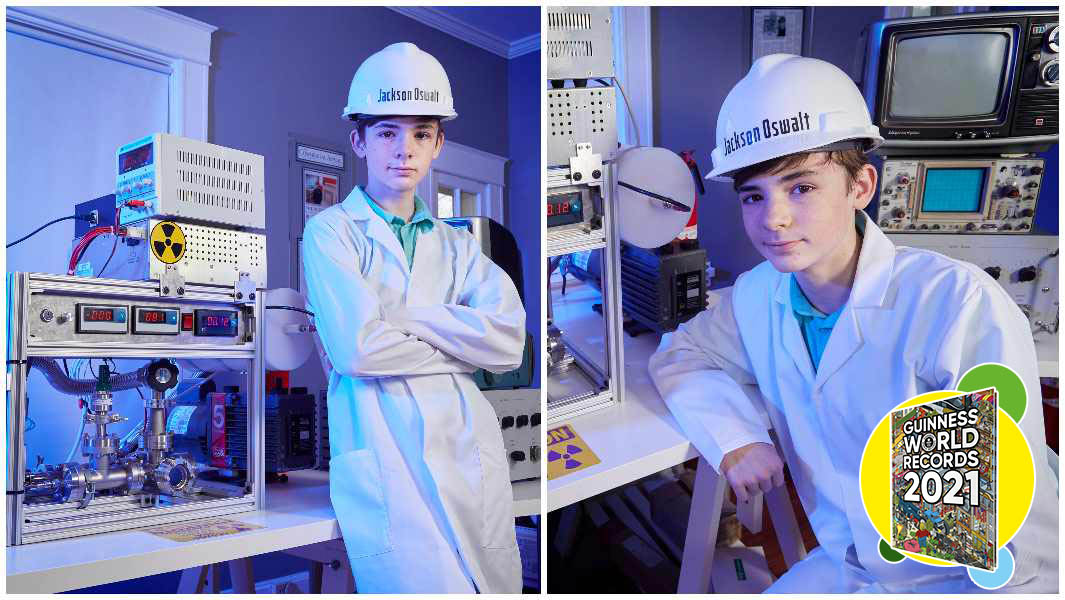


Young Science Prodigies Tend To Impress The World, But Some Inventions Can Go Too Far. A 13-Year-Old Boy Decided To Build A Nuclear Fusion Reactor In His Room, Catching The Attention Of Authorities And Resulting In An Unexpected Visit From The FBI To Investigate The Case.
While many teenagers spend hours on social media or playing video games, Jackson Oswalt, a resident of Memphis in the United States, dedicated his time to an unusual project: building a nuclear fusion reactor.
At the age of 12, he managed to achieve nuclear fusion in a laboratory set up inside his own home, becoming the youngest to achieve this feat in the U.S. Oswalt entered the Guinness World Records as the youngest person to successfully achieve nuclear fusion.

The experiment was completed on January 19, 2018, just hours before his 13th birthday.
-
They were brilliant! Scientists discover that our ancestors in China were already making super advanced tools 160,000 years ago, changing everything we knew.

-
Scientists unveil 3 million years of climate secrets hidden in the ice of Antarctica.

-
Ancient farmers created “aggressive plants” that changed nature forever.

-
Astronomers find a “backward” solar system that ignores all the rules of space and leaves scientists scratching their heads!


The reactor, developed by the teenager, uses a complex system of vacuums, pumps, and steel chambers to fuse atoms and generate energy.
The process mimics the workings of the Sun and other stars, where the fusion of atomic nuclei releases large amounts of energy.
Unlike nuclear fission, technology used in conventional nuclear power plants, fusion does not produce highly radioactive waste, making it a promising alternative for clean energy generation in the future.
The Beginning Of The Nuclear Fusion Reactor
The idea emerged when Jackson was 12 years old. He decided he wanted to do something more productive than just playing Fortnite.
Fascinated by nuclear energy, he began researching the topic online. During his search, he discovered the story of Taylor Wilson, a young person who built a nuclear fusion reactor at the age of 14 in 2008.
Determined to beat that record, Jackson launched his project. He first studied what other enthusiasts had done and made a list of necessary parts, acquiring most of them through eBay.
However, many of the components were not exactly what he needed, requiring modifications. He spent months learning about the functionality of each component and how to adapt the parts he purchased.
The research phase was intense. Jackson watched videos, read academic articles, and participated in specialized forums.
Every piece of information he absorbed was tested in practice, which made the process time-consuming and challenging. He didn’t have the help of teachers or scientists, only his determination and the knowledge shared online.
The Challenge Of Building A Reactor
Transforming an old game room into a laboratory, Jackson received financial support from his parents, spending between US$ 8,000 and US$ 10,000 on components.
The assembly was a process of trial and error.
Without a clear manual, he relied on his own research and the collaboration of amateur physicists in the forum Open Source Fusor Research Consortium.
Initially, understanding the mechanisms was challenging, but over time, each piece fitted into the puzzle.
Precision was essential. Small errors could compromise the entire system. Jackson had to build vacuum chambers and test different materials until he found the most suitable ones to withstand high temperatures.
Controlling the flows of deuterium gas and the stability of the plasma were some of the most complex challenges faced by the young scientist.

Safety And Risks
Jackson’s father, Chris Oswalt, did not fully understand what his son was doing. To ensure his safety, he asked experts to explain the risks involved, such as exposure to radiation and the dangers of working with 50,000 volts of electricity.
Despite his concerns, Chris was impressed by his son’s dedication. For an entire year, Jackson studied daily, faced failures, and kept working until he achieved his goal.
Safety was one of the most critical aspects of the project. Jackson needed to learn how to measure radiation levels, create protective barriers, and ensure that all electrical connections were secure.
He invested time understanding shielding mechanisms to prevent radiation leaks, minimizing risks as much as possible.
The FBI Visit
According to Indiatimes, one day, a van full of FBI agents parked near the garage entrance. A group of police officers, wearing tactical jackets, got out and knocked on the door.
The young man had certainly dreamed of people approaching him, but never in his wildest dreams did he imagine the FBI would show up at his door.
However, the agents did not invade the premises as in search operations. Instead, they approached Jackson Oswalt’s parents politely, asking for permission to inspect his “project” and assess potential radiation levels.
Armed with a Geiger counter, the agents did not detect any danger. With the safety measures properly verified, Oswalt continued his journey to achieve nuclear fusion.
The Achievement Of Fusion
Jackson documented the entire process in the research forum until, on January 19, 2018, just hours before turning 13, he achieved nuclear fusion.
He combined two deuterium gas atoms in the reactor’s core, generating a neutron that was detected, confirming the success of the experiment.
Richard Hull, administrator of the website Fusor.net and a retired electronics engineer, verified the results and confirmed Jackson as the youngest to achieve this feat in the United States and possibly the world.
Jackson’s achievement impressed scientists and nuclear physics enthusiasts. The success of the experiment demonstrates how young people can explore scientific knowledge independently, driven by curiosity and access to information.
The Future Of Nuclear Fusion
Although Jackson managed to achieve nuclear fusion, humanity is still far from building a reactor that produces more energy than it consumes. Currently, scientists are working to develop a viable system that can power homes and buildings.
Dr. Jingbiao Cui, a professor at the University of Memphis, emphasizes the complexity of the challenge. “Creating a fusion reactor that produces electricity is still a distant goal. That’s why Jackson’s achievement is amazing“.
Jackson’s Focus Shifted To AI
In September 2024, Jackson announced on his account on X (formerly known as Twitter) that he was dropping out of the University of Southern California (USC) to join the hardware team at Midjourney, a company specializing in artificial intelligence.
According to his LinkedIn profile, at Midjourney, Jackson is involved in the design of an AI-enabled hardware product, aimed at providing users with perfect memory and a personalized assistant.
With information from FoxNews and IndiaTimes.









QUAL PAI NO MUNDO NÃO TEM 10 MIL DOLARES, MISEROS 52 MIL REAIS PARA COMPRAR ALGUNS BRINQUEDINHOS PARA O FILHO MONTAR UM REATOR DE FUSÃO NUCLEAR ? OBVIAMENTE TEREMOS MUITOS PEQUENOS GENIOS DE 11, 10, E ATÉ MENOS ANOS NO BRAZIL E NO MUNDO, A REPETIR A FAÇANHA!!!!
Como tudo de bom tem seu preço;tem a natureza com tornados ,furacões e neves fortes em que todos esses fatores da natureza e aliados aos seus psicopatas,tem levado a mortes de muitos americanos. Tudo tem seu preço, cada nação com seus problemas.
Num país de tantos talentos em premios nobel,não é supresa que a juventude se ocupe com coisas mais importantes de que as fúteis.