





 Portuguese
  English
  Spanish
  4 min of reading
  0 comments


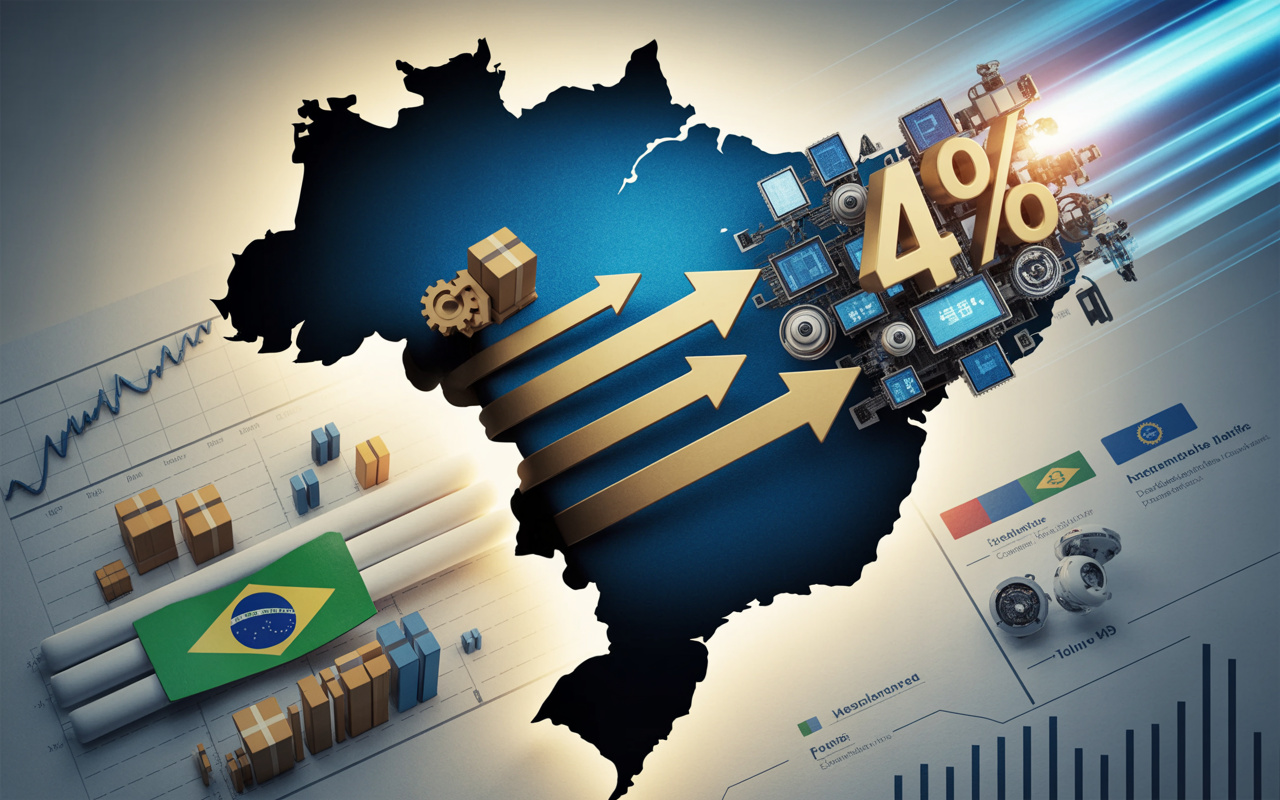
Brazil Signs Dozens Of Technological Cooperation Agreements, But Only 4% Of Manufactured Exports Are High Technology, According To World Bank.
Brazil maintains technological cooperation agreements with dozens of countries and institutions, in a network that should serve as a lever for innovation and for integration into global value chains. These treaties involve strategic areas such as biotechnology, semiconductors, renewable energy, and artificial intelligence. However, the numbers revealed by the World Bank expose a concerning paradox: in 2023, only 4.17% of Brazilian manufactured exports could be classified as high technology.
The data shows a gap between rhetoric and practice and reinforces Brazil’s historical difficulty in transforming science into wealth.
The Modest Weight Of High Technology In Brazilian Exports
According to the World Bank series “High-technology exports (% of manufactured exports),” Brazil performs far below other emerging economies.
-
“No one will make us change the Pix,” says Lula after the US report.

-
Lula responds directly to Trump and says that Pix is from Brazil and will not change under pressure from anyone, after a report from the United States pointed out the Brazilian payment system as an American trade barrier.

-
Amazon has just announced a new fee on all deliveries, and your online purchases will become more expensive starting April 17, including for those buying from the United States here in Brazil.

-
He sold his share for R$ 4 thousand, saw the company become a giant worth R$ 19 trillion, and missed the opportunity of a lifetime.


While countries like South Korea and China manage to surpass 25% to 30% of their high technology manufactured exports, Brazil hovers around 4%.
This means that even with scientific advances in areas such as tropical agriculture, health, and clean energy, the capacity to transform knowledge into sophisticated products for the foreign market remains limited.
The Brazilian export agenda continues to be dominated by agricultural and mineral commodities, as well as low value-added industrial products.
The Contradiction Of International Agreements
The Itamaraty lists over 40 bilateral cooperation agreements in science, technology, and innovation signed by Brazil with countries in Europe, Asia, and the Americas.
These treaties include researcher exchanges, joint research projects, and training programs. On paper, the country has the foundation to expand its technological insertion in global trade.
But in practice, the results are modest. A large portion of the agreements remains restricted to academic exchanges or isolated initiatives, without developments on an industrial scale. The lost link between science and market remains one of the greatest challenges for Brazil’s innovation system.
Why Can’t Brazil Take Off In High Technology Exports?
Experts point to at least four factors that explain Brazil’s difficulties:
Low Investment In R&D – Brazil invests around 1.2% of GDP in research and development, well below the OECD average (2.7%) and far from leaders such as South Korea (4.9%).
Lack Of University-Industry Integration – A large portion of scientific production remains in universities and does not reach the productive sector.
Outdated Industrial Structure – Early deindustrialization reduced the base of companies capable of competing globally in cutting-edge segments.
Hostile Regulatory And Tax Environment – Tax complexity and bureaucracy hinder the attraction of investments in innovation.
These bottlenecks help explain why Brazil continues to export quality scientific knowledge (in articles and research), but cannot convert this capital into high technology products in the global market.
Comparisons That Expose The Backwardness
While Brazil remains at 4%, countries like:
- China: 27% of manufactured exports in 2023 were high technology.
- South Korea: 30% in the same period.
- Mexico: about 17%, driven by the automotive and electronics sectors.
The comparison shows that the problem is not a fate of emerging countries, but rather a reflection of strategic choices.
For example, Mexico took advantage of its proximity to the USA and the NAFTA/USMCA agreements to insert itself into global high technology chains. Brazil, on the other hand, maintained a focus on commodities.
Economic Consequences
The low participation of high technology in exports has direct effects:
- External Vulnerability – The country depends on the international prices of soy, minerals, and oil to balance its external accounts.
- Low Competitiveness – Products with little sophistication face fierce competition in the global market with smaller margins.
- Qualified Unemployment – The lack of cutting-edge industries limits the absorption of highly qualified labor.
- Loss Of Protagonism – In a world driven by digital and energy transition, Brazil risks consolidating as merely a supplier of basic inputs.
Paths To Change The Scenario
For experts, reversing this situation requires a consistent innovation policy. Among the proposed measures are:
- Increase Investments In R&D – getting closer to the average of developed countries.
- Strengthen University-Industry Integration – with incentives to transform research into products.
- Stimulus For The Semiconductor, Biotechnology, And Clean Energy Industry – strategic sectors for the 21st century.
- Insertion In Global Value Chains – seeking trade agreements that facilitate Brazil’s participation in technological segments.
Without these changes, the country will remain trapped in the role of commodity exporter, wasting the scientific potential accumulated over decades.
Brazil has human capital, scientific knowledge, and natural resources to be a powerhouse in innovation. But reality shows that, while other emerging economies advance in high technology, the country maintains an export agenda concentrated on basic products.
A country that signs dozens of technological cooperation agreements, but only converts 4% of manufactured exports into high technology, according to the World Bank.








-

-

-

-

-

-

154 pessoas reagiram a isso.