





 Portuguese
  English
  Spanish
  3 min of reading
  0 comments


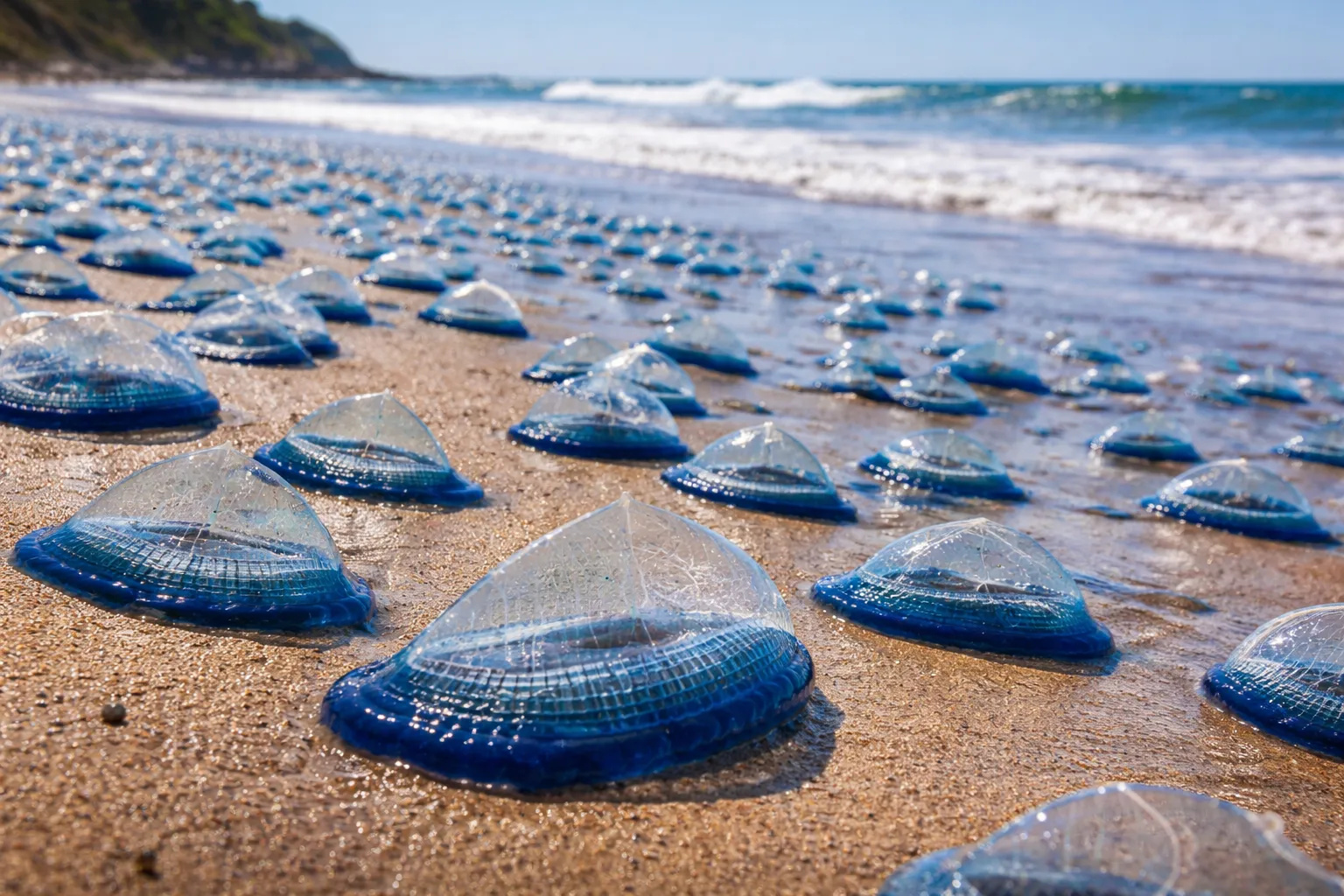
Thousands of Gelatinous, Translucent Marine Organisms Have Started Appearing Simultaneously on California Beaches, Forming Extensive Bluish Mats on the Sand and Drawing Attention for Their Unusual Volume, Exotic Appearance, and Concentration Observed in a Short Time Frame
Thousands of gelatinous marine organisms known as velellas have begun to wash ashore since March 30 on California beaches, especially in the San Francisco Bay, driven by winds, currents, and ocean upwelling, a seasonal phenomenon that may increase the number of appearances in the coming days.
The animals, scientifically called Velella velella, accumulate in large numbers along various beaches in Northern California, drawing attention for their bluish, translucent aspect and their jellyfish-like appearance.
Despite their visual similarity, velellas are more closely related to the Portuguese man o’ war (Physalia physalis), a species known for more intense stings, according to specialists monitoring the phenomenon observed this week.
-
The most consumed fruit in the world is under pressure: the fusarium fungus tr4 is spreading through Cavendish banana crops, weakening plants, threatening harvests, and prompting experts to intensify research for resistant varieties.

-
Workers were digging normally and came across a 300-year-old cannon, nearly 3 meters long and weighing over a ton, buried in an old dock area in the United Kingdom.

-
The water cooling system of the nuclear fuel pool in Fukushima has resumed operation.

-
With images from NASA’s Juno spacecraft, researchers detected lightning on Jupiter that is up to 100 times stronger than that on Earth.
Each velella can reach up to 4 inches, about 10 centimeters in length, and is not a single organism but rather a colony formed by hundreds of smaller individuals, each with specific functions.
These colonies have a sail in the shape of an S that projects above the sea surface, allowing them to be carried by the wind, while small tentacles remain submerged capturing prey in the open ocean.

Upwelling and Wind Changes Explain Stranding
According to Jennifer Stock, an education specialist at the Greater Farallones National Marine Sanctuary, the west coast is entering this time of year known as the ocean upwelling season.
The process occurs when cold, nutrient-rich waters rise from the depths, altering currents and wind patterns, factors that directly influence the movement of organisms that depend exclusively on these natural forces.
According to Stock, the massive presence of velellas indicates a change in winds and currents, directing colonies that usually live in the open sea straight to the California coast.
As these organisms cannot orient themselves or swim actively, they end up stranded on the sand until the tide carries them back to the ocean or they die, a common phenomenon in such events.
Recent Storms and New Arrivals Expected
In recent weeks, winds coming from the north and storm systems have transported large quantities of velellas to the San Francisco Bay, a scenario that may repeat itself in the coming days, according to oceanographers.
For Raphael Kudela of the University of California, Santa Cruz, periods of high pressure associated with upwelling tend to concentrate these colonies just offshore.
A subsequent break in this pattern, with the arrival of a low-pressure system or weakening of the high, favors the mass movement of velellas to the beaches, forming extensive bluish mats on the sand.
Although the stings of velellas are considered relatively mild compared to those of more dangerous species, specialists recommend avoiding touching the face or eyes after contact as a basic precaution.
Similar events have been recorded on beaches in different regions of the world, especially during spring and early summer, periods when oceanic conditions favor these natural strandings.





-

-

-

-

-

-

119 pessoas reagiram a isso.