





 Portuguese
  English
  Spanish
  4 min of reading
  0 comments


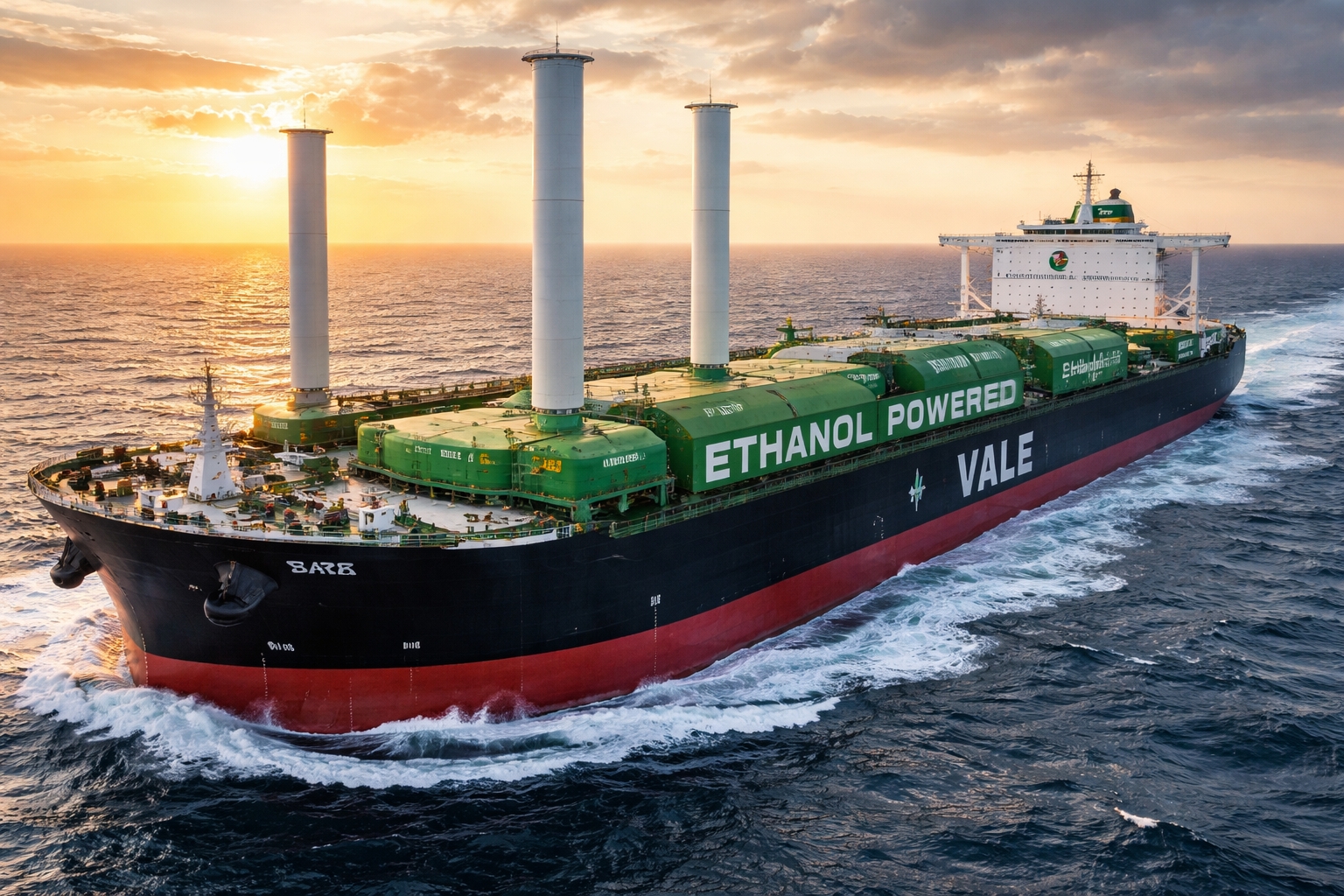
Vale Mining and Chinese Shandong Shipping have closed a deal for the world’s first ocean-going ship powered by ethanol, a project with 340 meters in length and a capacity of 325 thousand tons that can reduce emissions in maritime transport by up to 90%.
Vale Mining and Chinese Shandong Shipping have reached an agreement to put into operation the world’s first ocean-going ship powered by ethanol, a vessel with 340 meters in length and a capacity of 325 thousand tons that will begin to be delivered starting in 2029. The initial contract provides for two next-generation Guaibamax ships, with an option for more units, in a 25-year arrangement that brings ethanol to the center of large-scale ocean navigation.
The innovation is not just technological. It is also symbolic. For the first time, ethanol enters as the main fuel in an ocean-going ship, in a sector that still heavily relies on heavy fuel oil.
For Vale, the change helps to tackle one of the most challenging areas of decarbonization: long-distance maritime transport, which accounts for a significant share of the company’s value chain emissions.
-
Airfare prices can rise by up to 30% — what are the government and Petrobras doing to prevent an even larger increase?

-
Smoke in air traffic control halts Guarulhos and Congonhas, cancels flights, and spreads delays across Brazil; with a tight schedule, the cascading effect leaves people sleeping in the airport and exposes their rights.

-
Inflation in March reaches 0.88% according to IBGE and pressures the Brazilian economy, impacting family budgets and requiring more strategic decisions to maintain financial control.

-
In Paraná, distributor Pacto connects 100% of the load in Coronel Vivida to batteries: a BES of 10 MW and 20 MWh costs just over R$ 30 million and lowers the local tariff now.
World’s first ocean-going ship powered by ethanol comes to life with Vale Mining
According to the company, the use of ethanol can reduce carbon emissions by about 90% compared to the heavy oil currently used in navigation, considering the complete fuel cycle.
The project advances at a time when the IMO tightens sector targets, with a carbon intensity cut of at least 40% by 2030, increasing adoption of low or near-zero emission fuels within this decade, and a net zero emissions target around 2050.
The ship is born within a strategy that avoids dependence on a single technological route. In addition to ethanol, the vessel will be able to operate with methanol and heavy oil.
The design also already anticipates future conversion to LNG or ammonia, providing flexibility for the fleet to navigate the energy transition without losing competitiveness if the alternative fuel market shifts direction in the coming years.
Project of 340 meters in length and a capacity of 325 thousand tons is ready for more than one fuel
The new ethanol-powered ships will be similar to the other 10 second-generation Guaibamax already contracted by Vale with Shandong, with deliveries expected starting in 2027.
These vessels have been designed to incorporate technologies tested in the Ecoshipping program, including five rotating sails, more efficient engines, hydrodynamic devices, shaft generators, frequency inverters, and silicone paint to reduce friction.
This technical package alone has the potential to cut about 15% of emissions compared to the current generation of Guaibamax.
Vale itself has been preparing this ground for years. Since 2011, the company has operated Valemax ships, and according to the company, these vessels are among the most efficient in the world, with the potential to reduce CO2 equivalent emissions by up to 41% compared to a standard capesize.
In 2024, Rodrigo Bermelho, Vale’s Navigation Director, stated that “wind energy will play a central role” in the decarbonization of maritime iron ore transport, signaling that the company has been pushing its fleet towards lower carbon solutions long before the announcement of ethanol.
Chinese Shandong Shipping enters into a 25-year agreement and reinforces Vale Mining’s climate plan
The partnership with Chinese Shandong Shipping also fits into the broader climate plan of the mining company. In its decarbonization strategy, Vale aims to reduce Scope 3 net emissions by 15% by 2035, compared to 2018.
The company also reports that, since 2020, spending to mitigate Scope 1, 2, and 3 emissions totals approximately $1.4 billion. Since maritime transport weighs heavily in this account, the agreement becomes not just a fleet innovation but a direct part of the company’s financial and environmental strategy.
The movement gains strength as ethanol has already been treated as a viable route for heavy navigation.
In February, Everllence, Vale’s technology partner in the development of ethanol-powered marine engines, classified the initiative as “a milestone” in the decarbonization of large-scale maritime transport.
This assessment helps to show that the project is not being seen as a peripheral test, but as an ambition with industrial scale and international potential.
With this agreement, Vale Mining moves beyond just discussing energy transition and places a concrete vessel in this competition.
The result is a project that combines scale, flexibility, and global pioneering: the world’s first ocean-going ship powered by ethanol, built with Chinese Shandong Shipping, with 340 meters in length and a capacity of 325 thousand tons, on a route that could change the pace of decarbonization in maritime iron ore transport.
Did you like the article? Leave your comment and share this publication with those who follow mining, logistics, and energy transition.









Seja o primeiro a reagir!