





 Portuguese
  English
  Spanish
  5 min of reading
  0 comments


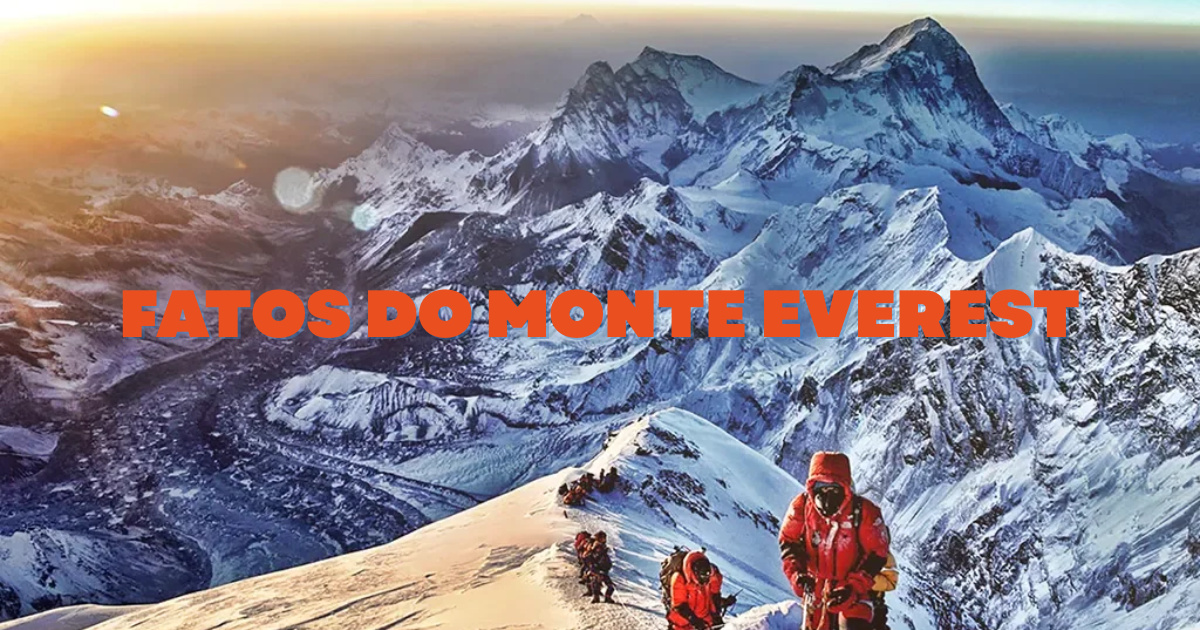
Between Millennia Geology, Stories of Overcoming and Hidden Dangers Beneath the Ice, Mount Everest Reveals Impressive Curiosities That Go Beyond Its Title as the Highest Mountain in the World, Awakening Fascination and Respect in Those Who Dare to Explore It.
The Highest Mountain on Earth Fascinates Adventurers, Challenges Human Limits, and Reveals Geological and Cultural Secrets That Are Millennia Old
Located on the border between Nepal and the Tibetan Autonomous Region of China, the Mount Everest is the highest mountain on the planet, with an altitude of 8,848.86 meters, according to the official measurement of 2020, confirmed by authorities from both countries.
In addition to its impressive size, Everest is shrouded in natural mysteries, heroic stories, and curiosities ranging from marine fossils found at its summit to the high cost required to explore it.
The mountain is part of the imposing Himalaya Range and continues to grow, literally, every year due to tectonic movement.
-
The Brazilian colonial city that stopped in time and shares territory with a rocket launch base.
-
79-year-old woman challenges limits, visits 193 countries in the world after 56 years of planning and reveals the behind-the-scenes of a global journey that few have managed to accomplish.
-
These are the drivers who may stop paying tolls on highways in a project that promises to reduce costs for those who live from transportation in Brazil.

-
(Video): Italian pilot lands plane on moving train at 120 km/h and achieves unprecedented feat in aviation, even with a narrow runway and without direct visual contact.

For those considering climbing the Everest or just wanting to learn more about this natural icon, we have prepared a list of 20 interesting and updated facts about the highest point on Earth.
1-The Highest Mountain in the World
Everest is the highest point on the Earth’s surface, standing at 8,848.86 meters, as announced by authorities from Nepal and China in 2020.
This measurement is based on modern GPS and radar technologies, including the permanent snow layer at the summit.
2-A Window to the Curve of the Planet
At the top of Everest, the view is so vast and distant that many climbers report being able to see the curvature of the Earth.
In addition to the stunning view, the thin air and deep silence contribute to an almost transcendental experience.
3-A Giant With Millions of Years
Everest started forming about 60 million years ago as a result of the collision between the Indian and Eurasian tectonic plates.
This collision caused the marine sediments from the bottom of the ancient Tethys Sea to rise, giving birth to the Himalayas.
4-The Mountain That Continues to Grow
Geological studies indicate that Everest grows about 4 millimeters per year.
This continuous growth occurs due to the movement of tectonic plates, which are still in active collision.
5-A Tribute to a British Surveyor
The name “Everest” was given in honor of Colonel Sir George Everest, the former Surveyor General of British India.
Interestingly, Sir George never saw the mountain in person.
6-How Everest Is Referred to Locally
For Nepalese, Everest is known as Sagarmatha, which means “face of the sky.”
Meanwhile, Tibetans call it Qomolangma, which can be translated as “mother of the universe.”
7-The High Cost of Conquering the Top of the World
Climbing Everest is not only physically demanding but also financially burdensome.
The average cost of an expedition in 2025 varies between US$ 55,000 and US$ 115,000 (around R$ 310,000 to R$ 650,000), depending on the route, support contracted, equipment, and necessary permits.
8-The First Attempts and Conquests
The first documented attempt to reach the summit was in 1921 by John Noel.
The first successful ascent occurred on May 29, 1953, led by Edmund Hillary from New Zealand and Tenzing Norgay, a Nepalese sherpa.
9-Extreme Climate and Oxygen Conditions
Temperatures at the summit can reach -50 ºC, with winds exceeding 160 km/h.
The extreme altitude also reduces oxygen to less than one-third of the level found at sea level.
10-The Most Used Routes
There are two main ascent routes: the southeast route from Nepal and the northeast route from Tibet.
The Nepalese route is the most popular among climbers as it is considered slightly safer.
11-A Destination for Thousands
About 1,300 climbers attempt to scale Everest annually, while over 60,000 tourists visit base camp just for the view.
The busiest season is between April and May when stable weather windows allow for summit attacks.
12-Danger Lurks in the Descent
About 80% of fatal accidents on Everest occur during the descent.
The combination of extreme fatigue, dehydration, and mental changes caused by altitude contributes to most incidents.
13-The Dead That Remain on the Mountain
More than 300 people have died trying to climb Everest as of March 2025.
Approximately 150 bodies still remain on the mountain, as rescue at such altitudes is extremely difficult and risky.
14-Everest Was Once a Sea Floor
Fossils of marine creatures have been found in the summit region, proving that the mountain was once submerged.
This is clear evidence of its sedimentary origin and the action of tectonic plates over millions of years.
15-Height Variations Over Time
The height of Everest can undergo slight changes depending on the amount of accumulated snow.
Events such as earthquakes also affect the official measurement, like the one recorded in 2015, which caused minimal changes.
16-Environmental Issues Concern Authorities
Tourism and constant expeditions have caused an alarming accumulation of garbage on the mountain.
Abandoned equipment, oxygen cylinders, and human waste have turned part of Everest into an ecological threat.
Projects like the “Eco Everest Expedition” have been created to collect tons of garbage accumulated along the routes.
17-A Constant Risk Even With Preparation
Despite the evolution of equipment and technical preparation, climbing Everest remains a high-risk activity.
In addition to the weather, there are risks of avalanches, falls, pulmonary and cerebral edema, among other complications.
18-The Mountain Is Sacred
Everest is considered sacred by various local peoples, such as the Sherpas, Nepalese, and Tibetans.
Rituals and offerings are made before expeditions as a way to ask for permission and protection from the mountain.
19-A Journey Beyond Climbing
For many, climbing Everest is more than a sporting achievement: it is a spiritual experience of self-discovery and overcoming.
Reaching the summit requires extreme physical preparation, specialized support, psychological resilience, and absolute respect for nature.
20-A Golden Curiosity
The record for the most ascents belongs to Sherpa Kami Rita, who has reached the summit more than 28 times by 2024.
His dedication has become an inspiration and a symbol of the strength of the peoples of the Himalayas.
Mount Everest is much more than a mount of ice and rock: it is a living frontier between sky and earth, science and spirituality, tourism and conservation.
Each year, it continues to fascinate new adventurers and reinforce its status as the greatest symbol of human boldness in the face of nature.



-

Uma pessoa reagiu a isso.