





 Portuguese
  English
  Spanish
  5 min of reading
  0 comments



Inaugurated in 1854 in Magé (RJ), the first railway in Brazil was a milestone envisioned by Baron of Mauá that redefined transport in the Empire.
Long before progress on rails reached the major capitals, the first railway in Brazil had its inaugural whistle sounding in the interior of Rio de Janeiro. On April 30, 1854, the Mauá Railway was inaugurated at the Port of Mauá in the city of Magé, a visionary event led by Irineu Evangelista de Sousa. As detailed by Wikipedia in the entry on the “Mauá Railway,” this initial stretch was modest, with only 14.5 km connecting the port to the locality of Fragoso.
The ceremony was attended by Emperor D. Pedro II, who, on the same day, granted Irineu the title of Baron of Mauá. This project was not an isolated act; it emerged from the urgent need to modernize the country. According to the portal Prepara Enem, the economy of the Empire was dominated by coffee, and transportation by mule was a logistical bottleneck that hindered expansion. The railway was the first major response to that industrial challenge.
The Engine of Coffee and the End of Trafficking
In the mid-19th century, Brazil was under the sway of the “coffee barons”. The mercantile-slave economy depended on this product, but, as Prepara Enem points out in its article “Railways and Coffee in the Empire,” the flow of production from the Paraíba Valley to the ports was precarious and costly, done almost exclusively by mule trains. This logistical bottleneck threatened the very growth of the crop, making the search for faster and more efficient transportation a national urgency.
-
Rio Pardo, the most mysterious city in Rio Grande do Sul: untouched Pampas castle, the missing treasure of the Devil Boy, bride’s saint, invisible tunnels, and a 200-year curse today.
-
China retires the J-7 fighter after years of military protection and can now transform military items into drones, following more than 60 years of operation of the J-7, derived from the MiG-21, with thousands of units produced and strategic use in the PLAAF and PLANAF.
-
Volunteers are sought to live in the mountains for a month: a study pays people to stay at 2,500 meters, with 24-hour monitoring of sleep, metabolism, and blood pressure.
-
Goodbye to kitchen cabinets: innovation retires the traditional furniture of Brazilian kitchens by introducing modern pantries with modules of up to 2.40 m, 40% more organization, ergonomic access, adjustable shelves, and smart lighting in 2026.


The viability for the first railway in Brazil arose from a crucial political factor: the Eusébio de Queirós Law of 1850. Prepara Enem explains that the law, driven by British pressure, prohibited the transatlantic trafficking of slaves. This freed up a huge amount of capital that was previously used to buy labor. This now idle money migrated to new investments, with railway infrastructure being the most promising, stimulated by incentive laws from the imperial government.
Mauá: The Visionary “Foreigner”
The central figure of this endeavor was Irineu Evangelista de Sousa. Of humble origins, he had his education shaped by working in a Scottish import company. There, he absorbed a capitalist and industrial mindset very different from the Brazilian agrarian elite. A trip to England in 1840, where he witnessed the epicenter of the Industrial Revolution, was decisive for his determination to modernize Brazil.
Mauá was not just a merchant; he was a serial industrialist, responsible for gas lighting in Rio, shipyards, and banks. His liberal vision, which included the defense of free labor and the abolition of slavery, directly put him in conflict with the powerful coffee barons, who depended on the maintenance of the slave system. The first railway in Brazil was his boldest attempt to prove that a new model of development, based on industry and technology, was superior to the existing agrarian system.
“Baroneza”: The Symbol of the New Era
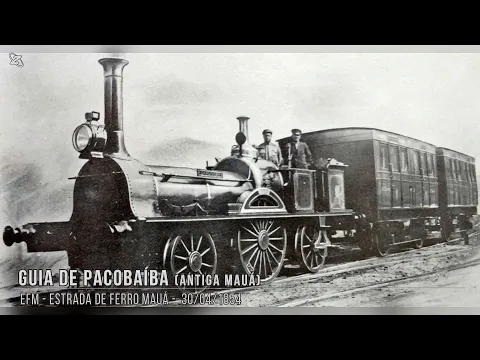

The heart of the Mauá Railway was its locomotive, the “Baroneza”. It was the first to circulate in the country and became the great symbol of progress. According to Wikipedia in its article “Baroneza (locomotive),” it was manufactured in 1852 in Manchester, England, by the renowned company William Fairbairn & Sons. Brought to Brazil, it was the star of the inaugural journey.
The name of the machine was given by D. Pedro II himself during the inauguration, an elegant tribute to Mauá’s wife, Dona Maria Joaquina. As Wikipedia details, the baptism of the locomotive and the granting of the title of Baron of Mauá to Irineu occurred on the same day, publicly sealing the alliance between industrial capital and the Crown. After 30 years of service, the “Baroneza” was retired in 1884 and, in 1954, was listed by IPHAN, today being a central piece of the Train Museum in Rio de Janeiro.
The Real Legacy: A “Successful Failure”
Although it was a historical milestone, the first railway in Brazil was not a financial success. Wikipedia on the “Mauá Railway” notes that the stretch was short (14.5 km, later extended to Raiz da Serra in 1856) and did not reach the rich coffee areas inland. Its main practical function ended up being to facilitate access for the court to Petrópolis, the summer resort of the imperial family, which did not guarantee high profitability.
The true impact of the project was psychological. It was a “successful failure”. Before Mauá, the idea of building railways in Brazil was met with enormous skepticism. By proving that it was possible, Mauá broke the inertia and redefined the perception of risk. The railway generated confidence and served as a catalyst, inspiring future projects, such as the E.F. Santos-Jundiaí, which would indeed boost the economy of coffee in São Paulo. The date of the inauguration, April 30, is still celebrated today as Railway Worker’s Day.
The Abandonment of a Historical Landmark
Over time, the pioneering section of the Mauá Railway lost its relevance. Wikipedia points out that, after the construction of other railways in the 20th century, the branch became obsolete. Traffic on the original stretch, between Piabetá and Guia de Pacobaíba (the former Port of Mauá), was officially discontinued in 1962, 108 years after its inauguration.
Today, the Guia de Pacobaíba station, in Magé, the zero mark of the first railway in Brazil, is in poor condition and abandoned. The degradation of the site is a direct reflection of Brazil’s strategic choice, starting in the 1920s, to prioritize road transportation over railways. The ruins symbolize a development model that the country has deliberately left behind, despite the current efforts of the local government and associations to try to revitalize the heritage.
The Mauá Railway was much more than tracks and a locomotive; it was the watershed that proved the viability of industrial projects in Imperial Brazil. Born from Mauá’s vision and the need of the coffee economy, it changed the mindset of a nation, even though its physical legacy today struggles against abandonment.
The poor condition of the station in Magé is a reflection of how Brazil has treated its railway history. Do you think the country made a mistake by focusing almost everything on highways? Do you believe that the revitalization of old railways, like this one, could be a real solution for transportation today? We want to know your opinion on this debate.





Seja o primeiro a reagir!