





 Portuguese
  English
  Spanish
  3 min of reading
  0 comments


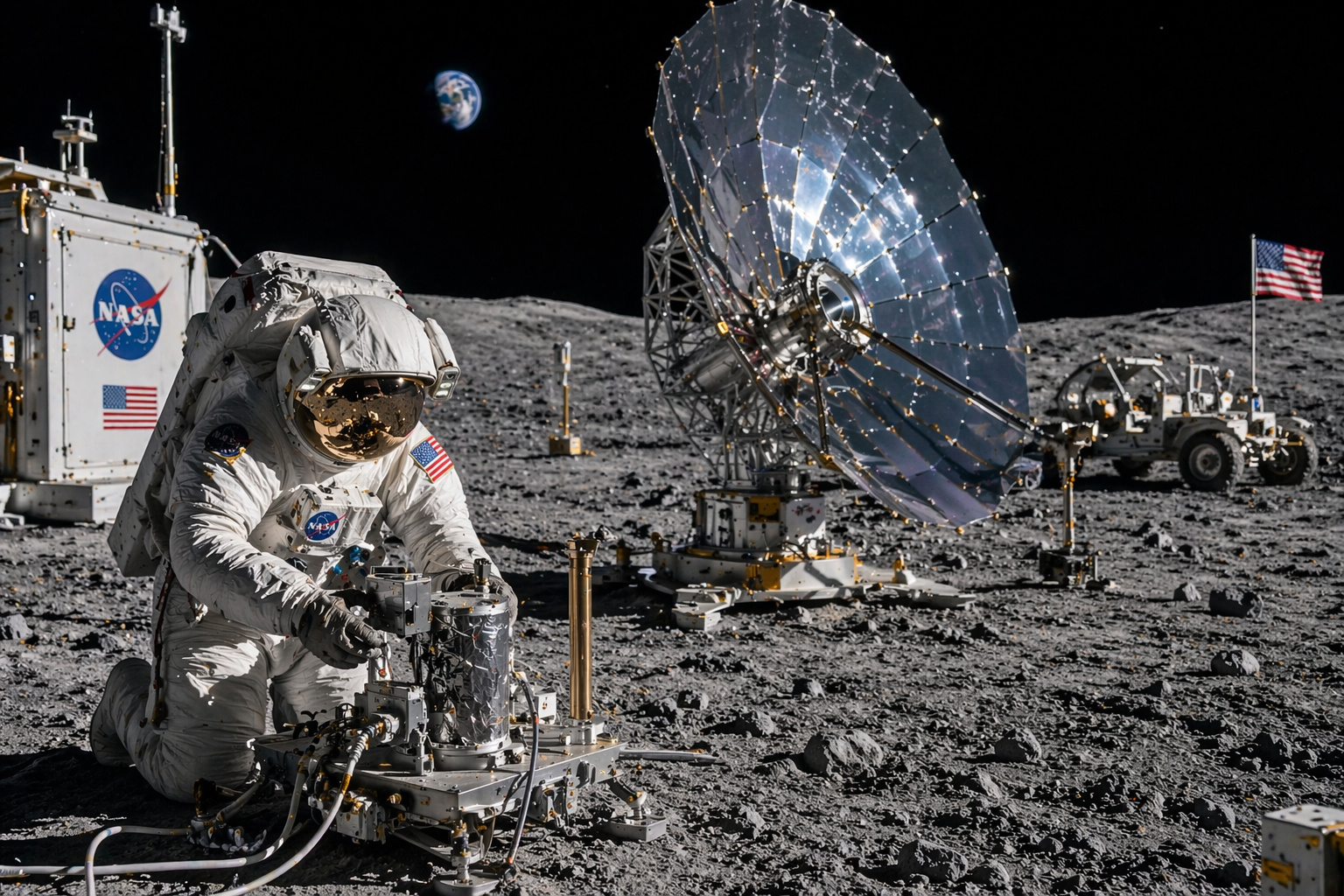
New technology uses solar energy to extract oxygen from lunar soil and reduce dependence on Earth for long-duration missions
A groundbreaking technological innovation was recently presented by NASA, attracting global attention and repositioning the debate on human permanence beyond Earth.
The experiment uses concentrated sunlight to extract oxygen directly from lunar soil, which expands the possibilities for prolonged missions.
This approach makes human presence on the Moon for months more viable, with less logistical dependence.
Technical data released by the agency in 2024 indicates that tests were conducted in simulated environments, with consistent and replicable results.
The advancement significantly reduces the need to send essential supplies, such as breathable air.
This establishes an important milestone for space life sustainability and for planning permanent bases.
-
How a central pivot works inside: from the pump house to the 500 m rotation, 150 hp motor, 75 hectares irrigated in 16 to 24 hours, sensors, nozzles, and maintenance.
-
Why is the ship’s command bridge located at the back: engine and rudder at the stern, more space for cargo, safer maneuvers, more stable crew, and laws that sometimes require it to be in the center or bow?

-
Advancement in health: UNB and FAPDF develop new technology that reduces Parkinson’s tremors and shows significant results by increasing movement stability and improving patients’ quality of life.

-
Advancement in health: UNB and FAPDF develop new technology that reduces Parkinson’s tremors and shows significant results by increasing movement stability and improving patients’ quality of life.


Transformation of lunar soil into an oxygen source
Lunar regolith contains minerals rich in oxygen trapped in its chemical structure, making it a strategic resource.
Scientists have developed reactors capable of releasing this gas through extreme heat, ensuring efficiency in the process.
The technique breaks molecular bonds and allows for the collection of oxygen for use in pressurized environments.
This system enables human presence on the natural satellite for extended periods, with greater operational safety.
The process involves technical steps that ensure the purity and stability of the produced gas:
- Chemically processed regolith
- High-intensity thermal heat
- Molecular filtration systems
Each step directly contributes to the reliability of life support systems.
This technological integration ensures consistent performance even in extreme conditions.
Concentrated sunlight as the energy base of the system
The use of parabolic mirrors allows for the concentration of solar radiation and generates extremely high temperatures.
This method eliminates the need for fossil fuels or heavy generators on the lunar surface.
The solar energy available in space is directly converted into heat, powering high-efficiency thermal reactors.
Technical reports from NASA, released in 2024, indicate that this model surpasses traditional electric methods.
The result is less wear on equipment and a longer lifespan for the involved systems.
Additionally, the process acts as a clean energy catalyst, significantly reducing the need for heavy batteries.
Reduction of dependence on Earth and logistical gains
Dependence on Earth launches still represents one of the main challenges of space exploration.
The transport of oxygen and water increases costs and limits the duration of missions.
The use of local resources strategically alters this scenario.
Space agencies begin to prioritize more robust scientific equipment and living structures.
Among the main logistical gains, the following stand out:
- Drastic reduction in transportation costs
- Increased operational safety of bases
- Extended duration of crew stays
This model establishes a system of lunar self-sufficiency, considered essential for long-term missions.
Operational efficiency becomes a determining differential in expanding human presence in space.
Tests confirm the viability of permanent bases
Experiments conducted in chambers simulating the lunar environment confirm the viability of the technology.
The automated systems operate autonomously under constant sunlight, maintaining the supply of oxygen.
The stock can be maintained without continuous human intervention, allowing full focus on scientific activities.
NASA states in recent reports that the results are promising for future applications.
The construction of permanent bases is no longer just a theoretical concept.
The topic is now part of concrete planning in modern space engineering.
The ability to transform lunar soil into a vital resource redefines the limits of space exploration.
This advancement marks the beginning of a new phase for human presence beyond Earth — more autonomous, efficient, and sustainable.
Will the next generation of astronauts be ready to breathe oxygen produced directly on the Moon?








Seja o primeiro a reagir!