





 Portuguese
  English
  Spanish
  4 min of reading
  0 comments


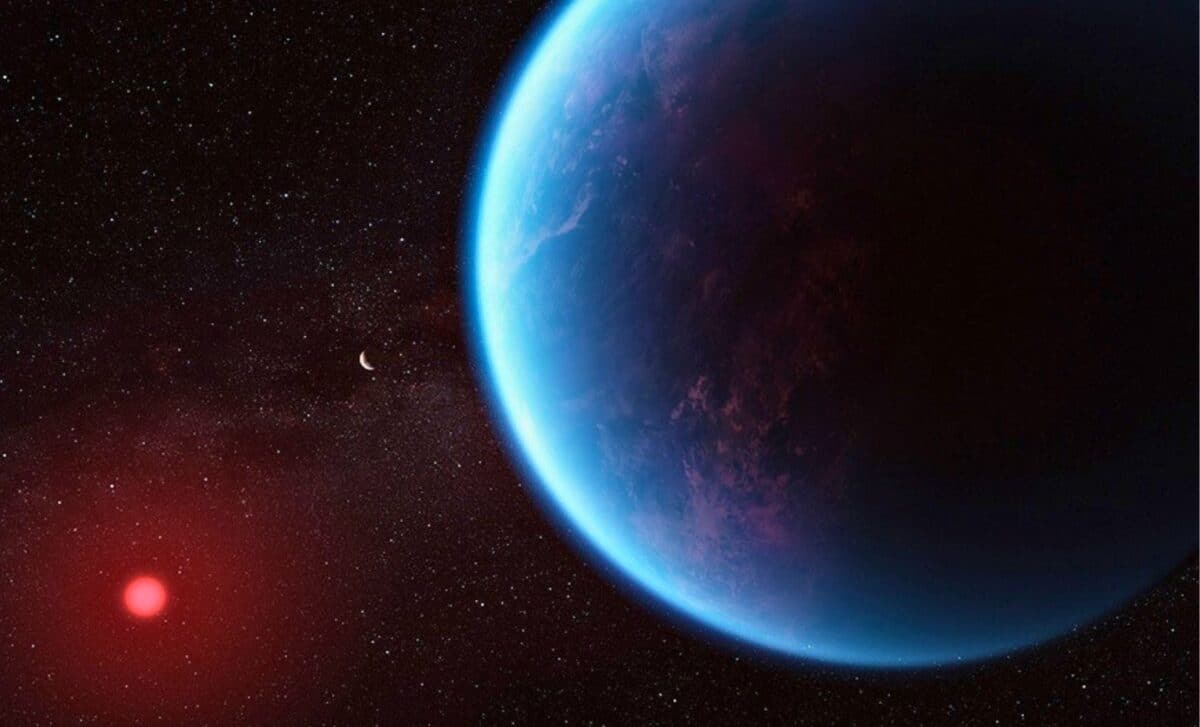
Scientists from NASA Identify a Planet With More Than Eight Times the Mass of Earth, 120 Light-Years Away, That Contains Gas Linked to the Presence of Life.
The universe has just revealed another of its intriguing secrets. Scientists from NASA, using the powerful James Webb Space Telescope, have identified a colossal planet, named K2-18 b, which has unique characteristics and signs of gases exclusively related to living organisms on our planet.
This discovery could be a significant step in the search for extraterrestrial life.
K2-18 b: A Larger and Different World Than Earth
Located 120 light-years away in the constellation Leo, K2-18 b is an exoplanet. It is 2.6 times larger than Earth and has a mass equivalent to 8.6 times that of Earth.
-
They were brilliant! Scientists discover that our ancestors in China were already making super advanced tools 160,000 years ago, changing everything we knew.

-
Scientists unveil 3 million years of climate secrets hidden in the ice of Antarctica.

-
Ancient farmers created “aggressive plants” that changed nature forever.

-
Astronomers find a “backward” solar system that ignores all the rules of space and leaves scientists scratching their heads!
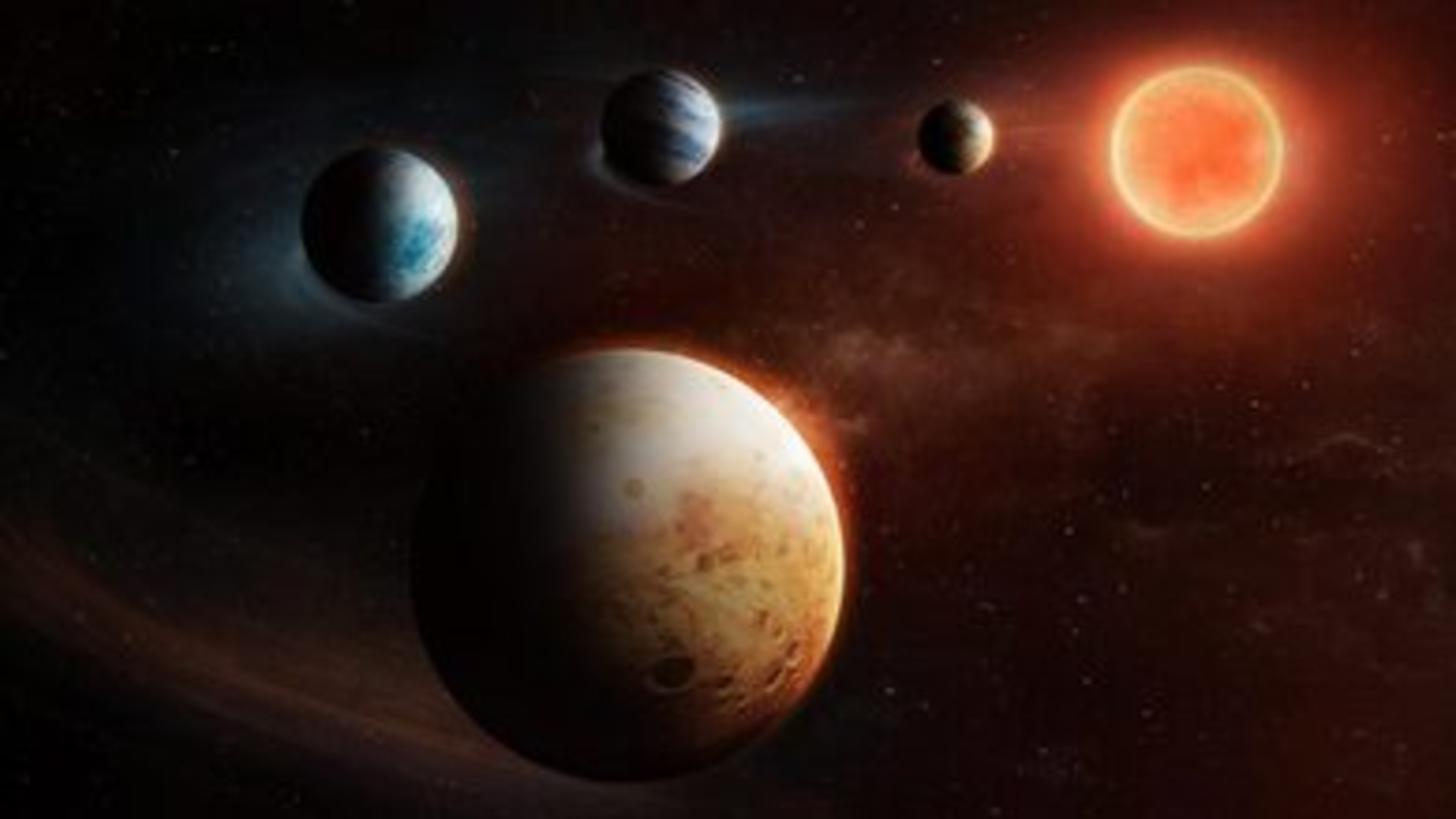

Its orbit occurs around a red dwarf star called K2-18, which is smaller and cooler than the Sun, but stable enough to host potentially habitable planets.
Initially discovered by NASA’s K2 mission in 2015, K2-18 b has become the focus of atmospheric studies due to its ideal location in the habitable zone of its star, where temperatures allow for the presence of liquid water.
Atmospheric Highlights
Recent data collected by the James Webb Telescope revealed:
- Methane and Carbon Dioxide: Indicators of active chemical processes in its atmosphere.
- Possible Presence of Dimethyl Sulfide (DMS): A molecule that, on Earth, is produced exclusively by living organisms, such as phytoplankton in the oceans.
This composition suggests a dynamic chemical environment, potentially compatible with conditions that could support life.

The Hypothesis of Hycean Worlds
The discovery raises the hypothesis that K2-18 b may be a hycean planet – a type of world with hydrogen-rich atmospheres and possible oceans on its surface.
These exoplanets represent a new frontier in the search for life, with characteristics different from those typically found on smaller rocky planets like Mars or Venus.
According to principal researcher Nikku Madhusudhan, “hycean worlds are significantly more favorable for atmospheric observations and may harbor life under conditions we previously did not consider viable.”
However, the size of K2-18 b poses challenges. It may have a high-pressure ice mantle beneath its dense atmosphere, creating extreme conditions that make the existence of life as we know it difficult.
Essential Features of K2-18 b
| Property | Details |
|---|---|
| Distance From Earth | 120 Light-Years |
| Location | Constellation of Leo |
| Mass | 8.6 Times That of Earth |
| Radius | 2.6 Times That of Earth |
| Discovery | NASA’s K2 Mission (2015) |
Contribution of the James Webb Telescope
The detailed atmospheric analysis of K2-18 b was only possible thanks to the advanced capabilities of the James Webb Telescope.
During the planet’s transits – moments when it passes in front of its star – the telescope captured the starlight filtered through the atmosphere, allowing for the identification of its chemical compositions.
Comparison With Previous Data
- Two transits observed by the James Webb provided data equivalent to eight years of Hubble measurements.
- The analysis revealed detailed spectra, marking a new benchmark in the study of exoplanetary atmospheres.
For future observations, the MIRI (Mid-Infrared Instrument) will be used to confirm the presence of dimethyl sulfide and provide an even more detailed overview.
According to Madhusudhan, “this discovery was only possible due to Webb’s unprecedented sensitivity and its broad wavelength range.”
Habitability
Despite being in the habitable zone, K2-18 b still presents many mysteries. Its dense atmosphere and extreme conditions, including possible high temperatures in the ocean, may be hostile to terrestrial life. Still, the detection of DMS, if confirmed, will represent a significant milestone.
For astronomer Savvas Constantinou, “these initial observations demonstrate Webb’s potential in exploring habitable worlds beyond our solar system.”
Next Steps and Future Possibilities
NASA will continue investigating K2-18 b and other hycean worlds. Future observations will seek to validate the presence of dimethyl sulfide and further examine the conditions of the planet.
The goal is to understand whether it can truly support any form of life or if it represents an environment completely different from anything we know.
As Madhusudhan highlighted, “the identification of life on a habitable exoplanet would be a transformative milestone for humanity.”
With discoveries like this, the question that has intrigued humanity for centuries – “Are We Alone in the Universe?” – takes on a new level of urgency and fascination. K2-18 b is now one of the greatest symbols of the potential existence of life beyond Earth.










-

Uma pessoa reagiu a isso.