





 Portuguese
  English
  Spanish
  2 min of reading
  0 comments


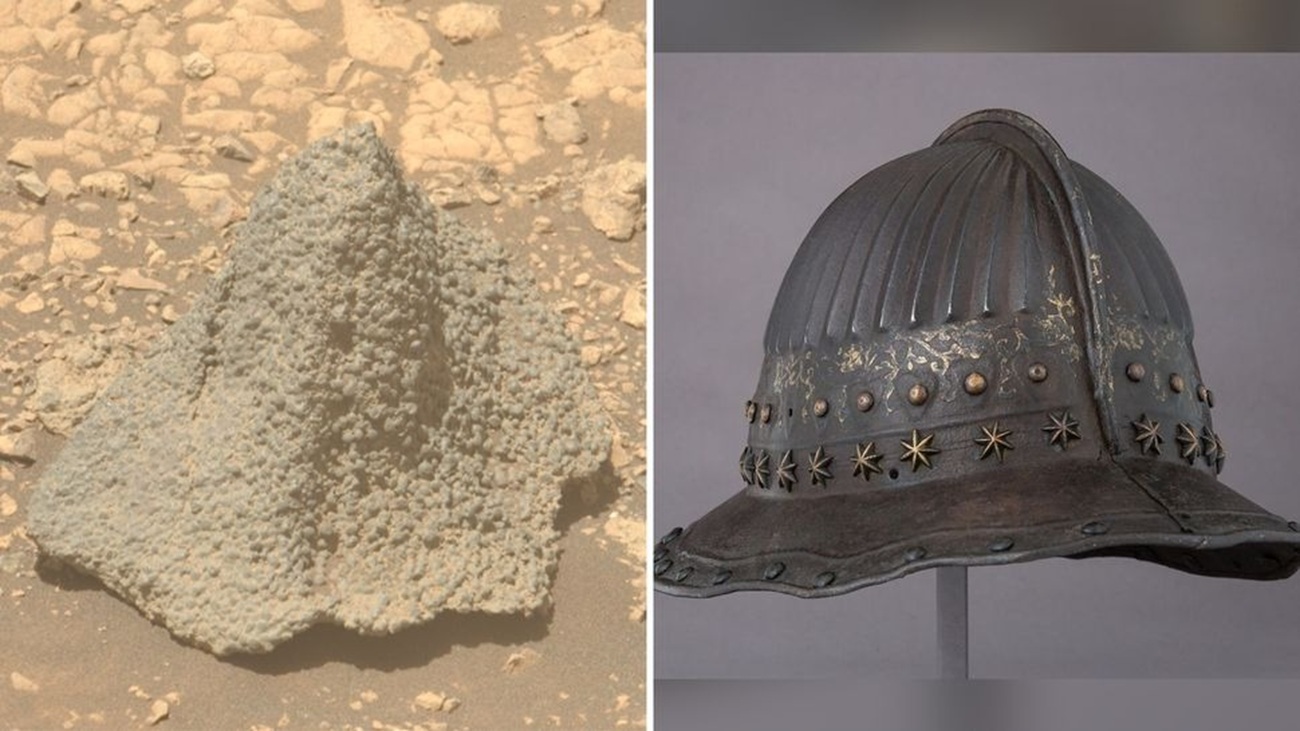
Perseverance Rover Records Rock on Mars Shaped Like a Helmet and Covered with Spherules, Raising New Geological Questions.
The Perseverance rover, from NASA, captured an intriguing image on the surface of Mars. On August 5, 2025, the Mastcam-Z instrument took a picture of a rock shaped like a volcano that resembles an ancient battle helmet.
The object features a pointed peak and a nodular texture, with grooves reminiscent of armor forged centuries ago.
On Earth, similar formations can arise from chemical weathering, mineral precipitation, or volcanic processes.
-
They were brilliant! Scientists discover that our ancestors in China were already making super advanced tools 160,000 years ago, changing everything we knew.

-
Scientists unveil 3 million years of climate secrets hidden in the ice of Antarctica.

-
Ancient farmers created “aggressive plants” that changed nature forever.

-
Astronomers find a “backward” solar system that ignores all the rules of space and leaves scientists scratching their heads!


Most importantly, Perseverance itself had already found similar rock in March 2025, increasing the interest of the scientific team.
Composition and Hypotheses
According to David Agle, spokesperson for NASA’s Jet Propulsion Laboratory, the rock, nicknamed Horneflya, stands out for being composed almost entirely of spherules. He emphasized that the hat-like shape is less significant than the composition, which may help understand Martian geological processes.
Scientists believe that, in some cases, these spherules form when groundwater permeates the pores of sedimentary rocks.
However, it is uncertain whether all originated in this manner. Therefore, the Perseverance team will continue investigating other formations in search of answers.
Technology and Observation
The Mastcam-Z, a set of zoom cameras mounted on the rover’s mast, allows for high-resolution stereo images. This technology makes it easier to identify details from a distance, as seen with the “helmet” rock covered in spherules.
Additionally, Perseverance has already collected a varied assortment of unusual shapes. Among them are donuts-shaped meteorites and stones resembling avocados.
These images highlight pareidolia, a phenomenon where the human brain recognizes familiar patterns in random shapes.
Importance for Science
For researchers, formations like the helmet rock help reconstruct Mars’ environmental history. They show how wind, water, and internal processes have shaped the landscape over billions of years. This type of finding may indicate past interactions with water, a crucial factor for understanding the planet’s evolution.
Currently, Perseverance is exploring the northern edge of Jezero Crater. At the end of last year, it completed a challenging ascent to the location known as “Lookout Hill,” from where it continues its mission to investigate geological mysteries and search for signs of habitable conditions in Mars’ past.










Seja o primeiro a reagir!