





 Portuguese
  English
  Spanish
  3 min of reading
  0 comments


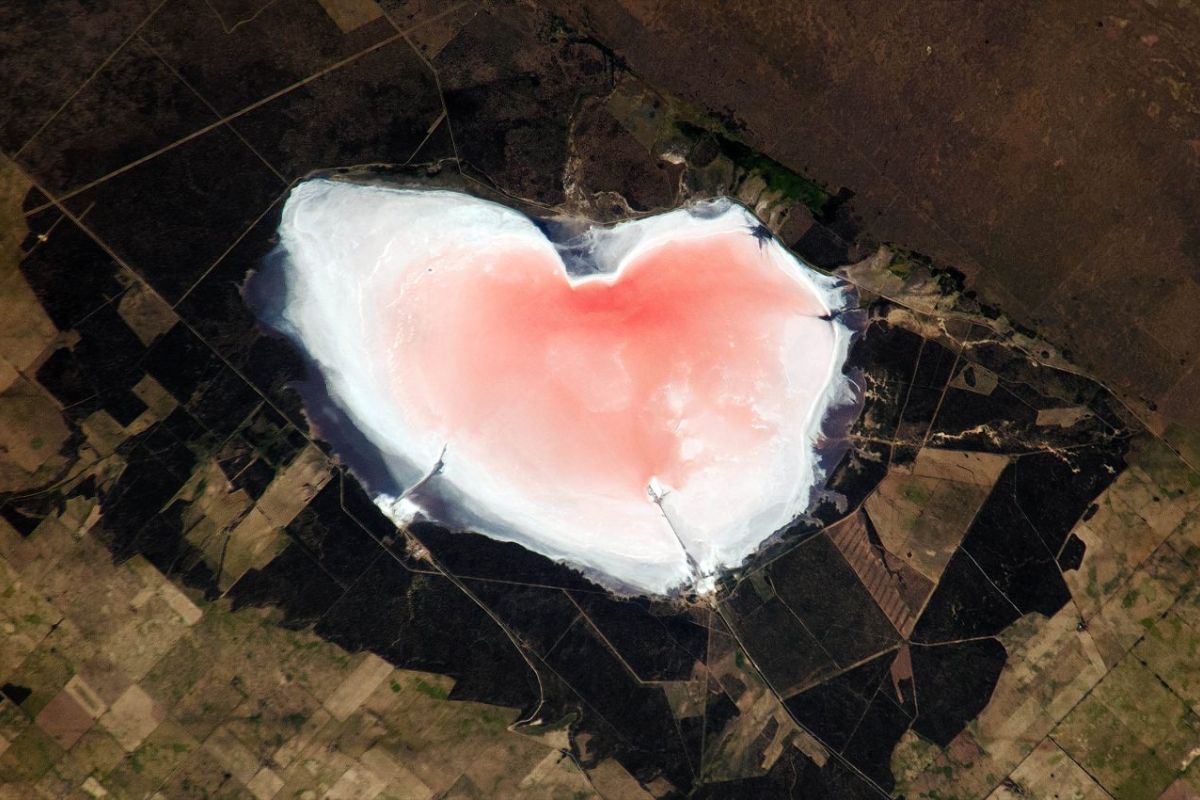
Pink salt lake registered from the International Space Station changes with rain and evaporation; salt flats expose crystals and halophilic microorganisms explain the intense tone
The heart-shaped pink salt lake, with its intense color, gained attention when it was recorded from the International Space Station. The image drew attention not only for its visual impact but also for the environmental and biological processes that explain the hue.
Located in the south of Argentina, in an area of natural salt flats, the pink salt lake is an example of an extreme environment, where the dynamics between rain, evaporation, and high salinity shape the landscape throughout the year.
Where is the pink heart and why does it stand out
The so-called pink heart is a shallow pink salt lake situated within a large area of salt flats known as Salinas Las Barrancas, also called Laguna de Salinas Chicas. It is located a few dozen kilometers from Bahía Blanca, in the south of the province of Buenos Aires, in a region with a dry climate and flat terrain.
-
The world extracts about 50 billion tons of sand and gravel from the oceans every year, and the UN has created a satellite monitoring system called Marine Sand Watch to track in real time an industry that destroys the seabed, weakens the natural protection of coastlines, and already operates on a global scale with an impact comparable to that of large mining chains.

-
NASA chief says in an interview with CNN that the chance of finding alien life in the universe is quite high and reveals that this search is at the heart of all the agency’s missions, including the Artemis program that has just taken humans around the Moon.

-
From the light bulb to the ENIAC: the Edison effect paved the way for diodes and triodes, amplified radio and telephony, turned into Boolean logic with relays, and created giant computers, leading to the leap towards modern silicon.

-
With more expensive oil and the risk of shortages, China is expanding the use of technology developed in Germany during World War II that transforms coal into plastics, fuels, and chemical products.

This combination of topography and climate favors the temporary accumulation of water and the formation of very distinctive salt surfaces, which are even visible in satellite images.
How the pink salt lake changes with rain and evaporation

The pink salt lake acts as a temporary reservoir. After periods of heavy rain, water accumulates and forms a larger lake. With the arrival of drier seasons and strong solar radiation, evaporation increases, the level drops, and large areas become exposed.
In this cycle, typical stages of the salt flat environment emerge: progressive salt concentration, crystal formation, and drying of the ground, until the point where the surface can be accessed for local activities of collecting and transporting raw salt.
Why is the color of the pink salt lake so intense
The main point to understand the phenomenon is that the hue does not come from artificial dyes or pollution. The color is the result of biological and chemical processes associated with high salinity and intense brightness.
Under stress conditions, halophilic microorganisms can survive and produce pigments. One cited example is the alga Dunaliella salina, which generates carotenoids when exposed to high salinity and abundant light.
In these conditions, it can accumulate large amounts of β-carotene, a pigment with an orange to reddish hue that acts as protection. Other halophilic microorganisms also contribute to enhancing the pink tones.
What the extreme environment reveals about salt flats and “living” landscapes


The pink salt lake shows how salt flats are dynamic systems: the landscape changes as water comes and recedes, the salt concentration increases, and crystals begin to dominate the surface. It is an environment where chemistry, climate, and microbiology intersect to produce a result visible to the naked eye.
Therefore, the pink heart has become an emblematic example of how an apparently simple landscape can carry natural processes that repeat year after year.
How the pink salt lake is used by the population
With evaporation, the exposed surface becomes covered by a thick layer of salt. According to the base, this salt is traditionally exploited by local communities as an economic resource, with collection, transportation, and processing.
The activity is directly connected to the natural cycle of the lake, which alternates between periods of water accumulation and phases of drying and crystallization.
In your opinion, should the pink salt lake have some special protection to preserve this extreme landscape, or can the economic use of salt continue as it already does today?




Seja o primeiro a reagir!