





 Portuguese
  English
  Spanish
  6 min of reading
  0 comments


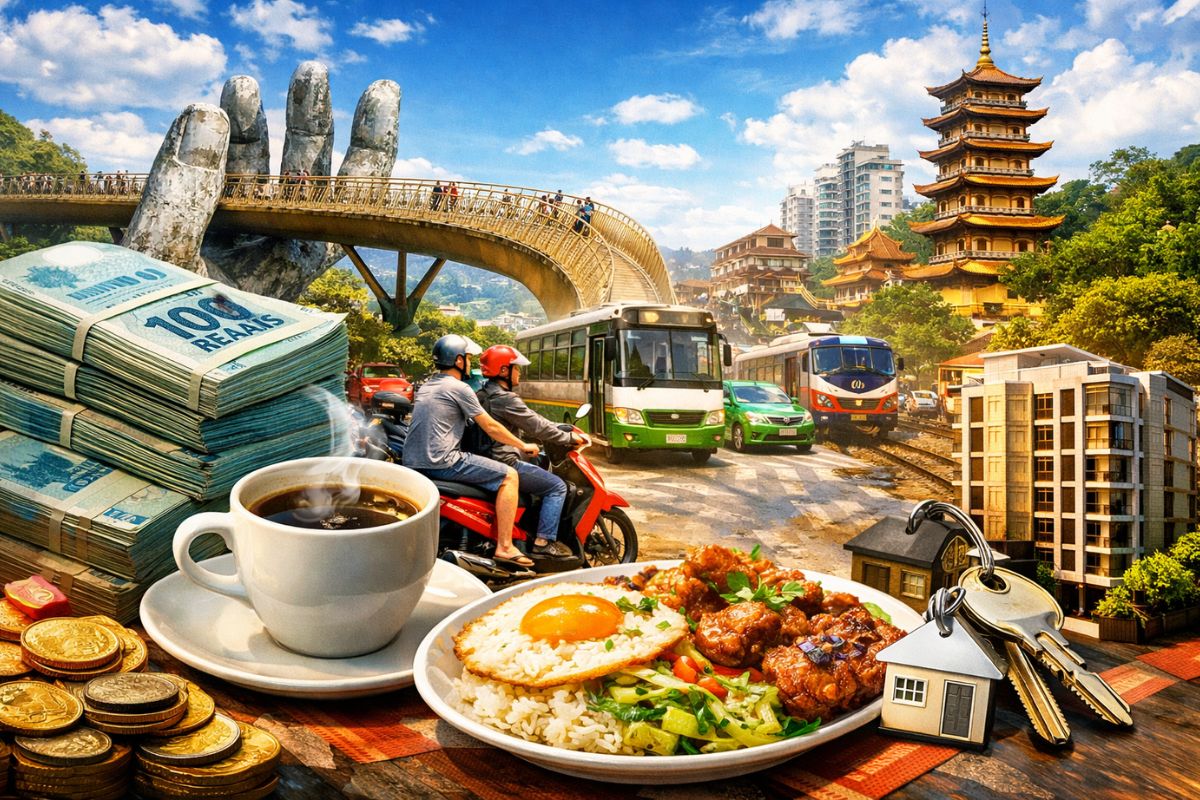
Understand How the Brazilian Minimum Wage Becomes Millions in Vietnamese Currency and Allows You to Live in Danang with Coffee at R$ 3, Cheap Food, Affordable Transport, and Rent Near the Beach for Around R$ 2,000 Per Month.
When the Brazilian minimum wage becomes millions in the local currency, your relationship with money changes completely. This is exactly what happens in Vietnam, where a Brazilian minimum wage is transformed into more than 6 million dongs, the Vietnamese currency, making any supermarket, café, or restaurant seem cheap for someone earning in reais.
Upon arriving in Danang, a coastal city in Vietnam, it feels like everything costs pocket change. You walk the streets paying R$ 2, R$ 3, R$ 5 for food, drinks, and transport, while enjoying the beach, massages, quality coffee, and rent in upscale neighborhoods for amounts that would hardly cover the same standard of living in Brazil.
How Much Is the Brazilian Minimum Wage Worth in Vietnam?

A Brazilian minimum wage converted yields more than 6 million dongs. In practice, this literally means holding “millions” in bills to pay for everyday items.
-
Tourists on Everest were poisoned by guides who mixed substances in food to provoke false symptoms of altitude sickness while helicopter operators and hospitals charged inflated rescue fees to insurance companies.

-
Few people know this, but Neil Armstrong, one of the most famous NASA astronauts in history, survived the Korean War after jumping from the plane during his seventh combat mission aboard the USS Essex aircraft carrier of the United States.

-
Diving with a camera in Lake Furnas reveals a submerged city with an entire street, almost intact houses, a preserved bridge, a wood stove, a Kombi, and even a bus at the bottom of the largest lake in the Southeast.

-
Iceland accidentally drilled into a magma pocket at 2,100 meters and revealed that the extreme heat beneath the crust could pave the way for a new source of continuous energy.


Seeing 1,000,000 printed on a single bill is shocking for any Brazilian used to never coming close to that amount in cash.
The central point is that the real buys much more in Vietnam than in Brazil, especially for items like food, transport, leisure, and housing.
Instead of counting every outing to avoid going over budget, the experience is quite the opposite: spending little while still feeling like you are living abundantly.
Hearty Breakfast and Special Coffees for Bakery Prices
Starting your day in Danang might mean sitting in a local restaurant and ordering a typical breakfast, like “bò né,” served in a hot pan with beef, eggs, sauces, and a fresh baguette. This complete dish costs around R$ 8, with even cheaper options available in truly local places.
Vietnam is the second-largest coffee producer in the world and mainly works with the robusta bean, which is more bitter and has about double the caffeine compared to the arabica that Brazilians are used to.
To balance the flavor, the Vietnamese use sweetened condensed milk, turning coffee almost into a liquid dessert. In a typical café, a coffee with milk costs about R$ 3, and special versions range from R$ 4 to R$ 5. In many places, the coffee even comes with a little cup of iced tea, included in the price.
For less than R$ 10, you can enjoy quality coffee, taste different flavors than in Brazil, and even receive complimentary tea, something unthinkable in many Brazilian capitals, where a simple coffee can cost double that amount.
Cheap Transport in a Country Dominated by Motorbikes
In daily life, moving around the city is another area where Brazilians feel the positive impact of the exchange rate. Using Grab, an app similar to Uber, you can request a motorbike or car for practically any urban commute.
A short motorbike ride usually costs around 15,000 dongs, which is about R$ 3, and generally, motorbike rides are always below R$ 5. For cars, a ride of about ten minutes costs around R$ 6, and rarely exceeds R$ 10 for trips within the city.
Furthermore, the traffic is filled with motorbikes, but horns are not used aggressively like in Brazil. They function more as a warning of “I’m passing,” making the flow intense yet surprisingly organized and less stressful for those observing from the outside.
Street Food, Sugarcane Juice, and Markets with Unbelievable Prices
The street food scene in Vietnam is vibrant and, for those earning in reais, incredibly cheap. At a stall, you can enjoy sugarcane juice for about R$ 2, often served with a mini local lime squeezed straight into the glass, making the drink even more refreshing on hot days.
At traditional markets, the experience goes beyond. A kilogram of fruit can cost around R$ 2, and a whole watermelon costs about 7,000 dongs, which comes to just over R$ 1 per kilo.
It feels like you’re buying fruit practically “for free” when compared to market prices in Brazil.
Eating well every day without breaking the bank becomes the norm, rather than the exception, especially for those who don’t mind visiting simpler places frequented by locals, away from tourist routes.
Massages and Small Luxuries That Become Routine
Services that are considered luxury in many countries, like massages, easily enter the routine in Vietnam. In a well-structured massage house, with comfortable chairs, foot washing, air conditioning, and complimentary tea, a foot or body massage can cost between R$ 30 to R$ 40.
By comparison, this same type of service in European countries can reach 60 or 80 euros, which translates to around R$ 400 to R$ 500. Abroad, it’s a gift for special occasions. In Danang, for the same amount you would spend on a single treatment in Europe, you could have a massage every week for a month.
This type of “affordable small luxury” reinforces the feeling that here, money works in favor of quality of life, not just survival.
When Not Everything Is Cheap: The Brand New Car
It’s important to highlight that not all costs in Vietnam are low. A clear example is the price of a brand new car. In a conversation with a driver, the price of a new Mitsubishi Xpander was reported to be 664 million dongs, which is around R$ 143,000 after conversion.
This means that even in a country where the Brazilian minimum wage becomes millions, some high-value goods are still far from being accessible to most of the local population.
A brand new car, for example, remains a long-term project, not a trivial item.
Living in Danang: From the R$ 40 Hostel to the R$ 2,000 Apartment
For those wanting to try out the city for a few days, there are well-located hostels in tourist areas, with large structures, a bar, a pool table, and a lively social environment, costing around R$ 40 per night. It’s the perfect gateway for backpackers and short-term travelers.
For longer stays, the game changes in favor of monthly rentals. In groups of Brazilians living in Danang, it’s common to find reports of rents ranging from 7 to 12 million dongs per month, which results in approximately just over R$ 2,000 for a renovated apartment in a well-located area near the beach.
There are few places in the world where you can live near the beach, in an upscale area, in a renovated apartment, paying around R$ 2,000 monthly. For those coming from large Brazilian cities, this completely reshapes the idea of housing costs.
How Much Do You Need to Earn to Live Well in Vietnam?


In a conversation with a local barber, a straightforward answer comes up: for a single middle-class person to live well, around 9 million dongs per month suffices.
When housing and food are added together, another important number enters the scene.
Calculating in real-time, the figure comes to around 3,200 reais per month to live well in the middle class in Vietnam, considering a rented house and basic expenses.
Students and other residents also report similar ranges, always within the same ballpark.
This means that a Brazilian earning R$ 5,000 per month and bringing that income to Vietnam will live at a standard that would be much harder to achieve in Brazil.
Living near the beach, dining out frequently, using a transport app daily, and even fitting massages into your routine no longer feels like a distant dream.
Vietnam Today: Communism, Open Market, and Growing Future
Vietnam is officially a communist country, governed by a single party, but with an open market economy that has been growing rapidly for years.
The combination of cheap labor, expanding industry, and still-low cost of living attracts digital nomads, investors, and professionals from various parts of the world.
Many people see Vietnam as one of the most promising countries in Asia for the next decade, while China represents the established present.
For a Brazilian working remotely and earning in reais or another strong currency, the country offers a rare equation: quality of life, low cost, good food, warm climate, beach, and opportunities to live something completely different from what is seen in Brazil.
And you, if your Brazilian minimum wage turns into millions in the local currency, would you consider living for a while in Vietnam to see how far your money could take you?






-

-

-

-

10 pessoas reagiram a isso.