





 Portuguese
  English
  Spanish
 5 min of reading
  0 comments


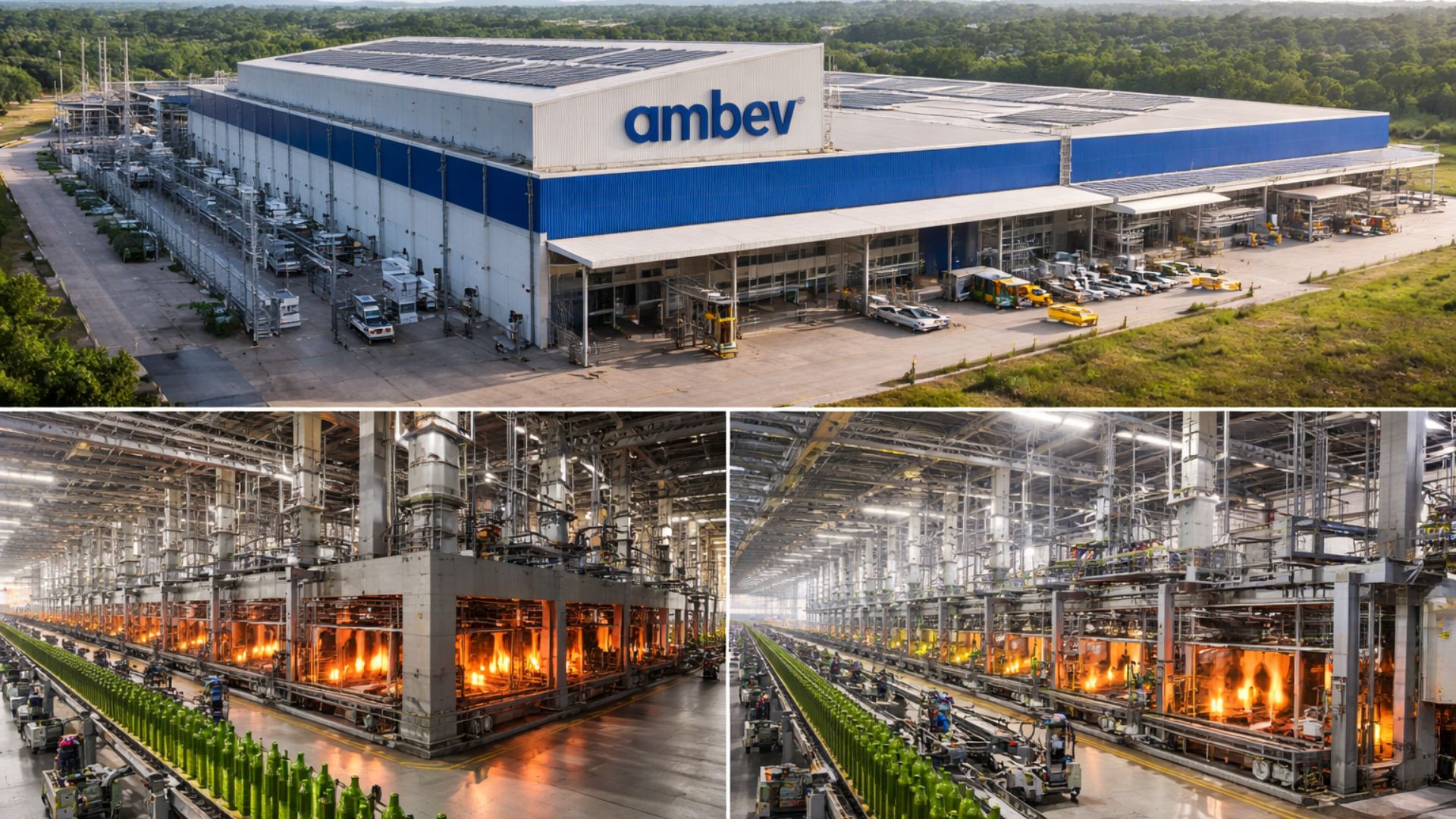
Industrial Inauguration in the Interior of Paraná Brings Together Billion-Dollar Investment, Job Creation, National Production of Glass Bottles, and a Promise of Sustainable Operation, Expanding the Integration of the Beer Chain and Strengthening Ambev’s Logistics Strategy in Brazil.
Ambev inaugurated a glass bottle factory in Carambeí, in the Campos Gerais of Paraná, on Monday (15), with announced investment of R$ 1 billion and projected capacity of up to 600 million units per year.
According to the company, the unit accounts for 4,600 jobs created in the region, considering the positions opened during construction and the operational stage, in a municipality with about 24,000 inhabitants.
The plant was presented by the company as part of its strategy to increase production of packaging for brands positioned in the premium segment and zero alcohol beers.
-
The institute that trained the greatest aerospace engineers in Brazil has just opened its first campus outside São Paulo after 75 years: ITA Ceará will have R$ 445 million, new courses in energy and systems, and classes are expected to start in 2027.
-
Luciano Hang, owner of Havan, goes to Juiz de Fora after the tragedy in February, brings R$ 1 million, hands out R$ 2,000 cards, and donates up to R$ 15,000 to victims in the region.

-
The Brazilian passport allows legal residence in dozens of countries without the need for a prior visa, and most Brazilians are unaware that they can apply for residency directly upon arriving in nations in South America, Africa, and even Europe.

-
Petrobras sends a message to Brazilian truck drivers after fuel collapse and reveals plan to have 100% domestic diesel.


Ambev states that the bottles made in Paraná will also supply breweries in the group in different states, in addition to the local market.
Production of Glass Bottles and Served Brands
According to Ambev, the factory will begin operations by producing bottles primarily for labels such as Stella Artois and Spaten, with the possibility of serving other brands in the portfolio, such as Corona and Original, in addition to non-alcohol versions.
The capacity reported by the company is 600 million bottles annually, in different sizes and colors, including variations like green, clear, and amber glass.
The company also indicated that the new unit will produce bottles in sizes commonly used in the Brazilian market, such as long neck, 600 ml, and other volumes.
The proposal, according to the company, is to reinforce internal supply and reduce dependency on third parties in the glass supply chain, increasing Ambev’s self-sufficiency in this type of packaging.

Jobs Created from Construction to Operation
Detailing the impact on the job market, Ambev reported that the construction of the complex mobilized over 4,200 jobs in the region since the beginning of the works.
With the factory operational, the company claims that there will be 400 direct and indirect positions linked to operations.
Although the numbers are presented as a total aggregate, the company did not detail the division by area, salary range, or hiring duration.
Nevertheless, the volume is cited as significant due to involving a small town and concentrating hires at different stages of the project, from construction to industrial production.
Paraná as an Integrated Operation “From Grain to Glass”
Ambev describes Paraná as its first operation in the “from grain to glass” model, a term used to indicate the integration of stages that range from agricultural input and malt production to bottling and distribution.
The state includes barley-producing areas and an existing industrial structure of the company, such as factories and distribution centers.
Ambev’s CEO, Carlos Lisboa, attributed the choice of Paraná to the logistical and productive weight of the state on the company’s map.
“We have barley fields, factories, distribution centers, and thousands of collaborators in the state who work every day to deliver the best products and services to Paraná residents,” affirmed the executive.
In the same vein, Lisboa said that glass production in the state should reach beyond Paraná’s borders.

“Now, the bottles made here in Paraná will also reach other states and supply our factories across Brazil, generating a national impact on the value chain,” he stated.
National Distribution of Produced Bottles
The company reported that the Carambeí plant was designed to supply Ambev breweries in different regions of the country.
Among the mentioned destinations are units in Santa Catarina, Rio Grande do Sul, São Paulo, Rio de Janeiro, Minas Gerais, Pernambuco, and Ceará, in addition to Paraná itself.
The company did not disclose an estimate of volumes by state or a detailed schedule for expanding the bottle mix by brand.
The strategic direction presented focuses on concentrating a significant portion of glass production in a point in the South with access to distribution routes connecting different consumer markets.
Renewable Energy and Use of Recycled Glass
Ambev claims that the Carambeí factory is the first of the company to begin operations with 100% renewable electricity.
The company also stated its intention to operate with biodiesel and high-energy efficiency furnaces, as part of the industrial design aimed at reducing emissions.
Another point disclosed is the use of recycled glass in the production of bottles.
According to the company, the composition starts with at least 20% recycled material, with potential to reach 80%, depending on supply conditions and availability.
Despite the announced target, Ambev did not detail the technical criteria that would determine this variation nor provided public numbers on specific CO₂ reduction for the plant.
Paraná Government Highlights the Consolidation of the Beer Hub
The governor of Paraná, Carlos Massa Ratinho Junior, linked the inauguration to the strengthening of the state in the beer chain, from the field to industry.

“Paraná is consolidating as this brewing hub that generates a lot of jobs, starting with the farmer who plants his barley, then in malt production, which goes to the factory that makes the liquid, and now also this bottle factory,” he said.
Ratinho Junior also highlighted the environmental aspect presented for the project.
“Importantly, all production here will be sustainable, both with renewable energy usage, effluent treatment, and also in glass recycling for this production,” he stated.
Industrial Structure and Investments of Ambev in Brazil
The Carambeí unit is presented as the second glass factory of Ambev in the country.
The company already operates a similar plant in Rio de Janeiro and maintains other industrial structures linked to packaging and inputs, such as can factories in Minas Gerais, label production in São Paulo, aluminum cap production in Amazonas, and two malt houses in Rio Grande do Sul.
In related announcements, the company stated that it has invested over R$ 10 billion in Brazil in the last three years.
In Paraná, the declared amount is R$ 2.5 billion in investments, with 16,000 direct, indirect, and induced jobs associated with operations in the state.
With the new glass factory, the challenge now is to monitor the achievement of the announced industrial and environmental goals over time, especially in supply logistics and the regional glass recycling capacity.







Seja o primeiro a reagir!