





 Portuguese
  English
  Spanish
  7 min of reading
  0 comments


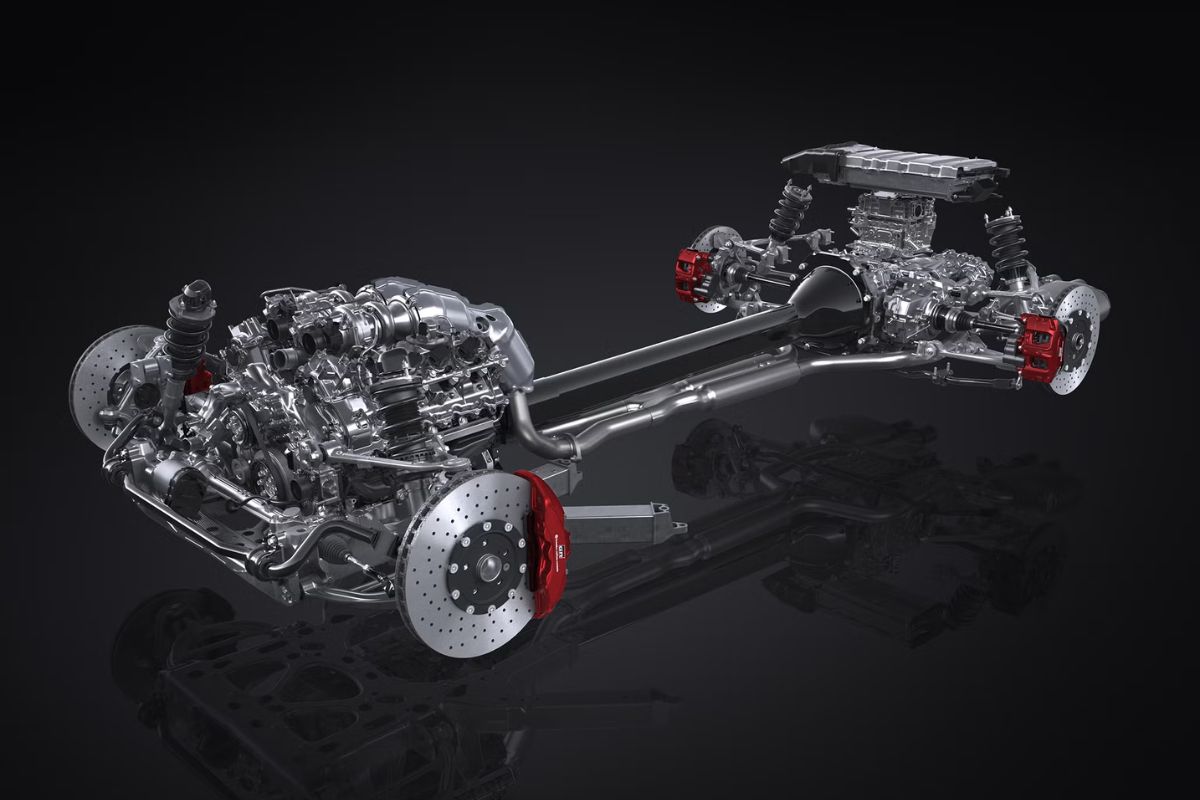
With Hot-Vee, Dry Sump, Rear Hybrid System, and Square Block, the New Toyota V8 Biturbo 4.0 Engine Delivers 641 HP and 850 Nm and Repositions the GR GT as a Track-Focused Supercar with Consistent Performance and Durability in Extreme Use on Race Tracks, Track Days, and Factory Tests.
On December 5, 2025, Toyota detailed for the first time the new Toyota V8 Biturbo 4.0 engine that will equip the GR GT, marking the brand’s return to the segment of iconic supercars. With 641 HP and 850 Nm in rear hybrid configuration, the assembly combines an aluminum biturbo V8, hot-vee architecture, dry sump, and an electric motor mounted on the driveshaft to prioritize track and intense use.
The 2025 presentation places the GR GT in the same historical line of models such as the 2000GT from 1967 and the Lexus LFA from 2010, but with a radically different approach: instead of a six in-line or naturally aspirated V10, the new Toyota V8 Biturbo 4.0 engine is born square, biturbo, electrified at the rear, and designed to operate at high RPM, high thermal load, and a weight distribution of 45/55 between the front and rear axles.
GR GT Rescues Toyota’s Supercar Tradition

The GR GT was conceived as the ultimate showcase of the Gazoo Racing sports division and as a new stage for the new Toyota V8 Biturbo 4.0 engine.
-
Electric car surprises on the Transamazon Highway as it tackles a mud pit; Saveiro and Hilux get stuck and need to be pulled out, while a milk truck crosses alongside with ease and draws attention.

-
The war in Iran could be the push needed for the electric vehicle market to truly explode because when the price of oil exceeds 100 dollars a barrel, combustion cars become a luxury, and China already dominates 60% of the global electric market.

-
Fiat is preparing an offensive with a 7-seater SUV larger than the Fastback, debuting in October 2026 with the Smart Car platform, electric versions with up to 400 km of range, turbo hybrid, new pixelated LEDs, and an advanced ADAS package.
-
OMODA 7 transforms the car into a global aesthetic expression by combining automotive design and fashion in London.


The strategy repeats the logic of the 2000GT and the LFA: to use a supercar project to debut an advanced engine architecture, with technologies expected to radiate to other models in the brand in the medium term.
This time, Toyota abandons classic naturally aspirated solutions and adopts the format that dominates the category: 4.0-liter biturbo V8.
The difference lies in the engineering details.
The 90-degree aluminum block has been redesigned to be lower, facilitating a reduced center of gravity and accommodating the dry sump, without compromising the rigidity necessary for intensive track use.
The goal is for the GR GT to withstand repeated sessions of fast laps without a noticeable drop in performance.
Square Architecture and Origin of the V8 Project
Unlike brands that simply join two 2.0-liter four-cylinders on the same crankshaft, the new Toyota V8 Biturbo 4.0 engine does not originate from the G20E modular family of 1.5 to 2.0 liters.
It derives from a V8 initially developed for a hypothetical Lexus LC F, which never made it to the streets but served as the technical basis for the current project.
The specifications show a square design: a reduced stroke of 83.1 mm and an increased bore of 87.5 mm, contrasting with the typical 80.5 x 97.6 mm of a 2.0 G20E.
This setup favors high rev capability and response, aligning with the philosophy adopted in engines such as the McLaren M840T (93.0 x 73.5 mm), while competitors like Mercedes (83.0 x 92.0 mm) and the VW Group (84.5 x 89.0 mm) follow a sub-square path.
Internally, the V8 features forged components: forged connecting rods, pistons, and cross-plane crankshaft, a traditional solution in high-performance street V8s.
The combination of forged components, optimized aluminum block, and square architecture prepares the new Toyota V8 Biturbo 4.0 engine to withstand turbo pressure, high RPMs, and prolonged full-load conditions, as required on racetracks.
Power, Torque, and Role of the Rear Hybrid System
Toyota speaks of 641 HP of combined power and 850 Nm of torque for the system that connects the new Toyota V8 Biturbo 4.0 engine to the electric motor installed on the rear driveshaft.
Even treating these figures as conservative projections, the message is clear: the GR GT enters directly into the performance range of the latest European supercars, focused on track use.
The values also indicate that hybridization is not merely an aid for urban consumption.
The electric motor mounted just behind the wet clutch, in front of the eight-speed planetary gearbox, acts as a torque booster on acceleration and as a fine-tuning element for traction on corner exit.
Without a torque converter, the starting function is taken on by a multi-disc wet clutch, a solution already seen in AMG sports cars.
In the final assembly, the weight distribution of 45/55 between the front and rear results from the decision to fix the eight-speed planetary transmission at the rear of the car, connected to the V8 by a carbon fiber torque tube.
This arrangement allows the new Toyota V8 Biturbo 4.0 engine to work further back and lower in the engine bay, while the electric motor and transmission help plant the rear axle on the ground during strong accelerations.
Hot-Vee, D-4 Injection, and Combustion Choices
Following the trend of current supercars, the new Toyota V8 Biturbo 4.0 engine adopts a hot-vee configuration: the exhaust manifolds exit into the internal valley of the V, where both turbochargers are housed.
The hot gases reach the turbines faster, reducing lag and facilitating pressure control, while the compressed air is cooled and redirected to the external intake manifolds.
The already disclosed technical images confirm the use of Toyota’s D-4 injection system, which combines direct injectors in the combustion chamber with injectors in the intake manifold.
This allows using only direct injection at high load, only indirect injection at specific regimes, or a mix of both depending on RPM and torque demand, optimizing emissions, consumption, and combustion stability.
Another relevant point is what the engine does not have.
Although Toyota holds patents for pre-chamber ignition, a solution similar to that used in the Maserati Nettuno engine, the images do not indicate the use of this technology in the GR GT V8.
The brand, therefore, preferred a more conventional but highly refined approach of stratified mixture and spark management under high turbo loading.
Dry Sump, Cooling, and Focus on Track Use
The dry sump lubrication is central to the track-oriented proposal of the new Toyota V8 Biturbo 4.0 engine.
By removing the traditional oil reservoir under the block, the engine can be mounted lower in the chassis, lowering the center of gravity and allowing for a flatter hood.
The oil circulates through a separate reservoir, with dedicated scavenging pumps, ensuring supply even in long high-speed turns and hard braking.
In addition to stability in corners, the dry sump increases the total oil capacity and aids in thermal control during extended sessions.
In a supercar like the GR GT, the priority is not just to reach 641 HP at a peak but to sustain that level for multiple consecutive laps, without oil temperature, pressure, or foaming causing fluctuations in power delivery.
The complete package combines with optimized cooling systems, with dedicated air ducts and radiators sized for the extra effort of a biturbo V8 sharing thermal space with an electric motor.
The hot-vee architecture requires extra attention to heat management in the V valley, reinforcing the need for proper insulation between turbines, manifolds, and other components.
Hybrid Transaxle and the Expected Driving Experience
At the rear axle, the eight-speed automatic planetary transmission works in conjunction with the electric motor in a kind of integrated hybrid module.
Without a torque converter, the wet starting clutch offers aggressive engagement while allowing low-speed maneuvers with smoothness.
This design ensures that the new Toyota V8 Biturbo 4.0 engine can be brutal on the track and usable on the street, within the limits of a supercar.
The electric motor installed just behind the clutch contributes to stronger launches, torque fill at low RPM, and electronic traction management, especially on tracks with variable grip.
At the same time, it opens up space for driving modes where the V8 operates in a more restrained manner, saving fuel and noise during regular commutes, even though this is not the priority of the GR GT.
The choice of a carbon fiber torque tube connecting the V8 to the driveshaft reduces unsprung mass and helps filter longitudinal vibrations, without sacrificing stiffness.
This reinforces the feeling of direct mechanical connection between the new Toyota V8 Biturbo 4.0 engine and the rear wheels, an essential element for an audience that values precise feedback on the track.
What Still Needs to be Known About the New Toyota V8 Biturbo 4.0 Engine
Despite the many details already confirmed, Toyota still holds sensitive information about the new Toyota V8 Biturbo 4.0 engine and the GR GT.
There is no official data on battery chemistry and capacity, complete torque curve, exact maximum power regime, RPM limits, reference lap times, or electronic strategies for traction control and torque vectoring.
Comparative curves between operation solely with the V8, solely with the electric motor, and with the hybrid system at full load have also not been disclosed.
These graphs will indicate to what extent the V8 has been calibrated to be the absolute protagonist or to share the spotlight with the electric unit, whether in launch accelerations or high-speed recoveries.
While these figures are yet to appear, the main framework is already drawn: a super-square aluminum block, forged internals, hot-vee, dry sump, D-4 injection, rear hybrid driveshaft, and 45/55 distribution.
Engineering indicates a clear focus on track use, with the ability to sustain the effort expected from a modern supercar at global race tracks.
Given this technical package and the promise of extreme performance, do you think the new Toyota V8 Biturbo 4.0 engine has the credentials to face the most traditional European supercars, or does the brand still need to prove all this with official lap times and track results?









-

-

2 pessoas reagiram a isso.