





 Portuguese
  English
  Spanish
  4 min of reading
  2 comments


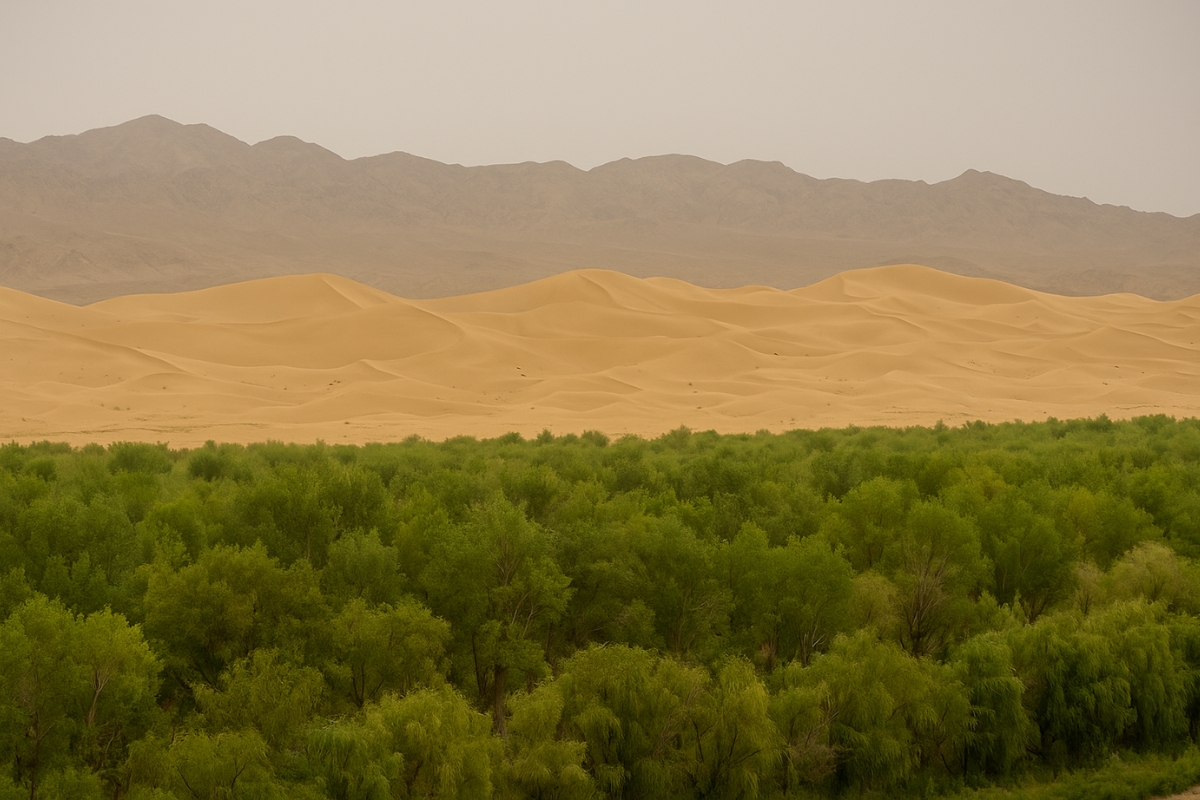


Program Started in 1978 Already Extends Over 4,500 km in the North of the Country, but Still Divides Experts on the Results Against Desertification
The so-called Great Green Wall of China is a mega-engineering ecological project created to curb the expansion of the Gobi and Taklamakan deserts in the north of the country.
The program started in 1978 and is officially known as the Three North Shelter Forest Program. The proposal is to form a large belt of vegetation along the borders of northern China.
Why Desertification Has Become a Bigger Problem
The northern part of China was already a dry region before the accelerated urbanization starting in the 1950s. One of the factors cited is the “rain shadow” caused by the Himalayas, which reduces precipitation in the area near the border with Mongolia.
-
A 2,400-year-old iron foundry has been discovered in Senegal with 100 tons of slag, 35 furnace bases, and signs of nearly eight centuries of continuous metallurgical activity.
-
Four humans are flying towards the Moon inside the Orion capsule launched by the SLS rocket, and on April 6, Artemis II will disappear behind the far side of the Moon without communication with Earth for nearly an hour.
-
Worlds covered by water, atmospheres filled with hydrogen, and the possibility of life beyond Earth: ocean planets are rewriting the map of cosmic search and forcing scientists to rethink where to look.

-
Argentina achieves the unimaginable after more than 110 years and reintroduces the largest native herbivore of South America to the Chaco to restore a lost link in nature.

With the advancement of cities and the expansion of agricultural areas, soil erosion and sand deposition increased. This favored a scenario with more sandstorms, which remove the top layer of soil, degrade the land, and elevate pollution from suspended particles in urban centers.
Dust storms in northern China are a phenomenon that worsens pollution from particles, reduces visibility, and accelerates the loss of fertile soil, with impacts on respiratory health.

The Numbers of Planting and the Long-Term Goal
Since 1978, China claims to have planted over 66 billion trees along a 4,500-kilometer stretch in the north of the country, in areas bordering Mongolia, Kazakhstan, and Kyrgyzstan.
The authorities also plan to plant another 34 billion trees in the next 25 years. If the schedule is met, the goal is for the green barrier to reach 4,500 km by 2050.
Giant Deserts and Constant Pressure on the Territory
The Gobi and Taklamakan deserts are cited as two of the largest in the region, totaling about 1.6 million square kilometers. The total size is described as slightly less than that of Alaska.
Even with decades of actions, the two deserts continue to advance. The Gobi, for example, is often cited as responsible for absorbing about 3,600 km² of Chinese grasslands each year, impacting ecosystems, agricultural areas, and air quality in cities like Beijing.
Announced Advances and Doubts About Effectiveness
Last year, government representatives reported that China had completed the “belt” of vegetation around the Taklamakan. The measure is said to have helped stabilize dunes and maintain the expansion of the country’s forest cover.
According to the cited data, forest cover is said to have increased from about 10% of China’s area in 1949 to over 25% currently. Still, researchers point out that there is no consensus on how much the green wall can actually contain desertification.
Critiques: Monoculture, Low Survival Rate, and Water Shortages
One of the critiques is the considered low survival rate of trees and shrubs planted in sections of the project. There are reports of large areas with only one or two species, primarily poplars and willows, which increases vulnerability to diseases.
An example cited occurred in 2000, when about 1 billion poplars were said to have been lost due to a single pathogen in the Ningxia province. Another pointed issue is planting in areas with little water availability, requiring constant human intervention to keep the trees alive.
Expert Xian Xue from the Chinese Academy of Sciences stated in 2017 that the planting effort in dune areas and the Gobi led to a rapid decline in soil moisture and the water table. In his assessment, this could accelerate desertification in some regions rather than contain it.
Impact Outside of China and Reference for Africa
Even with the controversies, the Chinese initiative is described as an inspiration for the Great Green Wall of Africa. The African plan envisions a belt of trees extending 8,000 km to curb soil degradation and desertification on the continent.
The Chinese project is also subject to critical evaluations for prioritizing few species in certain sections, which tends to contribute less to biodiversity than strategies based on a greater variety of native plants adapted to each region.









O deserto está lá por falta de agua e as arvores sumiram pela mesma razão Se irrigarmos as plantas no deserto , logicamente as plantas voltarao a crescer mas isso implica num gigantesco projeto de irrigação. É o mesmo que acontece na Amazonia . A floresta está lá por causa da chuva e não o inverso como querem nos fazer crer .
Isso mesmo. Corretíssimo.