Portuguese
  Spanish


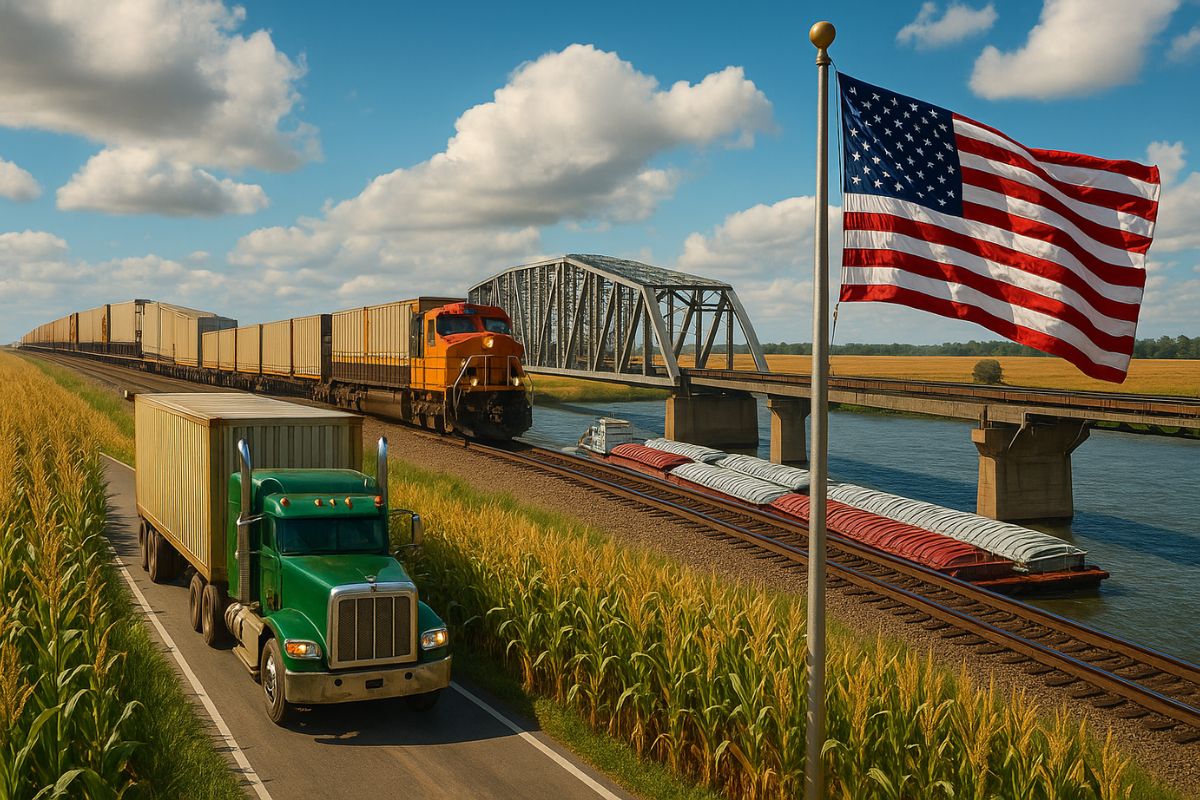

In the U.S. Agro, Railways and Waterways Operate Integrated, Replacing 15,000 Trucks with 15 Barges at Once, Reducing Cost and CO₂, While Brazil Remains Stuck with Road Transportation
The U.S. Agro operates with a logistics engineering that connects farms, railroads, and navigable rivers. When a fleet of 15 barges crosses the Mississippi, it replaces about 15,000 trucks, equivalent to 300 railcars per barge, freeing up roads, reducing costs, and lowering emissions. This integrated design explains why the movement of corn and soybeans from the Corn Belt to the ports is fluid, predictable, and competitive.
In Brazil, production from the Midwest travels 1,000 to 2,000 km to the ports, almost always by highways. The costs are heavy on freight and CO₂, and the absence of major continuous rail and waterway corridors keeps the country behind in the logistics game. The comparison is not meant to criticize, but to learn from what works and focus on concrete solutions.
Why Logistics Determines the Game
The U.S. Agro has shortened effective distances by connecting barns to the Mississippi via rail and locks. Navigation requires a draft of about 2.5 meters, thus routine dredging ensures loading windows with fewer surprises. Practical result: barges leave loaded, the train arrives at the riverbank, and the cycle repeats efficiently.
-
Flower strips in Brazilian farms become pest control strategy, attracting predator insects and reducing the need for chemical pesticides.

-
Yara acquires Texas ammonia plant for $1.3 billion, boosting global fertilizer competition with 1.3 million tons annual capacity

-
At 35, Lawyer Leaves Corporate Career to Turn 1-Hectare Farm into Organic Supplier for Schools in Southern Brazil

-
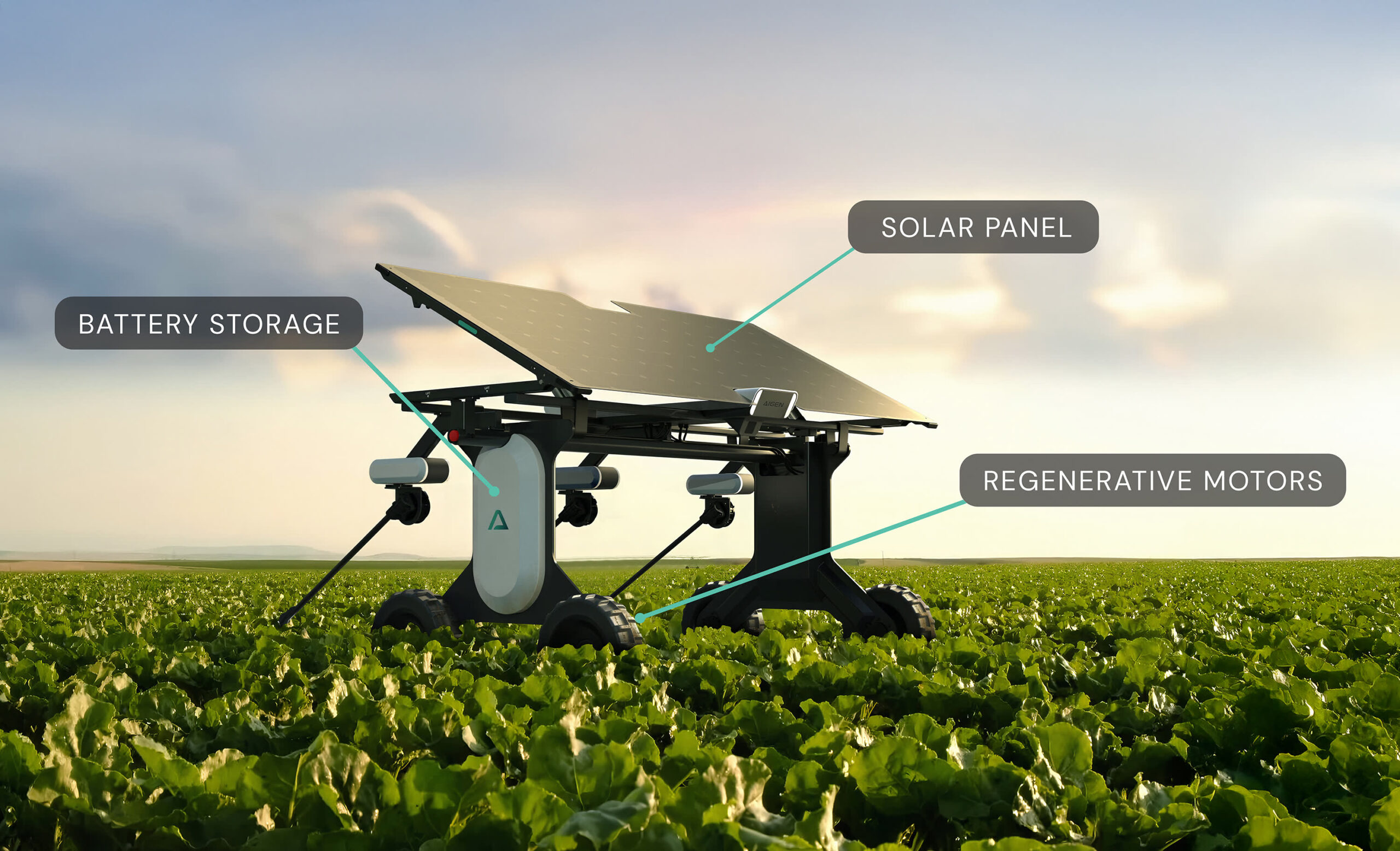
Solar-powered agricultural robots operate 24/7, remove weeds with 8mm precision, and aim to cut herbicide use without fuel consumption in the fields.


In Brazil, road transportation dominates from Mato Grosso to Pará and the Southeast. With each harvest, pressure mounts on the roads, leading to more accidents, slowdowns, and unexpected costs. When the distance is great and the modality is the least efficient, the final price carries a “logistical tax” that is hard to compete with.
Railways and Waterways: 15 Barges Equal 15,000 Trucks
In the U.S. Agro, a convoy of 15 barges is a common practice. Each barge is equivalent to about 150 trucks and 300 railcars, thus 15 barges replace the flow of 15,000 trucks at once. This scale changes everything, from cost per ton to delivery time.
In addition to the economic gain, there is a direct environmental impact. Fewer trucks on the road mean lower emissions per ton transported and less wear on the urban and rural road network. Scale, predictability, and low cost form the tripod of competitiveness that Brazil still needs to build in its grain corridors.
What Ferrogrão Symbolizes for Brazil
The Ferrogrão emerges as a logical shortcut: about 1,000 km linking Midwest production to outflows in the North. With railways and waterways working together, the estimate is to reduce CO₂ emissions from transportation currently concentrated on highways by up to 40%, in addition to lowering freight costs and relieving pressure off the BRs.
When rail meets water, freight costs drop and producer margins increase. The discussion is not just about infrastructure, it’s about systemic competitiveness. Without high-capacity corridors, Brazilian producers “export” logistics costs and see part of their income vanish on the way to the ship.
Distance, Cost, and CO₂: Where Brazil Loses and Can Turn the Game Around
The U.S. Agro is typically ~100 km away from a relevant rail or waterway point. Brazil faces 10 to 20 times that distance to a port, with the known disadvantages of road transportation over long distances. In the final price, freight can account for over 20%, while in the rail-waterway model, this weight tends to be a high single digit.
Reducing kilometers is not the only lever; it’s about reducing “type of kilometer”. Ten kilometers on rail cost less than ten on asphalt, and ten on a barge costs even less. By shifting from tires to rail and water, Brazil cleans its transportation matrix, cuts cost per ton, and gains regularity of shipment.
Management and Technology: Where Brazil is Already a Reference
Despite the logistics delay, Brazil succeeds in soil management and productive intensity. No-till, crop rotation, and even three harvests on the same land in tropical regions preserve moisture, fix more carbon in the soil, and reduce erosion. This is a real advantage over the snowy winters of the Corn Belt, where the growing window is shorter, and the soil goes through freezing cycles.
There is also organization in reverse logistics of packaging in Brazil, with high return rates, an environmental standard that many U.S. producers recognize as a challenge. Once heavy logistics are unlocked, the country will be able to combine field efficiency with transportation efficiency.
Waterways and Locks: Maintenance That Pays Off with Scale
In the U.S. Agro, waterways require continuous dredging and maintenance of locks. This is a fixed cost of the system, but amortized by the gigantic scale of barges. When the flow is predictable, the industry invests in warehouses, transloading, and long-term contracts, reducing risk for producers and trading companies.
For Brazil, the lesson is direct: a waterway and railway project must come with a maintenance budget from day one. Without continuous operation, the corridor loses reliability, and the cargo returns to asphalt, eliminating the built gain.
Priorities to Accelerate Competitiveness
First, choose anchor corridors: Midwest to the Northern Arc, from the interior of Minas and Goiás to the Southeast, complementary axes in the South. Second, unlock permits, standardize stretches, and synchronize railway, terminal, and waterway works to enter together.
Third, a contract that guarantees minimum volume and operating window. Without firm cargo, there is no cheap financing for terminals, rolling stock, and dredging. Fourth, governance of maintenance and draft monitoring, because a stationary barge is cost and truck lines are losses. Fifth, integration with storage and silos, shortening the path from the plot to the ship.
For Those in the Field: How to Prepare Right Now
Diversify outflow routes and logistics partners, negotiating slots at terminals and contracts with transloading options when possible. Anticipate harvest with on-farm storage planning, reducing exposure to lines and short shipping windows.
Invest in grain quality and delivery regularity, because the more integrated the corridor, the more it rewards those who meet specifications and deadlines. Signal volume in advance, strengthen regional associations to gain bargaining power in freight, and follow railway and waterway projects along your axis to adjust medium-term decisions.
The U.S. Agro shows that integrated logistics is pure competitive advantage: more rail and water, lower cost, less CO₂, more predictability. Brazil has already proven excellence within the gate and in conservation practices. What’s missing is to build the bridge between production and the ship with high-capacity corridors, the kind that replace 15,000 trucks with 15 barges.
In your region, which corridor would make the biggest difference: railway to a waterway terminal or a waterway connected to silos and existing rail? How much would freight drop in your case? Let us know in the comments, we want to hear from those who live this every day and know where the infrastructure truly hurts.