





 Portuguese
  English
  Spanish
  6 min of reading
  0 comments


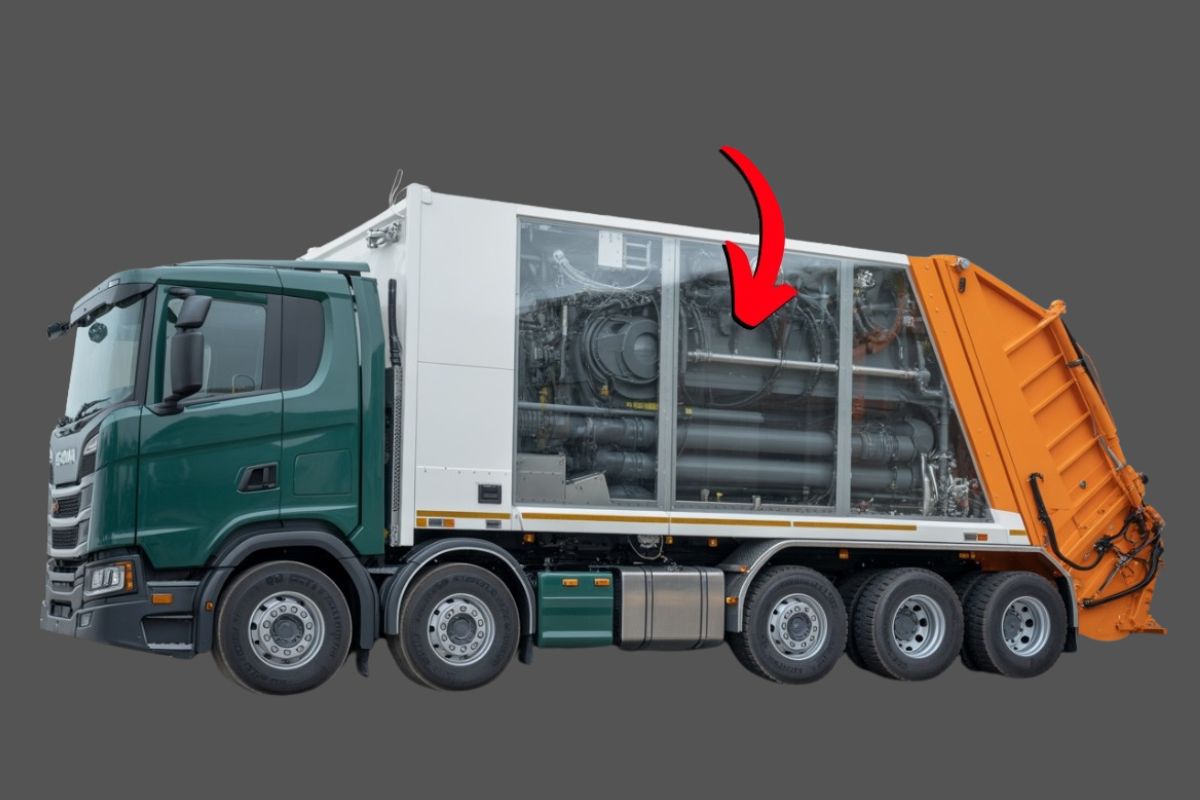
While Cities Discuss Selective Collection in the 21st Century, the Garbage Truck Uses High-Pressure Hydraulic Blades, Sensors, Internal Cameras, and Drain Tanks to Devour Bags, Compress the Content into Dense Blocks, and Forward Tons of Waste to Landfill, Energy, or Recycling Daily, Without You Seeing a Thing
In the 21st century, the garbage truck is much more than a noisy vehicle collecting bags on the sidewalk. Behind the metal body lies a hydraulic compaction system capable of crushing wood, cardboard, and metal cans with forces reaching tens of thousands of pounds, reducing the volume to fit as much waste as possible on each trip.
At the same time, sensors, cameras, and drainage systems work silently to monitor internal pressure, prevent leachate leaks, and detect hazardous materials such as lithium batteries and pressurized cylinders. The garbage truck has become a heavy logistics machine that starts the journey of household waste to transfer stations, landfills, power plants, and recycling centers.
Types of Garbage Trucks on the Streets

In cities, there is no single standard model.
-
New Zealand builds a shimmering building that vibrates, featuring a 62-seat cinema, moving sculptures, and an environment where sound, light, and energy are felt in the body.

-
Two colored cubes of 2.5 m transform a public bathroom into a selfie spot in Western Australia, costing up to 75% less than traditional construction and helping to reduce vandalism in public spaces.

-
Santa Catarina produces up to 7 times more than it consumes in some sectors, and its century-old industries founded by grandparents and great-grandparents now compete on equal footing with Germany and the United States in the international market.

-
U.S. war giant weighing 9,600 tons and equipped with long-range missiles is sent to the Atlantic to protect global internet and hunt submarines.

The most traditional garbage truck is the rear loader, where workers manually throw bags and containers into the back, and a hydraulic plate pushes this material into the main body, compressing everything in repeated cycles.
In planned residential neighborhoods, the side loader is gaining ground, often fully automated.
A robotic arm picks up the wheeled container from the sidewalk, dumps the contents into a side funnel, and the system automatically compacts it, requiring fewer workers for daily operations.
This is the type of garbage truck designed for efficiency on long and repetitive routes.
Large commercial and industrial areas often receive the front loader.
In this case, the garbage truck positions itself in front of the fixed container on the ground, inserts forks into specific grooves, lifts the container over the cab, and dumps the garbage into a top hopper before starting the compaction.
Meanwhile, roll-on/roll-off trucks transport huge open containers from construction and demolition sites.
They do not compact the material; they simply load and unload entire metal boxes.
In some places, there are garbage trucks with split bodies, with separate compartments for recyclables and organics, allowing for selective collection at the source within the truck itself.
How the Garbage Truck Swallows and Compresses Each Bag

Regardless of the model, almost every modern garbage truck revolves around the same principle: an entry hopper and a hydraulic compactor.
First, the garbage falls into the hopper, the funnel where all the material lands when dumped. Then, a blade powered by hydraulic cylinders pushes the load into the main body of the truck.
As more waste enters, the blade repeats the cycle, pushing both old and new garbage against the back of the compartment and forming a compact wall of compressed material.
Some trucks use oscillating blades, others sliding panels, and there are versions that adopt giant screw-shaped rotary drills to move and shred part of the content.
The idea is always the same: use extreme hydraulic force to reduce volume and keep the garbage truck on the road longer before unloading.
The pressure is sufficient to flatten cardboard as if it were a sheet of paper, crack and splinter wooden boxes, and crumple metal cans as if they were soda cans in hand.
The goal is both economic and operational: if the garbage truck carries more weight in less space, it makes more collections per shift and reduces the number of trips to the transfer station.
Pressure, Drainage, and Surveillance Inside the Compartment

Inside the garbage truck, the waste does not simply remain loose.
The garbage compresses into successive layers, creating a dense block that occupies the entire rear section.
In some models, movable partitions or ejector panels slowly move to the back, pushing the material always backward as space runs out.
Sensors monitor the fill level and internal pressure, alerting the operator when the operational limit approaches.
As there is a mixture of organic matter, packaging, and liquids, the body of the garbage truck is equipped with drainage channels to collect leachate, protective coatings, and anti-corrosive treatments to protect the metal from acidic liquids, along with seals to prevent leaks and strong odors.
Many trucks are also equipped with internal cameras that allow monitoring of what is being compacted, identifying illegal disposal of electronics, batteries, and hazardous waste, and detecting fire risks before the problem worsens.
These images help the crew stop operations when something suspicious appears, such as gas tanks, propane cylinders, or pressurized cans hidden inside the bags.
In some municipalities, there are even fire suppression systems installed in the compartment, ready to act if a fire breaks out inside the compacted waste after the crushing of batteries or unexpected chemical reactions.
Safety: Why the Garbage Truck Is a High-Risk Machine
With such hydraulic force, the garbage truck is also a high-risk machine.
Rear-loading models often include explicit warnings for no one to enter the hopper area, as the compactor is designed to crush wooden furniture, metal structures, and large pieces of material with ease.
Loud noise and limited visibility increase the risk for those circulating near the vehicle in operation.
For this reason, newer trucks incorporate emergency shut-off buttons inside and outside the hopper, dead-man controls that require constant action from the operator, backup cameras, and ultrasonic proximity sensors to identify obstacles and people.
In many fleets, drivers and collectors receive training to immediately stop garbage truck operations if there is a suspicion of hazardous material, opening the compartment only in a controlled area.
These protocols protect not only the collection crew but also residents who approach out of curiosity and other vehicles on the street.
With increasingly automated systems, the challenge is to balance productivity with full attention to the risk zones created by the garbage truck‘s own mechanics.
Where the Compressed Block Goes After the Garbage Truck
When the garbage truck reaches its load limit, it heads to a transfer station.
There, the vehicle is weighed, has its load recorded, and positions itself in the unloading area.
The rear door opens hydraulically, and the ejector panel pushes the rectangular block of compacted garbage out all at once, forming a dense pile on the floor of the facility.
Teams at the station inspect the exposed material, separate recyclables such as glass, plastic, and metal, remove electronics and hazardous waste, and direct the remainder according to local policy.
A portion goes to landfills, where the waste is buried and sealed, another goes to incinerators that generate energy, and a fraction is directed to recycling centers for re-entry into the production chain.
In some countries, the recycling and energy recovery rate reaches over 99 percent of household waste, showing that the journey that started in the truck can end in new glass, repurposed metal, or heat to warm entire homes.
After unloading, the garbage truck returns to the streets to repeat the cycle: collect, compact, transport, and unload, day after day, in a constant flow that prevents bags from accumulating on the sidewalks and that the urban system from collapsing.
The technology hidden inside the body dictates how much waste each city can remove from circulation each work shift.
Knowing all this, the next time you hear the sound of a garbage truck reversing on your street, will you be able to look at it the same way, or have you started to pay more attention to what happens with each bag right after it leaves your sidewalk?







-

-

-

3 pessoas reagiram a isso.