Archaeologist Artur Obłuski and a Sudanese-Polish team reached the original floor of the Great Church of Jesus at Old Dongola, a medieval cathedral 47 metres wide and about 21 metres tall that he says was bigger than the White House.
The building was the largest and richest church in medieval Nubia, according to Archaeology News Online Magazine, which reported the latest results from the dig on November 4.
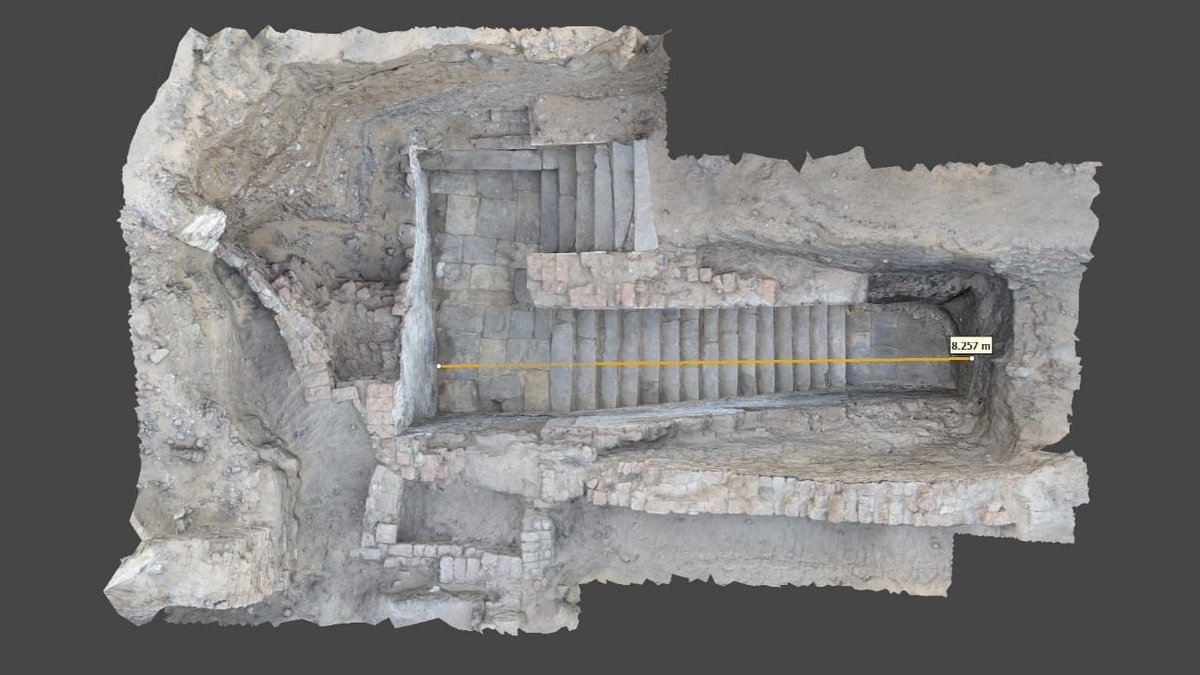
During the last excavation season, the crew uncovered a monumental staircase leading into the church and, for the first time, reached the floor that worshippers walked on centuries ago.
Old Dongola, on the Nile in northern Sudan, was the capital of the Christian Kingdom of Makuria. The dig there traces how that city grew and changed over more than ten centuries.
-
Gelephu governor Lotay Tshering received a Guinness certificate after about 40,000 volunteers raised 108 Buddhist stupas, each about 15 metres tall, in nine hours along a river in southern Bhutan

-
Former paratrooper Karl Bushby hugged his mother outside her Hull home on November 2 after walking about 31,000 miles across four continents for 28 years, a journey from Chile that he once expected to finish in 12
-
Brazil Is Home to the World’s Longest Iron Ore Slurry Pipeline: Stretching 529 Kilometers Across 33 Municipalities and Built with 133,000 Tons of Steel. But How Does the Ore Travel Almost Invisibly?

-
Tasmanian Premier Jeremy Rockliff was on board as Spirit of Tasmania V crossed Bass Strait on its maiden voyage, one of two Finnish-built ferries for 1,800 passengers that entered service five years later than planned


Walls still 11 metres high
The staircase is the only spot where diggers have reached the floor so far. Next to it, the walls of the church still stand about 11 metres high, buried in sand and debris.
That height makes the work unusual. The crew has to dig much deeper than on a normal site, using methods and funding well beyond those of a standard excavation, the magazine reported.
The team also found buttresses built to support the apse, the curved end of the church. Only a small part of the whole building has been opened up until now.
47 by 57 metres
What the team knows so far is already large. The church was 47 metres wide and about 57 metres long, and the archaeologists estimate its height at around 21 metres.
Obłuski compares it with a famous modern building. He says the church was bigger than the White House in Washington, D.C., and that his team intends to excavate the entire structure.
The next season should settle the church’s full size. Sudan’s antiquities authority supports the plan, according to the report, because a fully excavated church of this size could draw tourists.

Nubia’s answer to Hagia Sophia
Obłuski compares the Great Church of Jesus with Hagia Sophia in Constantinople, a building whose design shaped later architecture. He sees the Dongola church as a natural trendsetter for Nubia and possibly for other parts of Africa, the magazine reported.
The discovery also changes an old assumption. Scholars long treated a church outside the city walls as the cathedral of Dongola, so the role of that other building now needs a fresh look, the magazine reported.
A Polish-Sudanese dig since 2021
The team first came across the huge structure in 2021. Full excavation began after Poland’s National Science Centre provided funding for the work.
The dig is run by the Polish Centre of Mediterranean Archaeology at the University of Warsaw together with Sudan’s National Corporation for Antiquities and Museums, under Obłuski’s lead.
It is part of the European Research Council project Afropolis Tungul, which follows the growth of the city from the 4th to the 15th century, according to the report.
Six shelves of painted plaster
A second surprise came from a smaller church on an upper floor of a structure added to the cathedral. Its walls survive only about one metre high, but painted decoration left traces in the debris.
The team now stores six large shelving units full of painted plaster from that room. A church tied to King David, found in 2023 on the cathedral’s north side and dated to the 13th century, kept far more paint on its walls.
Greek prayers in half-centimetre letters
Some of the plaster pieces found in the debris of the upper church carry Greek inscriptions. Epigraphist Agata Deptuła of the Warsaw centre identified them as fragments of biblical odes, liturgical songs attached to the Book of Psalms.
One text comes from the Prayer of Hannah, mother of the prophet Samuel. The scribe wrote in a careful book hand with letters only about half a centimetre tall, the magazine reported.
Psalm texts were the most common biblical writing found at Old Dongola before. The odes are new for the site, adding another piece to the picture of how the church was used.
Repairs after a flood
Before digging, the team had to do conservation work with the Warsaw University of Technology. In autumn 2024, the worst flooding since 1988 hit Old Dongola and damaged some protective roofs over the ruins.
During the season, the team also finished a solar power installation funded by Poland’s Polish Aid programme. It runs pumps that draw Nile water for the homes and fields of around 10,000 people.
Eight booster stations now push that water to higher ground. The team also runs workshops on protecting Dongola’s heritage, and residents have formed an association to help care for the site.
Obłuski calls this cooperation with the local community a priority. Team members even shared an iftar meal with residents during Ramadan, the report said, as part of the work alongside the people who live next to the ruins.
Ancient sites keep producing finds like these, as in Pompeii, where archaeologists found a wardrobe untouched since AD 79 with 38 bronze coins inside.
How big was it really?
The full length of the Great Church of Jesus is still not settled. Only one staircase has been dug down to floor level, and most of the 47-metre-wide building is still under the sand.
Obłuski’s team plans to keep going until the whole cathedral is exposed, and the next season is meant to settle the full size of the building. Until then, a length of about 57 metres is the working figure, with the width of 47 metres already known.
Should a cathedral this size in Sudan become as well known to travellers as the great churches of Europe, once the excavation is finished?