





 Portuguese
  English
  Spanish
  3 min of reading
  2 comments


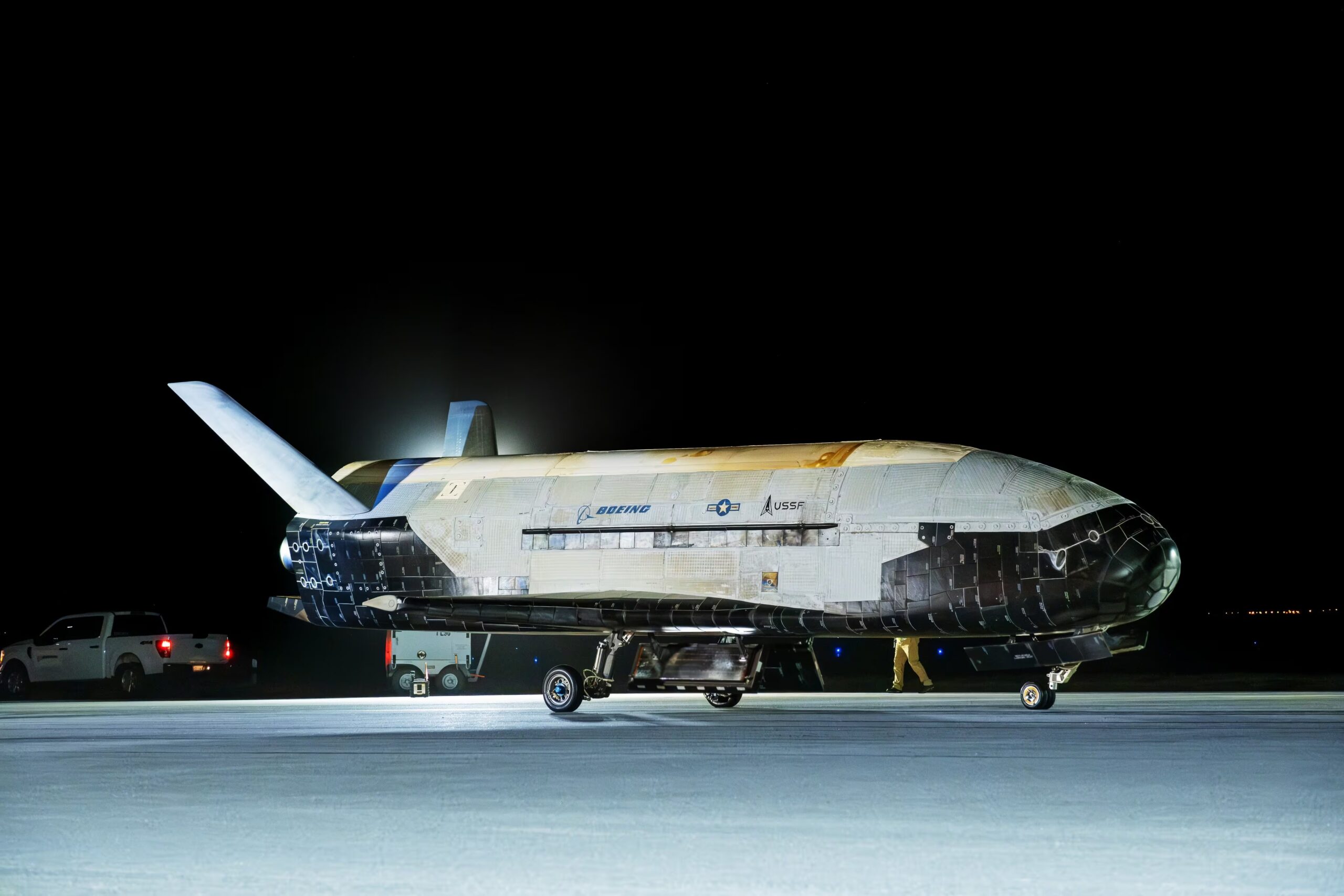


Military Mission in Space! After 434 Days in Orbit, U.S. Army Space Shuttle Returns to Earth Testing Innovative Propulsion and Trajectory Change Technologies.
The United States Army’s secret space shuttle, known as the X-37B, returned to Earth on Friday (8) after spending 434 days in orbit. This ultra-secret mission, conducted by the U.S. Space Force, tested advanced maneuver and propulsion technologies, including the ability to change orbit using atmospheric drag, a technique that allows deceleration without burning fuel. The successful return marks another chapter in the mysterious and ambitious military space program of the United States.
Secret Mission of the U.S. Army: What We Know About the 434 Days in Orbit of the Secret Space Shuttle
The X-37B (secret space shuttle) was launched in December 2023 from the Kennedy Space Center in Florida using a Falcon Heavy rocket from SpaceX. During its time in space, the vehicle conducted a series of experiments and technological tests, the details of which remain largely unknown to the public.
The X-37B Orbital Test Vehicle-7 (OTV-7), the U.S. Space Force’s dynamic unmanned spaceplane, successfully deorbited and landed at Vandenberg Space Force Base, California, on Mar. 7, 2025 at 02:22 a.m. EST. #X37B #USSF pic.twitter.com/L7pgNAVhMg
ARTICLE CONTINUES BELOWSee also
INMET danger alert: heavy rains between the 3rd and 4th may drop up to 100 mm/day and winds of 60 to 100 km/h in several regions of Brazil require extra caution.

The parts crisis may bring back the drop notch and microSD in 2026; while Windows 11 promises to become lighter, leaks mention batteries of up to 10,000 mAh and 200 MP cameras.

In Kenya, engineer Nzambi Matee created “bricks 2.0” using packaging plastic: a mixture with sand, heated and pressed; they are 5 times more resistant, already have official licensing, and are being used in streets and construction projects.

More than 20,000 positions could be opened, and thousands of technicians are starting to be trained in Brazil, as the expansion of data centers creates an urgent race for professionals to keep the internet, cloud, and artificial intelligence running 24 hours a day.

— United States Space Force (@SpaceForceDoD) March 7, 2025
According to military officials, one of the main objectives of the mission was to test the vehicle’s ability to change orbits using atmospheric drag. This innovative technique allows the X-37B to adjust its trajectory without relying on additional fuel, which could revolutionize how space missions are conducted in the future.

Lieutenant Colonel Blaine Stewart, program director, described the mission as an “exciting new chapter” for the X-37B, highlighting the importance of the technological advancements achieved.
Discreet Landing and Use of Advanced Technology
The landing of the X-37B occurred before dawn at the Vandenberg Space Force Base in California. The Space Force only announced the landing hours later, maintaining the discreet nature characteristic of the program. Photos released later showed the black and white vehicle parked on the runway under the darkness of early morning.


In addition to testing the orbit change, the mission also evaluated other advanced technologies, including propulsion systems and materials resistant to the extreme conditions of space. These experiments are fundamental for the development of future space missions, both civilian and military.
The Enigmatic X-37B: A Reusable and Versatile Vehicle
This was the seventh flight of the X-37B, solidifying its reputation as one of the most versatile and durable space vehicles ever built. Developed by Boeing, the X-37B is 9 meters long and has a wingspan of 4.5 meters, resembling a miniature version of the old shuttles from NASA.
However, unlike its predecessors, the X-37B is unmanned and operates either fully autonomously or remotely controlled. Its ability to remain in space for extended periods is one of its most impressive features. In a previous mission, the vehicle stayed in orbit for 908 days, a record that demonstrates its resilience and efficiency.
Secret Objectives and Speculations
Among the speculations are the development of spy satellites, testing of space weapons, and the creation of defense systems against orbital threats. The lack of transparency regarding X-37B’s activities raises questions about the future of space militarization and the role of the United States in this scenario.
The return of the X-37B after 434 days in orbit marks a significant milestone in the United States’ military space program. With its ability to test advanced maneuver and propulsion technologies, the vehicle demonstrates the potential for innovation and leadership of the U.S. in space.
As the world awaits more details about the secret activities of the X-37B, one thing is certain: the future of space exploration will be shaped by advances like those tested in this mission. Space remains the next frontier, and the United States is determined to lead this journey.










Quem sabe daí venha a tecnologia capaz de finalmente levar o ser humano a lua
Secreto mesmo tem sido o uso de tecnologias extraterrestres, a partir da engenharia reversa.