





 Portuguese
  English
  Spanish
  6 min of reading
  1 comment


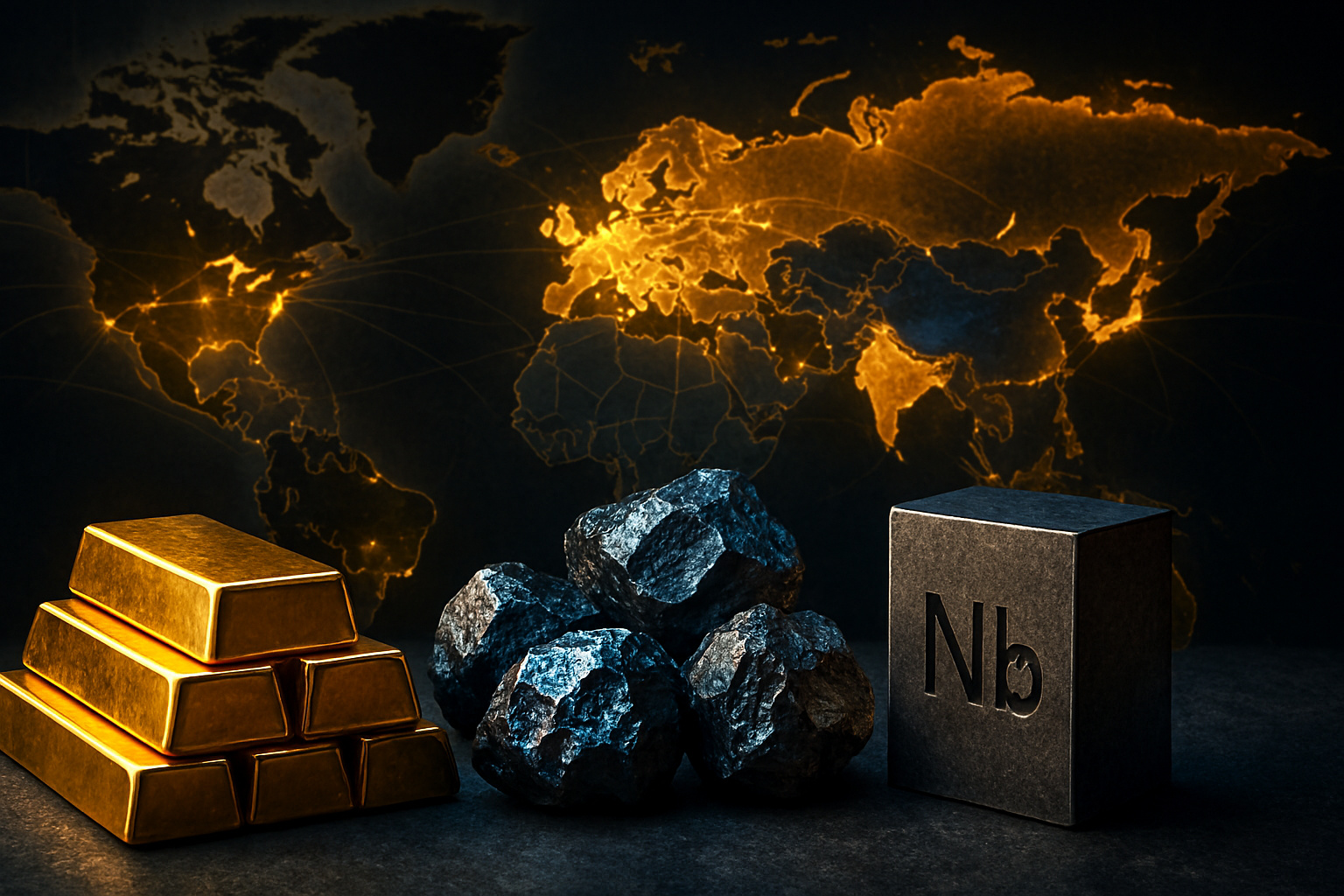


Gold, Rare Earths, and Niobium Form a New Triad of Power. Central Banks Accumulate Metal, Industrial Chains Compete, and Countries with Reserves Gain Advantage.
Over the past decade, global geopolitics has undergone a silent yet profound transformation. The competition among major powers has shifted from focusing solely on territories, military alliances, or GDP growth to revolve around strategic physical assets. In this new scenario, three elements are increasingly interconnected: gold, rare earths and niobium. Together, they create a triad that begins to redefine the concept of economic power and sovereignty in the contemporary world.
This movement did not arise from a single political decision or a formal agreement between countries. It is the result of a combination of financial crises, international sanctions, disruptions in global supply chains, and the understanding that control over physical resources has once again become decisive in a fragmented international system.
Gold Returns to the Center of Reserves and Regains Strategic Role
Gold is the oldest component of this triad, but it is also the one that has most clearly regained prominence. In 2025, central banks purchased a net 863.3 tons of gold, according to data from the World Gold Council.
-
Billionaire Anne Marie Werninghaus, heir to WEG with R$ 9.1 billion, inaugurated the a.marie store at Casarão Emmendörfer in Jaraguá do Sul.

-
While millions of Brazilians still face unemployment and low wages, Chinese companies are increasing the hiring of foreigners, bringing more than a thousand Chinese people to Brazil each month, and changing the industrial reality of Bahia.

-
China is about to get its hands on one of Brazil’s largest nickel sources, but the European Union has decided to hold up the $500 million deal and may even block the sale permanently in the coming months.

-
Once a joke, the Brazilian currency Real now sparks global interest. ‘We want the Real as a global currency,’ says an executive from the Solana Foundation.


Even with the metal operating at historically high price levels, official demand remained strong, consolidating a trend that began in 2022 when purchases exceeded the mark of 1,000 tons annually.


The most relevant data is not just the volume, but the profile of the buyers. Countries like Poland, Brazil, China, Turkey, and Kazakhstan have increased their reserves, each for different reasons, but with a common denominator: reduction of financial vulnerability.
Poland, for example, added over 100 tons in 2025, raising gold to nearly 30% of its international reserves, publicly associating the metal with national security.
Research from the World Gold Council indicates that over 70% of central banks expect a gradual reduction in the dollar’s share of global reserves in the coming years, as gold tends to gain ground as a neutral asset, without sovereign issuer risk. In practice, the metal has once again been considered a systemic hedge, capable of withstanding financial crises, sanctions, and geopolitical shocks.
Rare Earths Become the Invisible Bottleneck of the Modern Industry
If gold represents financial stability, the rare earths symbolize industrial power. These 17 chemical elements are essential for manufacturing permanent magnets, electric motors, wind turbines, military equipment, sensors, electronics, and advanced technologies related to the energy transition.
The critical point is not only the existence of mineral reserves but also the control of the processing and refining stages. Although several countries have relevant deposits, the global supply chain for separating and manufacturing rare earths is highly concentrated. This creates a strategic bottleneck that transforms these minerals into instruments of economic and political power.

Recent reports from the International Energy Agency and audits by the European Union warn that dependence on a few suppliers for rare earths and other critical minerals poses a direct risk to industrial competitiveness and strategic autonomy.
In response, the United States, European Union, and Japan have begun treating these elements as national security assets, creating strategic stocks, encouraging domestic refining projects, and redesigning industrial policies.
In this context, rare earths function as a kind of “industrial currency.” Whoever controls processing not only controls the production of advanced goods but also the capacity to impose costs, delays, or restrictions on competitors and geopolitical adversaries.
Niobium: The Discreet Metal That Underpins Advanced Materials
The third pillar of this triad is less known to the public but no less relevant. Niobium is a strategic metal primarily used to strengthen high-strength steels and special alloys, reducing weight and increasing mechanical and thermal performance. It is essential for sectors such as heavy construction, pipelines, automotive, aerospace, and defense applications.
Data from the United States Geological Survey indicates that Brazil accounts for about 92% of global niobium production and holds over 90% of the planet’s known reserves. Practically, this means the world depends on an extremely small number of suppliers to access this material.
Unlike rare earths, niobium often does not feature in public debates about energy transition or green technology. Still, it is quietly present in almost every industrial chain that requires lighter, stronger, and more efficient materials.
This combination makes niobium a long-term strategic asset, whose importance grows as the industry seeks to reduce energy consumption and enhance structural performance.
The Interconnection of the Triad and the New Concept of Economic Power
What transforms gold, rare earths, and niobium into a strategic triad is not just the individual relevance of each, but the way they complement each other.
Gold provides financial stability and international credibility; rare earths ensure industrial and technological capacity; niobium underpins the material base of advanced infrastructures and defense systems.
Together, these assets connect three fundamental dimensions of modern power: finance, industry, and materials. Countries that manage to align these three axes reduce their exposure to external shocks and enhance their maneuverability in international negotiations.
This movement helps explain why natural resources have once again been treated as a matter of state. The competition is no longer limited to extraction; it involves the control of production chains, processing capacity, strategic stocks, and integration with monetary and industrial policies.
From the Underground to the Vault: Physical Assets as a Response to Global Fragmentation
The consolidation of this triad occurs at a time of fragmentation in the international system. Financial sanctions, regional conflicts, trade wars, and the reconfiguration of global value chains have exposed the limits of a model based solely on financial assets and institutional trust.
In this scenario, physical assets have returned to serve as anchors of real power. Gold strengthens international reserves; critical minerals support industry and defense; strategic metals ensure performance and efficiency.
The sum of these factors creates a new economic hierarchy, less dependent on abstract financial flows and more anchored in tangible resources.
Implications for Producing and Importing Countries
For countries that concentrate reserves of these assets, the triad represents a structural advantage. The challenge becomes transforming this position into long-term policy, avoiding the export of merely raw materials and increasing participation in higher value-added chains.
For importing countries, the scenario imposes rising costs and risks. Dependence on concentrated suppliers forces governments to invest in diversification, recycling, technological substitution, and strategic agreements.
In both cases, access to gold, rare earths, and niobium has ceased to be merely an economic issue and has become central to national strategies.
A Silent Axis That Tends to Strengthen
The movement observed in recent years indicates that this triad is not transient. On the contrary, it is likely to strengthen as the world faces simultaneous transitions: energy, technological, monetary, and geopolitical. The control of critical physical assets emerges as a pragmatic response to a more unstable and competitive environment.
Gold, rare earths, and niobium do not form a formal alliance, nor an institutionalized block. Still, together, they outline a new silent axis of power, capable of influencing financial, industrial, and strategic decisions in the coming decades.






Bom seria se a moeda brasileiro force feita de niobio