





 Portuguese
  English
  Spanish
  3 min of reading
  0 comments


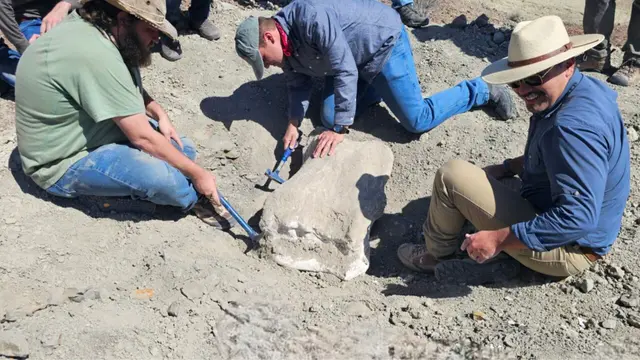
An Extraordinary Find Is Catching The Attention Of The Scientific Community: The Fossil Of A 70 Million-Year-Old Dinosaur, Considered The Largest Ever Discovered In North America
A remarkable discovery was made in the western Texas, where a team of novice paleontologists from Sul Ross State University found a giant fossilized bone belonging to a dinosaur. The find occurred in Big Bend National Park and is related to the Alamosaurus, a long-necked sauropod that lived at the end of the Cretaceous period, approximately 70 to 66 million years ago.
This dinosaur is considered the largest known land animal in North America, a fact highlighted in the university’s press release.
The discovery is even more impressive as it provides the first concrete evidence of a Late Cretaceous sauropod found in North America.
-
They were brilliant! Scientists discover that our ancestors in China were already making super advanced tools 160,000 years ago, changing everything we knew.
-
Scientists unveil 3 million years of climate secrets hidden in the ice of Antarctica.

-
Ancient farmers created “aggressive plants” that changed nature forever.

-
Astronomers find a “backward” solar system that ignores all the rules of space and leaves scientists scratching their heads!


The Discovery In Big Bend
In March, paleontology students from Sul Ross University traveled to Big Bend National Park to conduct research on the region’s rock formations.
Under the guidance of professors Dr. Jesse Kelsch and Dr. Thomas Shiller, the students, who were part of the Stratigraphic Analysis and Structural Geology courses, discovered a vertebra from Alamosaurus.
The Alamosaurus, like other sauropods, had an extremely long neck and a whip-like tail, features that helped these giants reach high vegetation.
This dinosaur would measure about 21 meters in length when fully grown, making it one of the most imposing creatures of its time.
The vertebra found by the Sul Ross team is considered one of the most complete ever unearthed in the area.
This skeleton was initially documented by researchers from the University of Texas in the 1970s, and now, with this new discovery, the understanding of Alamosaurus expands even further.
Big Bend National Park: A True Fossil Treasure
Big Bend National Park, besides being a tourist spot, is also a true fossil mine, having been the site of several important discoveries over the years.
Among the most notable finds are the remains of a giant pterosaur, which lived alongside the dinosaurs.
Fossils suggest that this pterosaur had a wingspan of approximately 11 meters, making it one of the largest flying creatures of its era.
Another important dinosaur found in the region is the Bravoceratops polyphemus, a horned dinosaur.
The skull of this giant dinosaur, found exclusively in the park, helps scientists better understand the diversity of horned dinosaurs that inhabited the Earth during the Cretaceous period.
Recently, discoveries have also been made that complement the prehistoric record of the region.
In March, a mammoth was identified through the discovery of a tusk at the O2 Ranch, located in Brewster and Presidio counties, near Big Bend National Park.










Seja o primeiro a reagir!