






 Portuguese
  Spanish


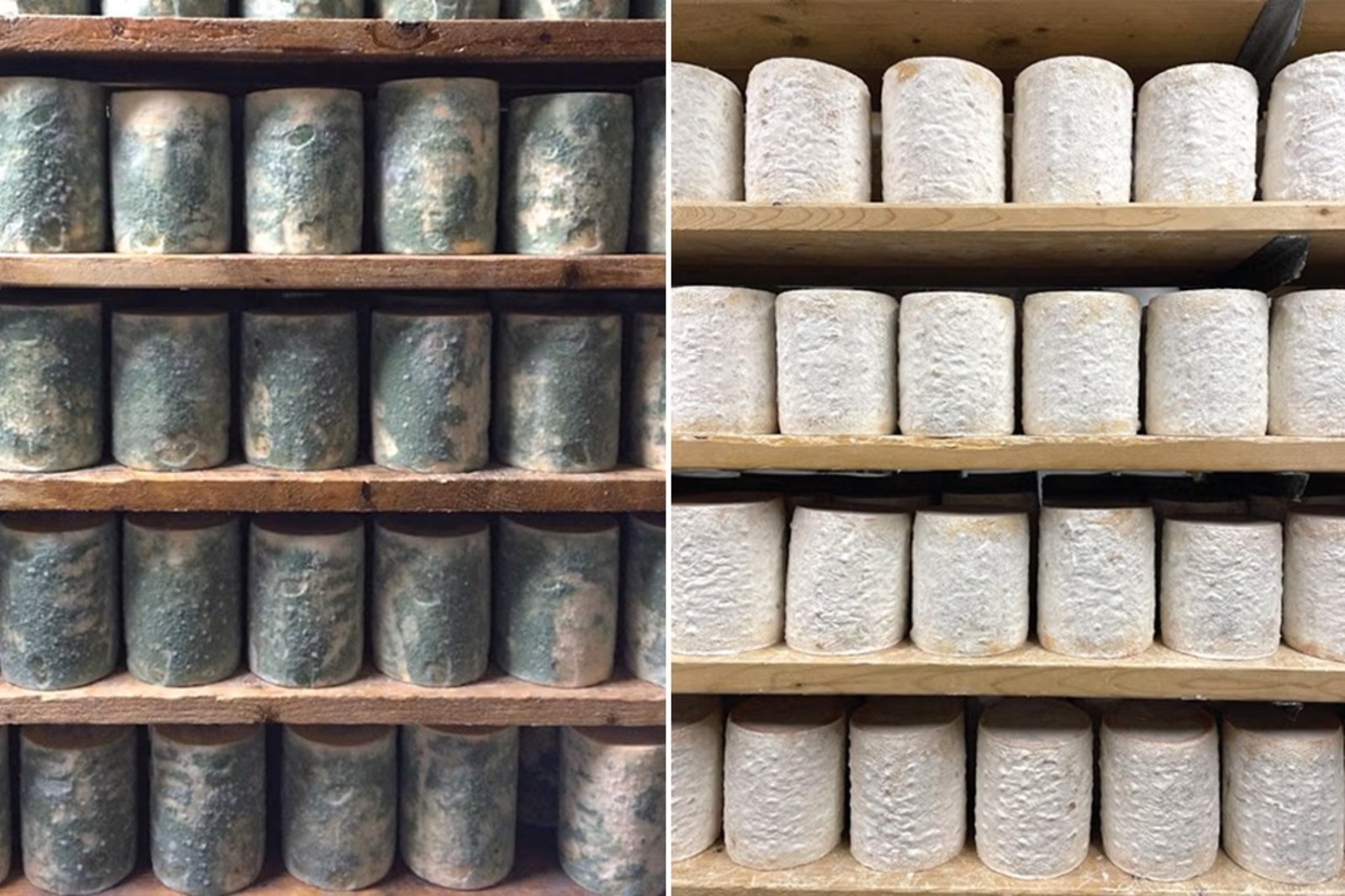


During A Visit To Jasper Hill Farm In The USA, A Collection Of Fungi From Aged Cheeses Revealed A Rare Phenomenon: Microbial Evolution Happening Before The Eyes Of Scientists In A Natural And Controlled Environment
In 2016, researcher Benjamin Wolfe traveled with his former advisor Rachel Dutton to Jasper Hill Farm in the United States, famous for aging cheeses in caves. The trip had a dual purpose. Dutton believed that the visit would only be for collecting samples for microbiological study, but in fact, it was part of a marriage proposal planned by her boyfriend, whom she had met at that same location.
Even so, the samples were collected. Wolfe, known for never discarding research material, kept everything in his lab. Years later, chance would give new meaning to that collection.
A Cheese That Changed Color
Graduate student Nicolas Louw returned to the same cave for another research project and noticed something curious: the cheeses, previously covered by a thin greenish layer, were now completely white.
-
World’s Largest Particle Accelerator Begins Four-Year Hiatus for Magnet Overhaul, Aiming to Hunt Dark Matter by 2030

-
“Sahara Dust Turns Rain Red, Startling Residents Across Europe”
-
Stanford Scientists Develop 20-Cent Paper Centrifuge Inspired by Ancient Toy, Spins at 125,000 RPM Without Electricity, Separates Plasma in 1.5 Minutes, Aiding Diagnostics in Remote Areas

-
World’s Largest Vaccine Manufacturer, Immunizing Two-Thirds of Global Infants, Originated in a Pune Horse Farm





The recipe and the yeasts were the same. Nothing had changed, except for the appearance.
The surprise piqued the researchers’ interest. “We thought it could be an example of evolution happening before our eyes,” Wolfe recounted.
Normally, microbial evolution is observed over long time scales or in laboratories, not in such specific natural environments.
Evolution Under Refrigeration
The 2016 samples stored by Wolfe proved to be fundamental. By comparing the old fungi with the new, the scientists confirmed: they were the same species, Penicillium solitum.
However, it had evolved rapidly, losing the genetic trait that produced the green pigmentation.
This color was a result of melanin — the same pigment that, in humans, defines skin, hair, and eye color, and protects against ultraviolet radiation.
Inside the cave, however, the fungus lived in a dark and protected environment. Without the need to defend itself against sunlight, the organism adapted and stopped producing the substance.
Fungi: Mutations That Favor Energy Economy
The process did not involve a single mutation, but several. Some fungi underwent point mutations — small changes in DNA — at different locations in the genome.
Instead of harming them, these changes represented an advantage: by not needing to produce melanin, they conserved energy for other metabolic processes.
Others exhibited mutations caused by transposable elements, known as “jumping genes.”
These DNA fragments move within the genome and can cause chromosomal rearrangements.
Although they are linked to serious diseases in humans, such as cancer and neurodegenerative disorders, in fungi, they acted as motors of adaptation.
A Lesson That Goes Beyond Cheese
The results, published in the journal Current Biology, reinforce how evolution can occur visibly and in short periods. For Wolfe and Louw, understanding these mechanisms could have direct applications in food safety.
“Mold is one of the biggest threats to global food production,” Louw explained. “About 20% of crops are lost before harvest due to fungal rot, and another 20% are lost after it. This includes everything from fruits on the shelves to bread that spoils at home.”
Thus, the discovery goes far beyond scientific curiosity. It shows that even a cheese fungus can reveal how life adapts, conserves energy, and evolves — even in the silent depths of a cave.
With information from Super Interessante.


