





 Portuguese
  English
  Spanish
  5 min of reading
  0 comments


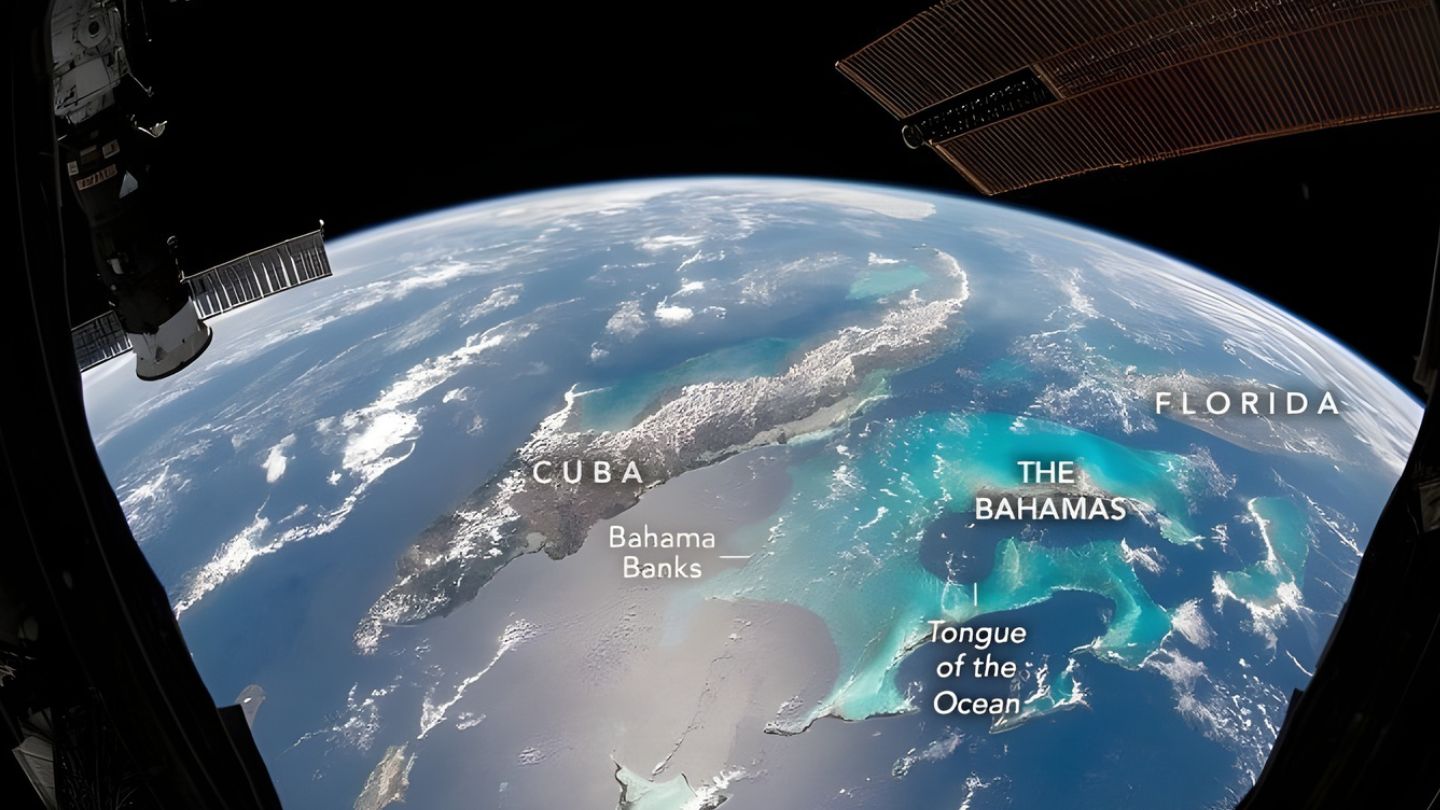
Great Bahama Bank shines in turquoise tones visible from space, reveals terrestrial past and houses one of the planet’s most abrupt underwater boundaries.
Over the past decades, astronauts aboard the International Space Station have recorded images revealing Earth from rarely seen perspectives. Among deserts, mountain ranges, and illuminated cities, a specific region of the Western Atlantic, over the Bahamas, stands out in an almost unreal way. In the shallow waters of the archipelago, a luminous pattern in turquoise tones attracts attention for its intensity and the way it seems to emit its own light, a visual effect that NASA has highlighted in orbital images of the region. These images were captured during different missions and analyzed by institutions such as the NASA Earth Observatory and the Gateway to Astronaut Photography of Earth, which describe the phenomenon as a result of the interaction between solar light, the underwater topography, and the extensive shallow banks of sand and reefs in the area.
The location most associated with this spectacle is the Great Bahama Bank, a vast carbonate platform surrounded by deeper waters, where the difference in depth intensifies the contrast between the light blue and dark blue of the ocean.
The visual impact is so striking that veteran astronauts have come to regard the area as one of the most impressive landscapes on the planet seen from orbit. In a post made from space, Scott Kelly called the Bahamas “the most beautiful place from space”; while Chris Hadfield described the scene as “surreal”, stating that there seemed to be “every blue that exists.” These two statements help to illustrate the extraordinary contrast between the illuminated shallow waters of the Bahamian banks and the deep blue of the surrounding Atlantic.
-
Super Typhoon Sinlaku reaches winds of 306 km/h in the Pacific Ocean and puts the Mariana Islands on high alert.
-
FBI issues urgent warning: end-to-end encryption does not prevent breaches and can expose messages even in the largest apps.

-
In 1994, Comet Shoemaker-Levy 9 exploded on Jupiter in front of telescopes, showing planetary impacts in real time and revealing the giant as both a shield and a threat, marking the beginning of the planetary defense era.
-
New technology developed by MIT researchers uses a bracelet with ultrasound to control robots and virtual systems with hand movements in real time.

Great Bahama Bank is a shallow platform with unique characteristics
The Great Bahama Bank is neither an isolated reef nor a simple coastal formation. It is one of the largest carbonate platforms on the planet, formed over millions of years by the deposition of limestone sediments produced by marine organisms.


In some areas, the water depth is less than 2 meters, allowing sunlight to reach the bottom directly, which is composed of extremely light sands. This combination creates a powerful optical effect: the light is reflected back to the surface, intensifying the turquoise coloration that becomes visible even from Earth orbit.
The total extent of the bank exceeds 100 thousand square kilometers, forming a continuous submerged landscape that contrasts with the deep ocean surrounding it. This contrast is one of the main factors that make the region so visible in satellite images.
Light reflection creates a visual effect compared to auroras in the ocean
The visual phenomenon observed in the Bahamas does not involve light emission, as occurs in polar auroras, but rather a physical process of reflection and dispersion.
The white sand on the seabed acts as a diffuse mirror, reflecting sunlight in multiple directions. Since the water is shallow and relatively clear, there is little light absorption, allowing the coloration to remain intense.

This effect is amplified by the absence of significant depth. In deeper ocean regions, light is quickly absorbed, resulting in dark tones. In the Great Bahama Bank, the opposite occurs: light returns to the surface, creating a glow that can be detected by orbital sensors.
This optical behavior is what leads many observers to compare the region to a kind of “ocean aurora,” although the physical mechanism is completely different.
Region was once solid land during the last ice age
One of the most relevant aspects of the Great Bahama Bank lies in its recent geological history. During the last glacial maximum, which occurred about 20 thousand years ago, global sea levels were significantly lower due to the large amount of water retained in polar ice caps.
During this period, much of the bank that is now submerged was, in fact, exposed solid land, forming a landscape similar to limestone plains and interconnected islands.

With the end of the ice age and the rise in global temperatures, the melting of glaciers raised sea levels, flooding these areas and transforming them into the shallow platform that exists today.
This process not only altered the geography of the region but also created ideal conditions for the formation of the carbonate sediments that now compose the bank’s bottom.
The Ocean Tongue marks one of the planet’s most abrupt transitions
If the central part of the Great Bahama Bank is characterized by shallow and luminous waters, its edge presents an extreme contrast. In certain regions, the seabed experiences a sudden drop that can reach more than 2,000 meters deep within a few kilometers.
This formation is known as the Ocean Tongue, a kind of deep underwater valley that separates shallow areas from abyssal ocean regions.

This type of transition is relatively rare and creates a unique environment, both geologically and biologically. The abrupt change in depth influences ocean currents, nutrient distribution, and species diversity.
The region is home to over 160 species of fish, corals, and marine organisms, many of which are adapted to specific conditions of light and pressure.
Ecological and scientific importance of the region
The Great Bahama Bank plays a relevant role in the ecological balance of the Western Atlantic. Its shallow waters serve as breeding and feeding grounds for various marine species.
Additionally, the region is used as a natural laboratory for studies on:
- Formation of carbonate platforms
- Dynamics of marine sediments
- Interaction between light and water
- Changes in sea level over time
Researchers use data collected in the region to understand processes that also occur in other parts of the world, including coral reefs and continental margins.
Why the location is so visible from space
The visibility of the Great Bahama Bank from space is the result of a combination of specific factors:
- Extremely shallow depth over large areas
- Bottom composed of highly reflective white sand
- Relatively clean water, with low turbidity
- Direct contrast with adjacent deep ocean areas
These elements create a unique visual signature, easily identifiable in satellite images and photographs captured by astronauts.
This characteristic has turned the region into one of the most used examples in remote sensing studies applied to oceanography.
What do you think of this phenomenon that transforms the ocean into a spectacle visible from space
The Great Bahama Bank brings together rare characteristics in a single region: recent geological history, well-defined physical processes, and a visual impact that impresses even observers accustomed to seeing Earth from afar.
Now I want to know your opinion: have you ever seen images of this kind or imagined that the ocean could produce such intense visual effects that they could be compared to atmospheric phenomena?







Seja o primeiro a reagir!